

The expression “straight out of the movies” has been used liberally over the last month, and rightly so, to describe the happenings on October 19 at the Louvre Museum in Paris. That morning, in broad daylight, thieves accessed the institution’s Apollo gallery by using a movable staircase, and with the help of an angle grinder, stole nine jewels from the French crown (though they managed to drop an actual crown along the way).
Among the photos released by news agencies on this historic date, one image caught the attention of millions, due precisely to its cinematic aura. Taken by Thibault Camus of the Associated Press, it showed a figure standing next to police officers who looked as though he had stepped straight out of a film noir, attired in a trench coat, a slightly tilted hat in the style of Humphrey Bogart, and what appeared to be a neatly trimmed mustache. That a figure of this kind appeared to be the detective in charge of the investigation into the crime seemed encouraging: no matter how much its historical heritage was plundered, France would never, could never stop being France.
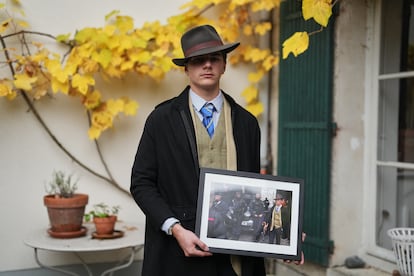 Pedro Elías Garzón Delvaux poses with the image that brought him worldwide recognition.Thibault Camus (AP)
For weeks, users on social media speculated about the identity of the mysterious “Fedora Man,” as he came to be virally known. A gumshoe so out-of-time that his image conjured visions of pursuing Al Capone during Prohibition — not traversing the streets of Paris in 2025. He cut a figure that seemed too surprising to be real, “too perfect,” as ventured by those who questioned whether such an individual really existed. The hypothesis that the character had been generated by AI took on such popularity that the photographer had to issue a public denial. Camus, who said he didn’t know the identity of the star of his shot, told The New York Times that the man had interested him visually, having emerged from a historic building attired in old-fashioned garb. On a day, no less, when a similarly old-fashioned heist had been committed. Could it in fact have been the thief? A white-gloved cat burglar, the privileged criminal behind the entire operation? A modern-day Thomas Crown?
Well, no. In a plot twist deserving of the case’s own unpredictability, the imagined detective who surely had ruined at least two of his marriages through his single-minded addiction to work, lack of sleep and various enemies behind bars, turned out to be a 15-year-old kid who simply knows how to dress. He answers to the name of Pedro Elías Garzón Delvaux and on the morning in question, he had been visiting the Louvre with his mother and grandfather. He hadn’t even dressed up for the occasion. Garzón Delvaux dresses like this on a daily basis, even to go to high school. The young man, whose family on his father’s side is half Colombian, speaks in halting Spanish during his conversation with EL PAÍS. “I really like history and the World War II era,” he explains. It all began with a party at his school. “I dressed up like Jean Moulin, hero of the French resistance, my idol. And when I was dressed like that, I liked the suit and how people looked at me. I also like old movies, the suits James Bond wears.”
Before speaking with the teen, EL PAÍS chatted with his mother, Félicité Douce de La Salle, 50, whose Spanish was a bit more fluent. That is due to the fact that between 2014 and 2020, the family resided in Seville because of the work of her husband, who is an environmental economist, at the Centro Común de Investigación. “Pedro Elías’s elegance also comes a little from his Spanish side,” she says. “When he started dressing like that, I told people it was a reference to the Feria de Sevilla, which is incredible, because everyone is extremely well-dressed, super-elegant, and no one thinks anything of it. I suppose that served a bit as inspiration for him, though he was very young, he wore children’s clothes at the time.” She looks kindly on the fact that her son dresses how he likes. “I prefer for my son to dress like that than dress like, I don’t know, the Joker,” she says. “It’s great to see your own kid in a three-piece suit!” The photo’s impact has brought much mirth to the family. Although they seem a bit worn out by the presence of journalists at the boy’s school, his mother is relieved by the fact that the motivation for all the attention is “something nice, a lovely story”, in contrast to the many “ugly stories on the internet.”
They live in Rambouillet, near Paris. On the morning of the heist, it took a while for them to found out what had transpired. “Everything was closed,” remembers Douce de La Salle. “We walked around, we passed by the pyramid and when we were leaving, that was when Thibault Camus took the photo, we didn’t even see him. Just afterwards, I asked that same police officer who is in the car in the photo looking at Pedro Elías what was happening, and he told us there had been a robbery. We hadn’t realized — none of us had been looking at our telephones for the last three hours.”
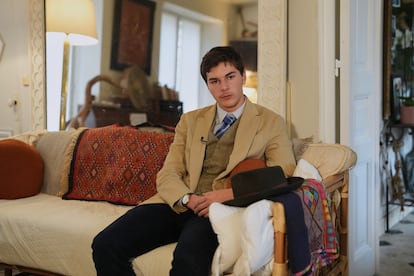 Pedro Elías Garzón Delvaux, during an interview with the Associated Press on November 8 in Paris.Thibault Camus (AP)His first mustache
One of the reasons that led so many to imagine that Pedro Elías couldn’t have been a kid was his impeccable mustache, which seemed finely and delicately styled. After the revelation that he was only 15 years old, it seemed pertinent to ask whether it had been painted on, part of the costume, or the result of a student’s tireless dedication to the care of facial hair. “Yes, of course it’s real,” confirms the boy. His mother interjects, “He hasn’t shaved it yet, it’s his first mustache.”
He admits that, before his Instagram account went public, before he gave his first interview to the Associated Press, the news agency who immortalized him and brought him to global fame, Garzón Delvaux wanted to play with the expectations of the public for a few days. “It seemed really cool and I kind of like that there was a little mystery. The theories were very entertaining,” he tells EL PAÍS. His acquaintances had already identified him, either directly or through his mother, who shows up in the photo behind him. In the days that followed the publication of the image, surprised family members in Colombia, Austria and Switzerland got in touch. Also, at school, where his clothes are part of everyday reality — though he swears he doesn’t get many comments on them — a lot of curious classmates were approaching him. “The funny thing is that he has friends who since last week have been wearing ties, because they said, ‘Why don’t I just wear a tie too?’” says Douce de La Salle. He’s been happy to oblige the requests that he star in a series or film as a junior detective: in the interview with AP, he said he was waiting for an invitation to shoot.
Garzón Delvaux’s grandfather, Douce de La Salle’s father, is the 82-year-old writer Bruno de La Salle, one of the architects of the French revival of the short story. Douce de La Salle has also published stories. This dimension of the boy’s tale — after all, one may argue that a detective in a hat and coat investigating a jewel theft is “straight out of the movies,” but surely a boy dressed as a detective in the middle of an assault on the Louvre is “straight out of storybook” — is what strikes her as being the most interesting aspect of all the uproar. “[The photo] has captured people’s imagination. They think, who is he? All he’s missing is the cigarette! Is it Sherlock Holmes?” While discussing the performative component of young people behaving like they’re in the 1940s, she quotes the famous monologue from Shakespeare’s As You Like It (1599): “All the world’s a stage, and all the men and women merely players.”
Another urgent question: how does an adolescent assemble a World War II-nostalgic wardrobe? “He’s 15, he has no money. He has what he can find at home,” says his mother. The teen vindicates his family’s keen fashion sense. “There are many things that come from my father and my grandfather. The vest is my father’s, Yves Saint Laurent,” he says. “The jacket is Hackett, that’s mine. And I also have a Cold War watch from Russia in practically every photo. We bought it in India, in Calcutta.” The most touching detail of his outfit is the garment that has caused the most talk, his fedora. “It’s a hat that belonged to my grandmother on my mother’s side,” says Douce de La Salle. “She passed away last year. In French, they say this is a clin d’oeil [wink], it was like a tribute that this photo was taken without us realizing it. My mother studied at the Louvre and was a curator, she loved the museum.”
The entire family is throwing themselves into helping Garzón Delvaux manage requests and provide him with some protection, with his older sister in charge of emails, his father doing his bit from Pakistan (where he is currently working) and deciding together which media outlets to respond to. And, this Spanish newspaper notes, their six years in Seville are not their only link to the country. “I have many friends, I loved the city and Sevilla Fútbol Club is my favorite team,” says Garzón Delvaux excitedly, while his mother laughs in the background. The boy’s love for the Seville team would certainly not have been suspected by many people during the days of speculation over the identity of the “Fedora Man” at the Louvre. His Instagram posts do not feature songs by El Arrebato, the author of the Sevilla anthem, but rather, Frank Sinatra and The Stranglers. These may be antediluvian references for someone born in 2010, but good taste, as has been demonstrated in this case, is hardly subject to trends.
Sign up for our weekly newsletter to get more English-language news coverage from EL PAÍS USA Edition