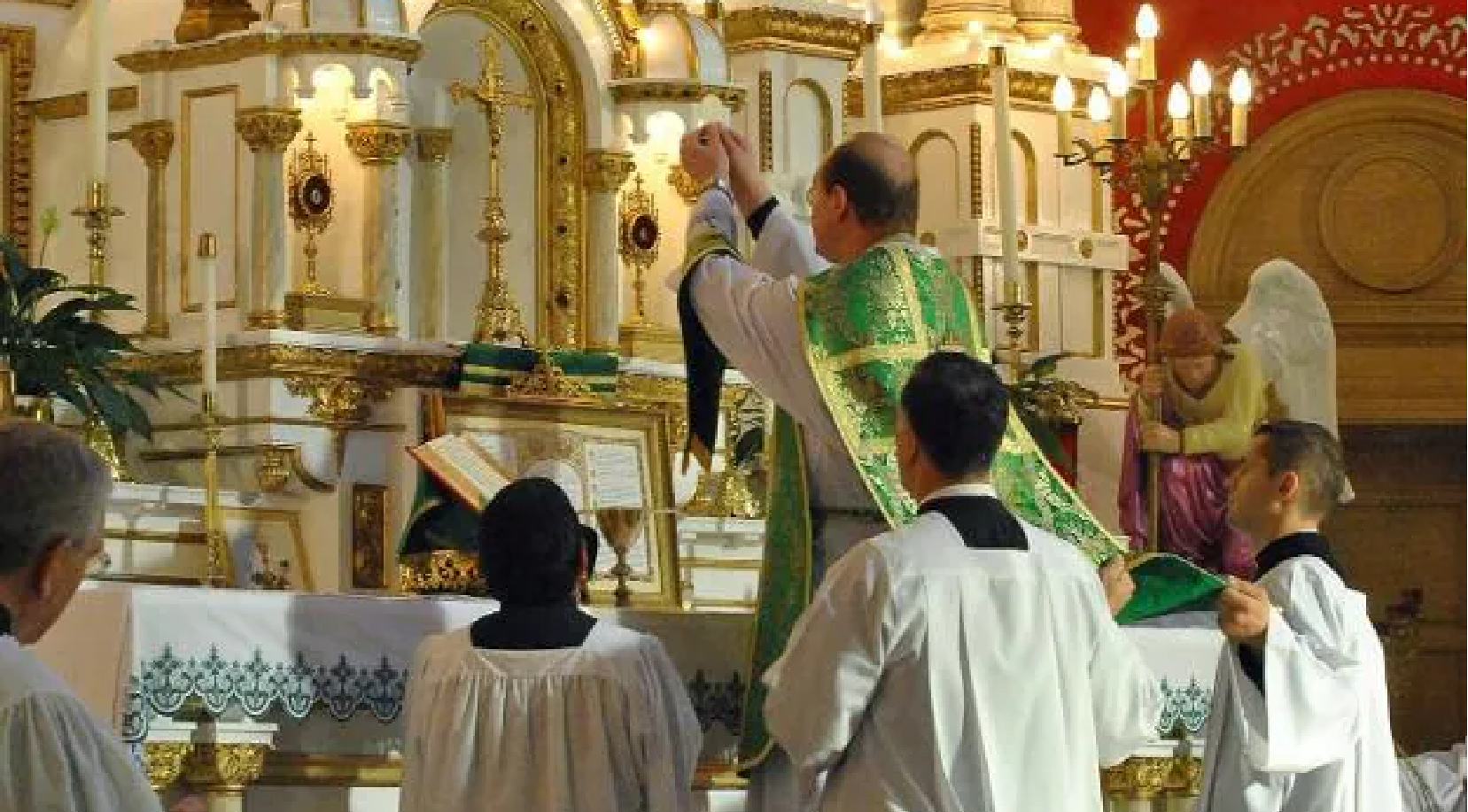
(ZENIT News / London, 11.16.2025).- When Pope León XIV stepped onto the world stage last spring, many wondered whether he would reopen one of the most sensitive liturgical debates of the past two decades. The question was simple but fraught: Would the new pontiff loosen the tight limits Pope Francis had imposed on the pre–Vatican II Roman Rite, the liturgy that for some Catholics is not simply a form of prayer but a cultural and spiritual home?
Half a year into his pontificate, the outline of his approach is beginning to emerge. According to information shared privately with bishops in England and Wales, León XIV appears inclined neither to undo the liturgical reforms advanced by Francis nor to enforce them with the same rigor. What is taking shape instead is a policy of pragmatic leniency.
This shift was first hinted at in mid-November, when Archbishop Miguel Maury Buendía, the Holy See’s representative in Britain, informed the bishops’ conference that the Pope was prepared to grant renewable two-year dispensations allowing continued celebration of the 1962 Missal in parishes where it has remained pastorally important. León XIV, he reportedly stressed, has no intention of revoking Traditionis Custodes, the 2021 motu proprio by which Francis dramatically curtailed the use of the so-called Tridentine Mass. But he is open to granting bishops broad leeway in its application.
Such exemptions, Vatican officials later noted, are not unprecedented. Since Traditionis Custodes came into force, diocesan bishops have been able to request permission for traditional Latin Masses in parish churches where communities depend on them. The process, however, has often been slow, uneven, and overshadowed by the perception that the dicastery responsible for enforcing the restrictions took a firm, sometimes unyielding stance.
For that reason, the nuncio’s comments landed with unusual force. They suggested that the atmosphere around the older liturgy might be shifting—and that a new balance might be emerging between unity, which Francis saw as jeopardized by liturgical parallelism, and pastoral realism, which León XIV appears to view as indispensable.
The signal was welcomed in Britain, where the debate over the Tridentine Mass has long had an outsized resonance. Several dioceses there had recently received permission to continue traditional liturgies, and the archbishop of Westminster, Cardinal Vincent Nichols, had spent the past two years navigating the issue with a pragmatism that contrasted with more restrictive interpretations elsewhere. British Catholics attentive to the Latin Mass—some of whom had once appealed publicly through the press to Francis to moderate future limitations—were quick to interpret the nuncio’s remarks as a sign of a gentler era.
The contrast with the previous direction of the Dicastery for Divine Worship was not lost. Under Cardinal Arthur Roche, himself British, the dicastery had issued follow-up documents tightening the application of Francis’s motu proprio, narrowing the space for diocesan discretion. León XIV’s willingness to allow bishops greater autonomy implicitly softens that line, even while leaving the fundamental legal framework untouched.
The implications are broader than the British Isles. If Rome is prepared to grant exemptions widely, dioceses around the world may soon experience a quiet recalibration: not a restoration of the old liturgical liberalization, but an easing of tensions that have strained relationships between bishops and tradition-oriented communities. Some will be disappointed that Traditionis Custodes itself remains intact; others will see the new approach as a step toward healing.
In an unrelated but symbolically significant episode, an Italian tribunal this month ruled in favor of a traditionalist Catholic blog (Messa in latino) that had been abruptly blocked in July, a decision that emboldened online communities already heartened by signs of moderation from Rome. The judgment was celebrated not only as a legal victory but also as a cultural moment for those who feel their identity has been misunderstood in recent years.
For now, León XIV appears intent on stabilizing rather than revolutionizing. His quiet authorization for Cardinal Raymond Burke to celebrate the older liturgy in St. Peter’s Basilica, and his willingness to extend existing permissions where pastoral needs justify them, fit a pattern: continuity without confrontation, flexibility without a reversal of course.
Thank you for reading our content. If you would like to receive ZENIT’s daily e-mail news, you can subscribe for free through this link.