
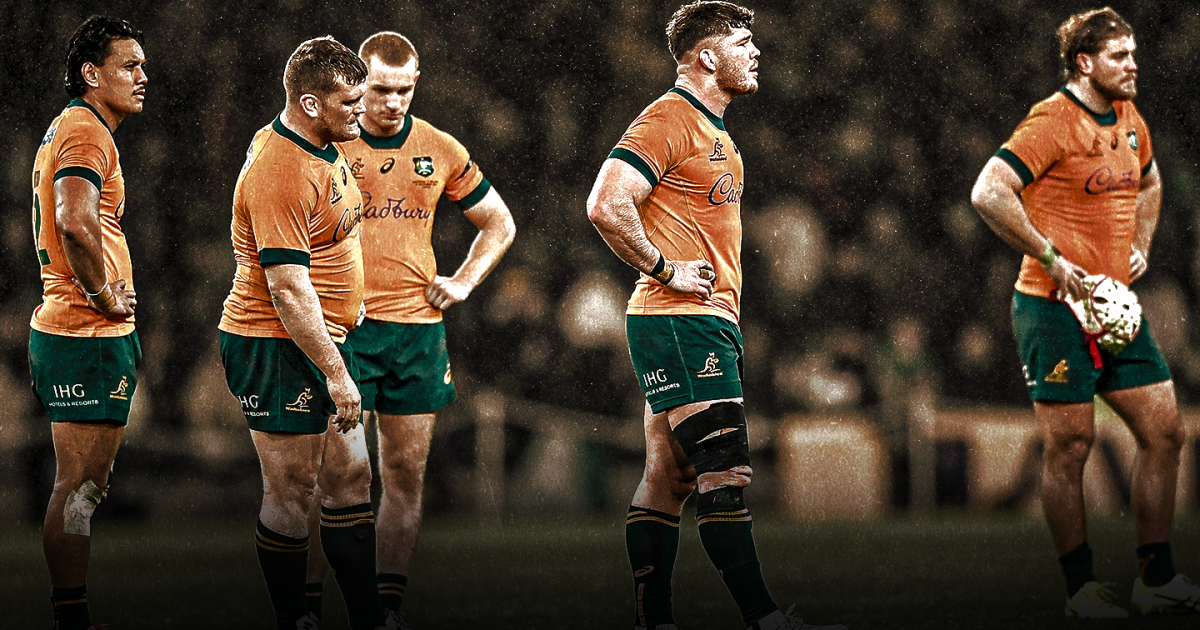
No other way to put it: the Wallabies performance in Dublin became grim viewing, as they slipped from a nine-point deficit inside the last quarter to a heavy 46-19 loss to Ireland at full-time.
Immediate reaction pondered whether it was a worse loss than against Italy last week, or against England the week before, but at this point in the season and with the trend line well on the way down, it’s kind of immaterial.
What’s not in doubt is that this northern tour has gone from bad to worse, and with France lying in wait and still stinging from their own capitulation to South Africa, the Wallabies’ final Test of the year looms as their hardest yet.
This week, like in most Test weeks, many an Australian fan has put forward their suggested XV, and many of them will definitely be the team that turns the Wallabies fortunes around, if only Joe Schmidt was smart enough to see it. Or some such. But again, this just feels like shuffling the deckchairs at this point in the season.
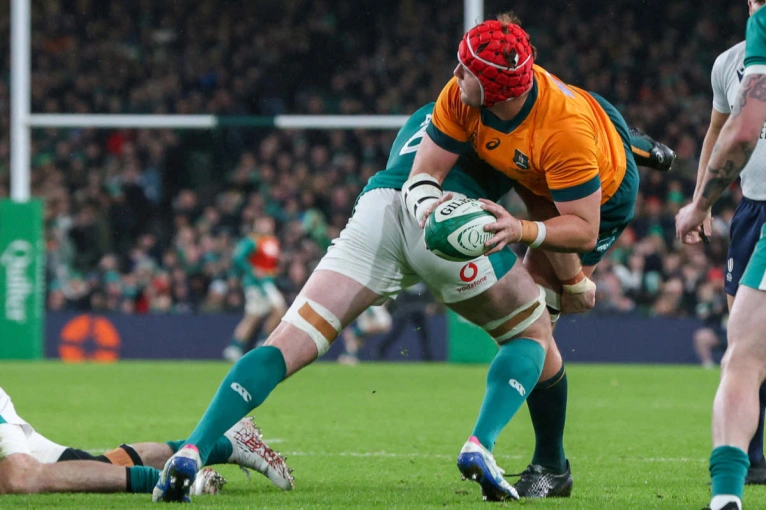 Australia are limping towards their last Test of a punishing year in which they have lost nine of 14 so far (Photo Paul Faith/AFP via Getty Images)
Matt Alverez, the Wallabies’ honorary statistician and historian, popped a stat up in the aftermath of the Dublin loss, highlighting that in more than a decade, going back to Michael Cheika’s installation as coach, Australia have named an unchanged XV from one Test to the next just three times in nearly 140 Tests.
Which is not to say that sticking with the Dublin XV will turn things around in Paris this weekend. But it’s not exactly a glowing endorsement for making yet more changes to a team that doesn’t appear to have a clear identity anymore, and which is finishing the year with no real semblance of cohesion.
But clearly the Wallabies need to do something this week, because they have become the dictionary definition of the one word a professional rugby outfit does not want to hear: they’re simply too predictable.
It’s not a sudden thing, but equally I couldn’t say when this started. But as a result, they have been way too easy to unpack, as was the case in Dublin.
No confidence under the high ball
The Australian problems under the high ball started ominously, when Harry Potter was nowhere near the first Irish contestable kick inside the first five minutes, and it never really got better from there.
By half-time, they’d only managed to hold onto two of six contestable kicks Ireland sent their way, and by the bitter end had retained less than half of 15 aerial contests. The Irish kickers and chasers were literally lining up for another crack at the Australian back-field, and it will surprise no-one to learn that Ireland kicked twice as much as the Wallabies did and profited from it significantly.
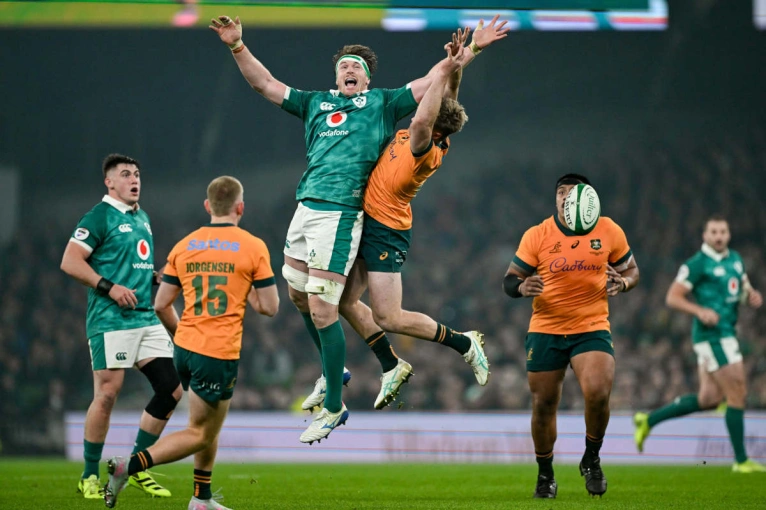 Ireland had a field day in the aerial contest, an area where Australia continue to struggle (Photo Ramsey Cardy/Sportsfile via Getty Images)
And in the wet conditions, and seeing how the Irish chasers were winning contestable ball for fun, all with momentum and perfect timing, the Wallabies launched the same tactic straight back at them, right?
I noted no more than half-a-dozen contestable Australian kicks during the match, and they regained just one of them. Two of them resulted in Ireland players claiming the mark before the chasing player arrived.
New Zealand did it through the Bledisloe Tests, Japan had a crack at it in Tokyo, England were relentless at it, Italy gained from it last week, and of course Ireland were going to pepper the Australian back three in Dublin.
It is such an Achilles heel now that the Wallabies may as well just prepare exclusively for contestable kicks this week in France. Because that’s all they’re getting for 80 minutes in Paris on Saturday night.
Very little lineout variation
What was a strength through the Lions series and even through much of The Rugby Championship has since gone very south, with the Wallabies losing six of 19 lineouts against Ireland, having lost just one against Italy last week, and none at Twickenham the week before.
With Nick Frost coming off the bench after 11 straight starts, and Tom Hooper thrust back into the second row after starting at blindside against Italy and New Zealand, and for Exeter too, since arriving in the West Country, the Wallabies found themselves down on regular jumping lineout options to start the match.
That resulted in Jeremy Williams calling a lot of ball to himself, regardless of whether the Wallabies set four, five or six-man configurations. They threw into 11 lineouts in Williams’ 67 minutes on the field and lost four of them – three of those to Williams from eight calls to himself.
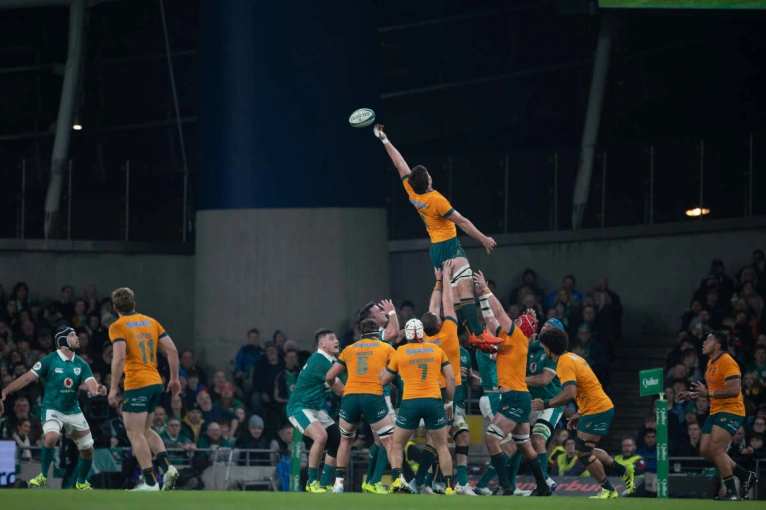 Lineout leader Jeremy Williams endured a difficult night as Ireland picked off four throws while he was on the field (Photo Tim Clayton/Getty Images)
By the time Frost replaced him, the Irish were happy to continue marking the primary jumper heavily, including two Australian lineouts five metres from the Ireland try-line.
With Lukhan Salakaia-Loto clearly still under some kind of injury cloud – he’d surely have played if fit – Australia found themselves surprisingly short in the lineout, and Ireland were only too happy to exploit it.
Too easy to pick off at the breakdown
Just as was the case last week in Udine, the Wallabies again suffered from inaccuracy and laziness at the breakdown, finding themselves penalised and/or turned over way too often.
Australia conceded 13 penalties in Dublin, seven of those while in attack, and more than a few of them for not releasing after finding themselves isolated, with the trailing cleaners either too slow or not there.
The issue only got worse as the game went on, too, and once Ireland got on a roll in the last quarter, scoring three converted tries in the last 10 minutes, the breakdown was all one-way.
It’s been a pattern for the Wallabies since heading north a month ago, and you shudder to think how much worse it might have been if not for Fraser McReight, who with the possible addition of Len Ikitau, feels like the only Wallaby who might finish 2025 with an enhanced reputation.
Bench injection is too easily absorbed
Only two weeks ago, England coach Steve Borthwick sent the media scrambling for variations of ‘bomb squad’ by sending five fresh forwards on in the 52nd minute against Australia at Twickenham. We appear to have settled on ‘Pom squad’ for what it’s worth. I’ve got to say, I expected better.
France have deployed forwards in bulk numbers in recent weeks, Ireland replaced five forwards in two pods in Dublin on the weekend, and obviously, South Africa have been revolutionising bench use for some time now.
A fortnight ago, I noted that Joe Schmidt only deployed the Australian replacements as pairs or single units against England, rather than a battalion, and that pattern has continued throughout these northern Tests.
Australia have been comprehensively out-scored in the back half of games in the last month, and while other teams are reaping the rewards of fresh forwards in numbers, the Wallabies continue with the piecemeal existence.
When Billy Pollard and Tom Robertson ran onto the Aviva in the 54th minute on Saturday, it represented the first time in the last four weeks that two replacement front-rowers went on together. In fact, it was the first time any forwards went on together.
That seems strange given the way the Wallabies have faded in the final quarters of matches recently. Australia have been comprehensively out-scored in the back half of games in the last month, and while other teams are reaping the rewards of fresh forwards in numbers, the Wallabies continue with the piecemeal existence.
Sending on replacements one at a time just allows teams to load up on them initially, but then just absorb them into the rest of the tiring pack, and thus, no real impact is felt by the opposition defence, and certainly none gained by the very obviously tiring Wallabies.
If there’s only one thing Les Kiss does differently to his coaching mentor, it needs to be the way he uses the bench.
Somehow, it’s all got to come together in Paris
After 14 Tests in 19 weeks and 47 players used, Australia have a short and long-term injury list that makes for sobering reading, not just for the length but the fact that injury has struck at every point of the season.
With that in mind, it’s been a bit bemusing to see commentary wanting to pin the Wallabies’ decline in 2025 on the loss of Tom Wright or availability of Will Skelton. They’ve been big losses individually, don’t get me wrong, but so many other players were out of action at the same time that it makes it almost impossible to pin it on the absence of one or two players.
 Flanker Fraser McReight is one of the few Wallabies to have maintained form and fitness through the year (Photo Paul Faith/ AFP via Getty Images)
Let me illustrate: Wright went down with a serious knee injury in the Cape Town Test, but nine other Wallabies from every on-field department – from a touring squad of 38, by the end – incurred some kind of injury on the South African tour. There were a lot of compromised players in those immediate weeks following.
And yet all the injuries, and the disappointing performances for the last month or longer, have to be set aside for one more week, as Australia finish their season at the State de France in Paris.
It may or may not be Joe Schmidt’s final game in charge. There are handover plans for Les Kiss next July, but who knows whether they will hold up over the summer and through Super Rugby next year. I remain dumbfounded that Kiss hasn’t had a more active role through this northern campaign.
Somehow though, the players and staff need to find their special sauce and magic beans and whatever else might be needed to turn in a performance to end 2025 on a high, which they can all be proud of. Something to hang the hat on and take a positive feeling into the New Year.
How will they do that? Good question. It doesn’t really matter how it happens, just that it does. Australia deserve a better finish than where it feels like they’re heading, and suffering Wallabies fans certainly do, too.