
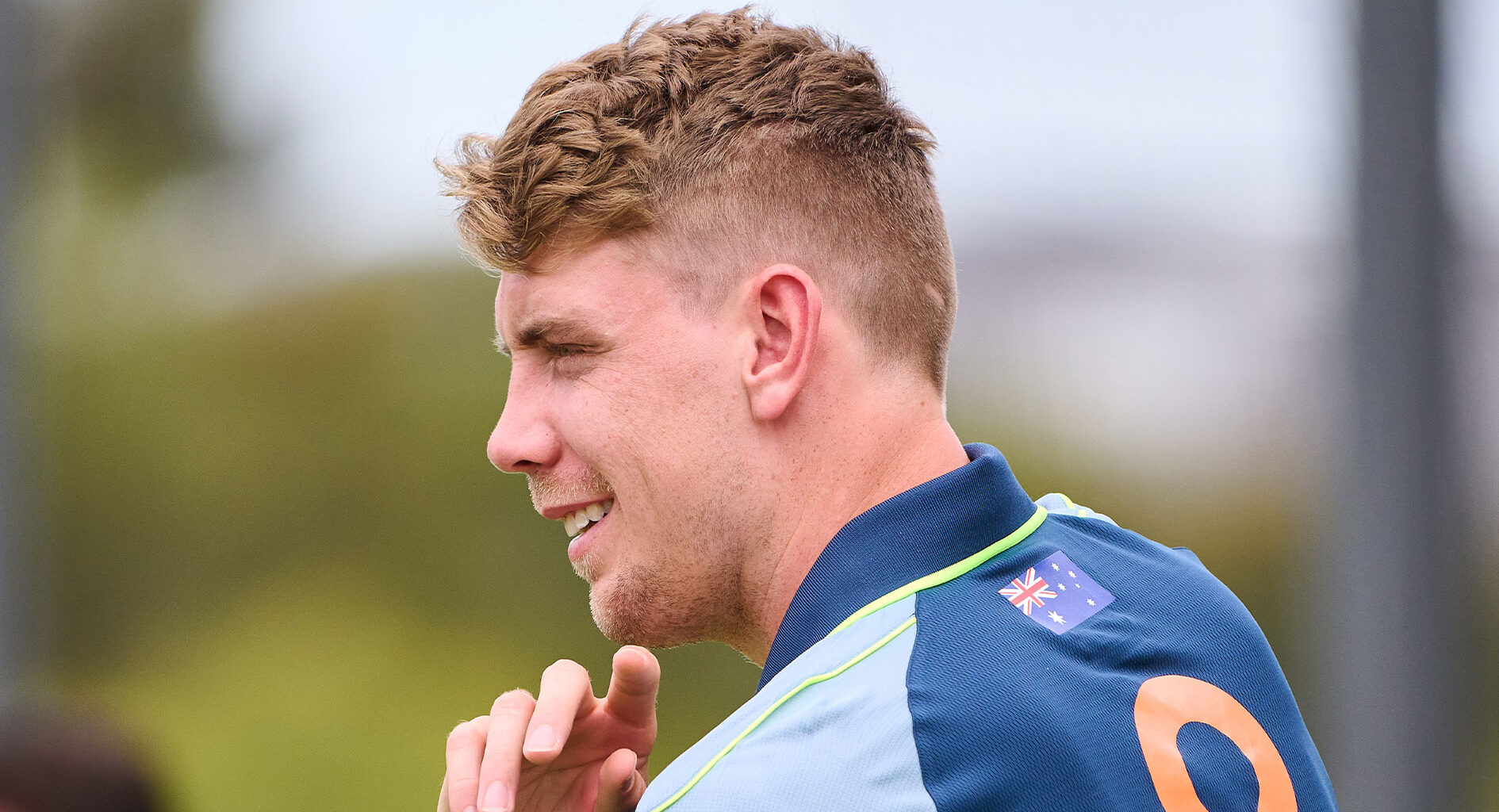
‘Soak it in!’: Behind the scenes of Cam Green’s Test morning
Cameron Green will enter the Ashes having broken the 140kph barrier in a match for the first time since his back surgery, with the allrounder confident his titanium-reinforced spine will allow him to send down rockets against England this summer.
While Green remains unsure of whether he will bat at three or six in the NRMA Insurance series opener, the West Australian is certain he can go the distance with the ball in the five-Test campaign against England’s ultra-aggressive batting line-up.
In October last year, Green underwent the same radical lower-back operation that has extended the careers of fast bowlers like Jasprit Bumrah, Shane Bond and James Pattinson, and more recently undertaken by his close friend, Lance Morris.
It has been a long road back for Green to return to bowling at full tilt. His 16 overs against Queensland in the Sheffield Shield last week was comfortably his biggest workload since the surgery. This week’s first Test will mark his first bowling stint at international level in more than a year.
“It felt really good,” Green, speaking on cricket.com.au’s Unplayable Podcast in an episode to be released on Wednesday morning, said of his Shield bowling spell.
“It was 35 degrees day one, and I was like, ‘Oh my god, have I completely lost my bowling fitness here?’ But it was nice to look around and all the bowlers who bowl heaps were also struggling.
“The body felt really good after – so big tick.
“I’ve been doing that sort of workload in the nets. But nothing is quite like bowling in a game. The intensity – you just hit a level that you just can’t hit in the nets.
“I think I went as hard as I could a few trainings beforehand and couldn’t get the airspeed that I just got reasonably easily in a game … they mentioned 140 (kph).”
Every ball of Cameron Green’s first spell on return
Green admits the volume of overs under his belt ahead of his home Perth Test is ultimately short of what he had hoped it would be. He was wrapped in cotton wool when a plan to bowl him in two of three ODIs against India last month was aborted due to him feeling some side soreness.
It was in keeping with the ultra-cautious approach Australia have taken with the man who is arguably their most important player across all three formats. Green believes going into the home series against England a little underdone will benefit him in the long run.
“I probably haven’t had the competitive overs in a game that I would have liked coming into this series. But I think the double-edged sword is that you come in really fresh,” he said.
“A five-Test match series versus England is going to take a lot out of you and if you’re already coming in a bit tired, you’re going to be exhausted by the end.
“Hopefully by the back-end, I’m still going really well whereas if I went a bit too hard with a few Shield games, I might not be. You probably prioritise the Ashes over anything (that comes) before.”
Green, who had been dogged by stress fractures through his junior years, has been emboldened by the lumbar spine operation performed by a pair of New Zealand surgeons in Christchurch which involves two titanium screws inserted into his spine.
It’s becoming an increasing common procedure for Australian bowlers who suffer repeated lumbar spine injuries. Current T20I quick Ben Dwarshuis had it done several years ago, while Pattinson and Jason Behrendorff also benefited from it. Morris, the CA-contracted speedster from WA, also opted for the surgery after speaking to Green.
The operation requires a lengthy rehabilitation process – Green was able to return to cricket as a batter well before he resumed bowling – but the 26-year-old now has more confidence his back will hold up to the rigours of top-flight cricket than he did pre-surgery.
“I’ve got the courage that it will be fine. That maybe (could be) a little bit too naïve, but when you’ve got metal in your back here, you hope that doesn’t break quite as easy as bone,” he said.
“If anything, it’s a bit of a confidence boost. At the same time, you’ve got to be quite careful, because if you do it again, what’s the next step?
“It’s had a lot of success – I don’t want to take that for granted, so it’s still being smart – but if anything, I’d say it’s probably a confidence boost.”
Spinal surgery aside, Green has had plenty to think about elsewhere. For the Test side, his return has come at the unfamiliar spot of No.3, while he has also emerged as an outright star with the bat in both 50- and 20-over cricket this year.
In August, the right-hander smashed the second fastest ODI century by an Australian, off 57 balls against South Africa, while he has also become a key member of the Aussies’ bruising T20I middle-order.
Green machine: Allrounder belts 47-ball ton
That came after a swift adjustment to the first-drop position he occupied for the World Test Championship final and ensuing three-Test tour of the Caribbean. After failing to reach 15 in his first four innings batting at three, Green’s scores of 52, 26, 42 and 46 in the final two Tests against West Indies made him comfortably the most successful batter from either team (in those two matches).
“It was the first time in my career batting three,” he said. “It didn’t quite go how I planned it, but it was nice just to get it out of the way and then work on a few things, find a few things that did work at three, and then have a bit of success by the end.
“The scoreboard – it probably doesn’t look that way – but the wickets (in the Caribbean) were that tough that getting a 40 or 50 was pretty amazing. So there were definitely positives to take out of it.
“I think it was just being able to leave the ball. That was the best thing to do over there, because it was going sideways, up and down.
“I found the best way was probably just to play literally (only) balls that were on your pads, and keep it as compact as possible.
“Trying to expand your game was just so tough over there, the percentages of being able to hit the ball were so low, so being able to leave the ball was probably your best bet, and try to nick and nudge your way around to get to 40 and battle through it.
“That was definitely a way that worked there. It may be a different way you might have to go about it on a flatter wicket.”
Green has maintained a preference to have long adjustment periods back into red-ball cricket, skipping white-ball series to hone his long-form batting, even as he has become more experienced across all formats at international level.
His 94 against Queensland last week – a hundred beckoned if not for a 50-50 lbw call off Michael Neser – was his highest score of the season so far. He hopes it has primed him for the biggest Test series on Australia’s calendar.
Green falls agonisingly short of ton in valuable pre-Ashes tune up
“There’s guys like Travis Head that do play very similar games (between formats). He loves just hitting the ball, and that works really well opening the batting in white-ball cricket,” said Green.
“I still feel like there’s a slight difference in how I play, and how I play my best cricket in red-ball cricket is reasonably different to how I play my best cricket in white-ball cricket.
“It is a big adjustment compared to someone like Travis, who bats very similar (between formats), so maybe I do need those few extra games to feel quite right.
“Over time you start to learn your game more. You work through all the theories in your own head that that may work. Whether that’s batting on middle, leg, (or) off, coming outside your crease, whether you want to play in the back foot or front foot.
“You work through so many different combinations to see what works. The older you get, the more hours you put into those theories and trying different ways and finding what works.
“I feel like I’ve found a way in white-ball cricket that really works, makes me feel really powerful and dominant. It’s just finding a right balance in red-ball cricket, because the ball behaves completely differently.”
2025-26 NRMA Insurance Men’s Ashes
First Test: November 21-25, Perth Stadium, 1:20pm AEDT
Second Test: December 4-8, The Gabba, Brisbane (D/N), 3pm AEDT
Third Test: December 17-21: Adelaide Oval, 10:30am AEDT
Fourth Test: December 26-30: MCG, Melbourne, 10:30am AEDT
Fifth Test: January 4-8: SCG, Sydney, 10:30am AEDT
Australia squad (first Test only): Steve Smith (c), Scott Boland, Alex Carey, Brendan Doggett, Cameron Green, Travis Head, Josh Inglis, Usman Khawaja, Marnus Labuschagne, Nathan Lyon, Michael Neser, Mitchell Starc, Jake Weatherald, Beau Webster
England squad: Ben Stokes (c), Harry Brook (vc), Jofra Archer, Gus Atkinson, Shoaib Bashir, Jacob Bethell, Brydon Carse, Zak Crawley, Ben Duckett, Will Jacks, Ollie Pope, Matthew Potts, Joe Root, Jamie Smith (wk), Josh Tongue, Mark Wood