

In the 125-year history of the Davis Cup, there is one particular day off the court that several onlookers recall to be pivotal in its downfall.
August 16, 2018, when fawning national delegates at the International Tennis Federation’s (ITF) annual meeting in Orlando posed for selfies with the footballer Gerard Piqué before voting for his controversial proposal to revamp one of tennis’s most historic tournaments into a season-ending finals.
“This new event will create a true festival of tennis and entertainment which will be more attractive to players, to fans, to sponsors and to broadcasters,” David Haggerty, the ITF president, said afterwards as he basked in the glory of a successful campaign to wave through a 25-year plan by Piqué’s Kosmos group to invest £2.15billion.
Seven years on, how is that bold new era going? Piqué has long gone after the ITF ripped up its contract with Kosmos over a financial dispute in 2023, while the world No2 Jannik Sinner could not be bothered to turn up at this week’s finals on home soil in Bologna, Italy, where the world No3 Alexander Zverev is the only top-ten men’s player in action. Add to this the fact that it is going largely unnoticed in the sporting sphere, it is all rather forlorn for an event self-billed as the “World Cup of tennis”.
The frustration for many in tennis is that this was all so predictable. You did not have to dig deep in 2018 to find someone who doubted whether the grand sums pledged added up. After less than five years of a 25-year agreement, this dawned on Kosmos when it requested a renegotiation with the ITF. This eventually ended up in an undisclosed settlement between the two parties earlier this year after Kosmos had filed a lawsuit at the Court of Arbitration for Sport, accusing the ITF of an “unjustified termination”.
The financial and reputational cost has been immense. One insider said this week that close to £75million had essentially been wasted on the Davis Cup in recent years, with the ITF playing catch-up ever since after calling upon “financial contingencies” when the Kosmos deal came to a premature end. Some delegates may consider their Piqué selfies to be priceless but the damage done when heads were lost on that fateful day has been near-catastrophic.

Alcaraz, defeated by Sinner in the ATP Finals on Sunday, flew in to Bologna for the Davis Cup only to be told his hamstring wasn’t up to it
MARCO BERTORELLO/AFP VIA GETTY IMAGES
Haggerty remains in his position, subsequently being comfortably re-elected twice by AGM delegates on four-year terms, but he is certainly not presiding over a Davis Cup that is “more attractive”. Both Sinner and Carlos Alcaraz have recently called for the competition to be reduced to a biennial format, while Zverev described the finals as an “exhibition” in which he was only turning up out of loyalty to his fellow German players.
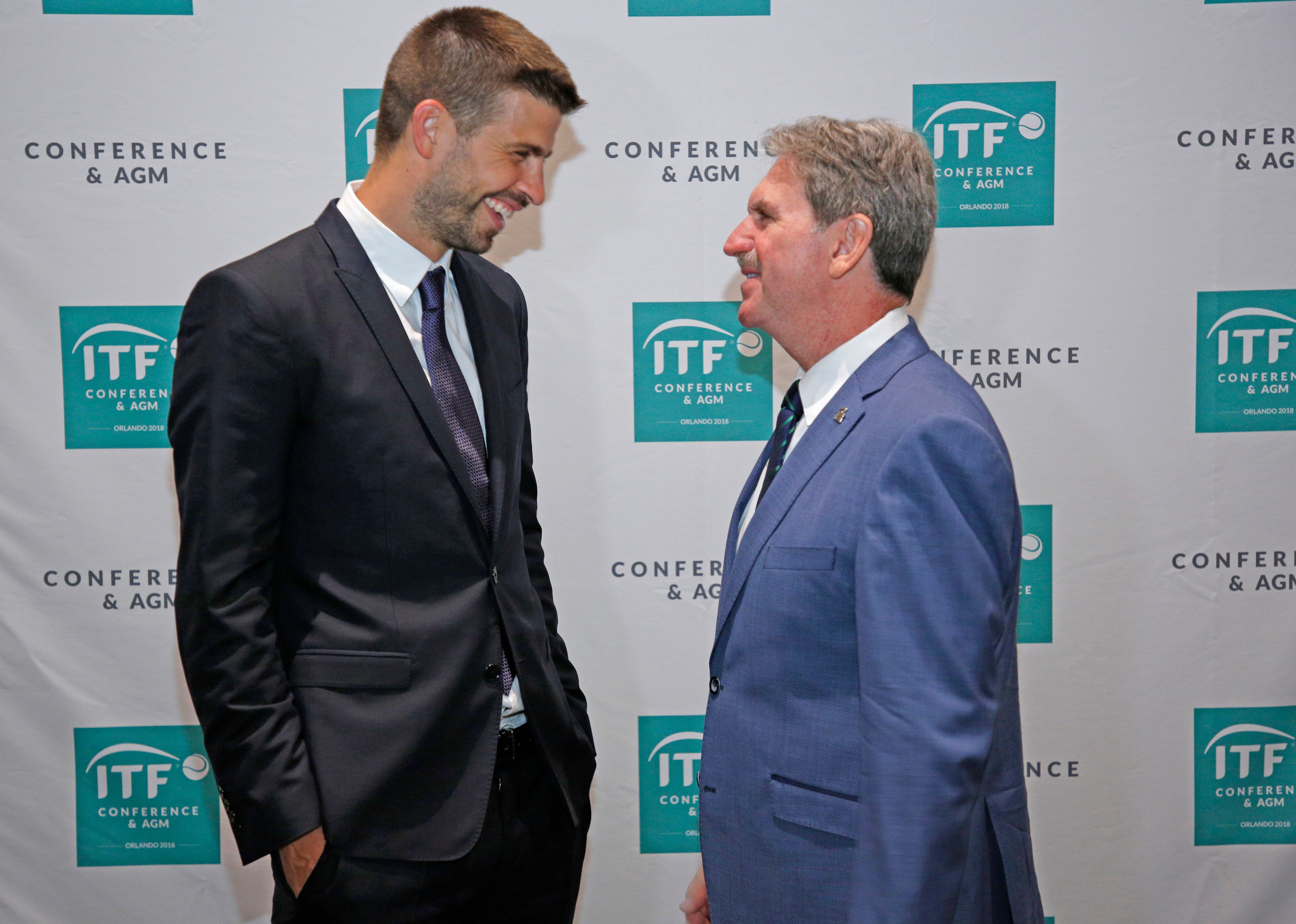
The ITF president Haggerty, right, with Kosmos founder Piqué after agreeing to a £2.15bn investment in 2018 — the deal collapsed within five years
GREGG NEWTON/AFP VIA GETTY IMAGES
“I don’t think this Davis Cup is the real Davis Cup,” Zverev said. “It’s an exhibition tournament in a way that is called the Davis Cup. I’ll play it now because my team-mates and my German colleagues really asked me to play because they feel like everybody’s getting older.”
It must be acknowledged that the Davis Cup has repeatedly been criticised and picked apart through the years, even under the traditional home and away format — this involved four knockout ties spread across the calendar from February to November. A common complaint then and now is that ties immediately after grand-slam tournaments, and at the end of a long, hard season, are far from optimal in encouraging the participation of top players.
By no means did Alcaraz snub this week’s finals. The world No1 travelled from a runner-up finish at the ATP finals in Turin straight to Bologna before being told by a Spanish team doctor that his hamstring muscle was in danger of tearing if he played. Alcaraz said he was “heartbroken” to withdraw.
Ultimately, though, there are clear and serious flaws with the scheduling and formatting of the Davis Cup. There has been so much chopping and changing with titles and draw brackets over the past seven years — the finals have reduced from 18 teams in 2018 to eight teams this year — that it is difficult for even the tennis connoisseur to keep up with the flow of the event. For example, if you are wondering why Great Britain are not involved this week, Leon Smith’s team lost to Japan in the “qualifiers first round” in February before winning a tie against Poland in “world group I” in September to secure a spot in the “qualifiers first round” in February 2026.

Having led Italy to consecutive Davis Cup victories, Sinner — who retained his ATP Finals title in Turin on Sunday — opted out this year
MATT MCNULTY/GETTY IMAGES FOR ITF
Given that Sinner and Alcaraz have both made clear their belief that one edition of the Davis Cup should be held over the course of two years — the ATP chairman Andrea Gaudenzi also noticeably did the same last week — it seems inevitable now that the ITF must head down this path. This could potentially include the reintroduction of a two-team final under the home-and-away format rather than a neutral multiple-team event.
The recent appointment of Ross Hutchins, the former British doubles player and ATP chief sporting officer, as the ITF’s new chief executive opens up the prospect of change. Described as a dynamic operator by those who have worked with him previously, he will be key to building a better relationship with tennis’s other governing bodies in an attempt to resolve scheduling difficulties.
It is the likes of Sinner and Zverev, though, who need to be persuaded that the Davis Cup is worth their full and consistent commitment. Tennis players who largely contest individual tournaments can sometimes find it hard to translate that mindset to a team event, particularly when there is so much importance placed on grand-slam totals in this day and age. Four ties for their countries over the course of two years seems a reasonable compromise.
How it worksStage 1: Qualifiers first round
When: January 30 – February 2, 2025
Who: 26 nations (including GB)
What: Winners move to Qualifiers second round. Losers move to World Group IStage 2a: Qualifiers second round
When: September 12-14, 2025
Who: The 13 winning nations from Qualifiers first round plus runners-up of 2024 Davis Cup
What: The seven winners qualify for finals (joining host nation)Stage 2b: World group I
When: September 12-14, 2025
Who: The 13 losing teams from Qualifiers first round plus 13 from World Group I play-offs
What: Decides who qualifies for 2026 Qualifiers first roundStage 3: Finals
When: November 18-23, 2025
Who: The seven winners from Qualifiers second round plus hosts (Italy)
What: Quarter-finals, semi-finals, final format. Best-of-three rubbers, two singles matches with a doubles decider if necessary.