

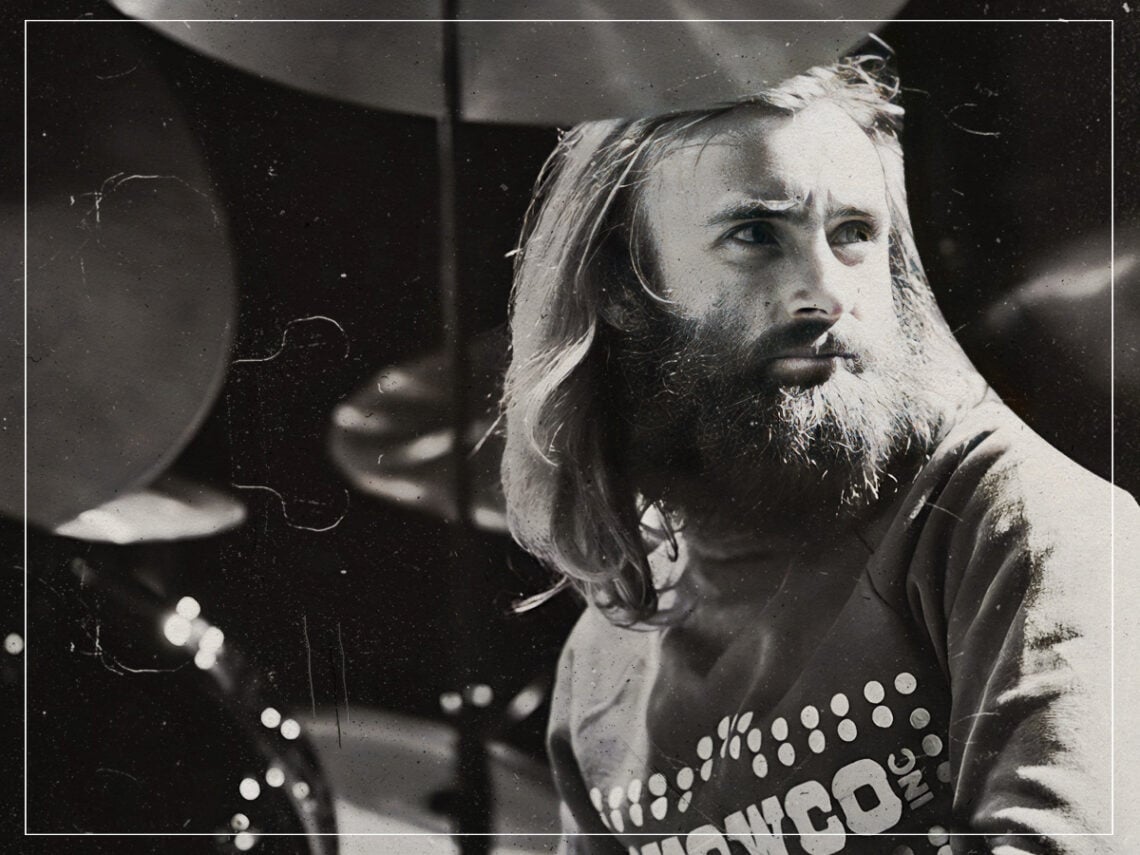
(Credits: Far Out / TIDAL)
Thu 20 November 2025 8:07, UK
If you had to guess which members of rock bands would break away from the group to have themselves a pop career, there is a very good chance that Phil Collins was at the very bottom of your list.
The Genesis drummer somehow managed to traverse the confines of his drum kit, break out of the murky world of prog-rock and become a bona fide pop star of the 1980s. During that time, equipped with bright white trainers and stonewash jeans, he managed to score nine number one songs and confirm his place in the history books as perhaps the most unexpected pop star of all time. But not all those songs have a place in his heart.
Every artist will have those few tracks they are tired of performing. Even though it might be nice to have millions of fans singing a song back to you in concert, it’s also a double-edged sword when the artist was never in love with the piece in the first place. Despite having one of the most lucrative careers of the 1980s, even Phil Collins wasn’t safe from a few songs that didn’t sit well with him over the years.
When first starting out, Collins didn’t even visualise himself as a songwriter. For the longest time, the drummer was more interested in working from behind his kit as the leading percussionist behind Genesis, only to be promoted to lead singer when Peter Gabriel quit the group to spend more time with his family.
Even though Collins was apprehensive about taking on the responsibility of a frontman, he was a natural behind the mic, even playing from behind his kit and keeping the audience engaged whenever the band performed live. Once his marriage was on the rocks, though, Collins took some time off from the band to work on his relationship, during which time he made the songs for what would become his debut solo release, Face Value.
Inspired by his troubled home life, the album would feature one of his trademark hits, ‘In The Air Tonight’, setting him on a course to be both a pop singer and a prog rock musician. Although Collins could still work in various pop stylings into later Genesis projects like Invisible Touch, he pulled from the bubblegum side of the charts when sculpting his solo hits, creating tracks like ‘Sussudio’ around a nonsense phrase.
Outside of his uptempo material, Collins thrived when writing ballads, creating heartbreaking odes to lost love on tracks like ‘Against All Odds’ or glowing declarations of love like ‘Another Day in Paradise’. Although many ballads bode well for him on the charts, Collins couldn’t help but have a few problems with ‘A Groovy Kind of Love’.
When talking about the song years later, the singer thought it had overstayed its welcome in his live set. Although he mentioned loving tracks like ‘Take Me Home’ whenever they were played live, he thought that ‘A Groovy Kind of Love’ wasn’t worth revisiting, saying, “There are some songs I wouldn’t mind if I didn’t sing again, frankly, ‘Groovy Kind of Love’.”
Even though the song has a fantastic melody beside it, it’s also easy to see where Collins is coming from in terms of a live setting. Despite the pleasant tune, the track moves on sluggishly, almost like every chord is being dragged out to squeeze every bit of melodrama out of it.
Lyrically, it is extremely turgid, too. “When I’m feelin’ blue, all I have to do / Is take a look at you, then I’m not so blue” is not the kind of lyric any songwriter would be happy singing again and again, even if they hadn’t initially penned them. Originally written in 1966 by Carol Bayer Sager and Toni Wine, it was picked up by The Mindbenders, and was inspired by a Paul Simon song that he also hated.
While Collins had no part in writing the final song, it does suit his voice very well, especially coming off his takes on classic doo-wop tracks like The Supremes’ ‘You Can’t Hurry Love’. Although Collins has built up a library of classic songs in his repertoire, this is the kind of track that is more suited as a relic of its time than meeting the concert stage.
Related Topics