
Jeff Thomson, arguably the fastest man ever to propel a cricket ball, did not just like to torment England’s cricketers on the field, but also off it. He had faced them once in a state game, before the start of the 1974-75 series that made his name, but had taken only two wickets.
“He’d come on the telly and say, ‘I can bowl a lot quicker than that,’” David Lloyd recalls. “Australian TV would interview their guys, they’d never bother with us. We’d turn it on and he’d send us messages: ‘I know you’re watching … I’ll see you tomorrow.’”
And see him they did, all too often. Lloyd missed the first of the six Test matches after breaking a finger in fielding practice — one of many English bones damaged on this brutal tour — but was fit in time for the second on the famously fast, true pitch at the Waca in Perth. By then, he was needed: John Edrich and Dennis Amiss had already been put out of action by Thomson in the series opener in Brisbane.
Lloyd’s Ashes debut would prove highly memorable, so memorable that what happened still resonates more than half a century later.

Thomson was able to generate frightening pace and bamboozle batsmen thanks to his rather unusual action
TIMES NEWSPAPERS LTD
In some respects it was one of the best games of his life. The previous summer he had scored an unbeaten 214 on his second Test appearance, but the circumstances could not have been more different. The India attack at Edgbaston was dominated by spin; now he was battling the wildness of Thomson from one end — “he never worried about where it was going” — and the craftsmanship of the great Dennis Lillee from the other.
“We’d faced nothing like it previously,” Lloyd, now 78, says of Thomson. “He’d have been quicker than the West Indies guys and was hiding the ball behind him because his action was like a catapult. The moment you really wanted to focus on the ball, you’d lost it. He’d get it wrong sometimes, but he was such a simple lad he’d just shrug his shoulders.”
Despite the immense challenge, Lloyd batted more than six hours in the match for 84 runs, chiselled out at a tortuous rate of 14 per hour. He estimates that about five balls of every eight-ball over were bouncers (this was in the days before the ICC imposed a limit on the number of short-pitched balls that could be bowled each over).

Luckhurst made 27 from 53 balls in the first innings before Cowdrey replaced him as opener and he moved down the order
PATRICK EAGAR/POPPERFOTO VIA GETTY IMAGES
After Brian Luckhurst had his left hand smashed by Thomson in the first innings, Lloyd found himself opening with the venerable Colin Cowdrey in the second. Cowdrey was 41 years old and had been flown out as an emergency reinforcement after the casualties at the Gabba.
On the basis that Thomson’s angle of attack was less threatening to left-handers, Lloyd volunteered to take the bulk of the strike from him, a gesture Cowdrey described as “the most generous act I have ever known in cricket”. At one point during the bombardment, Cowdrey walked down the pitch to Lloyd and said: “This is rather fun, isn’t it?” Lloyd raised an eyebrow: “I’ve been in funnier situations.”

Lloyd during the third Test at the MCG in December 1974. England lost the series 4-1
GETTY IMAGES
Technically, Cowdrey was very good, but his portliness meant he was not particularly mobile, a point brought home during the Melbourne Test when a young lad — “he couldn’t have been more than 12 years old,” Lloyd recalled — thrust an autograph book at one of England’s most celebrated cricketers and demanded: “Hey, Cowdrey, you pudgy f***er, sign this.”
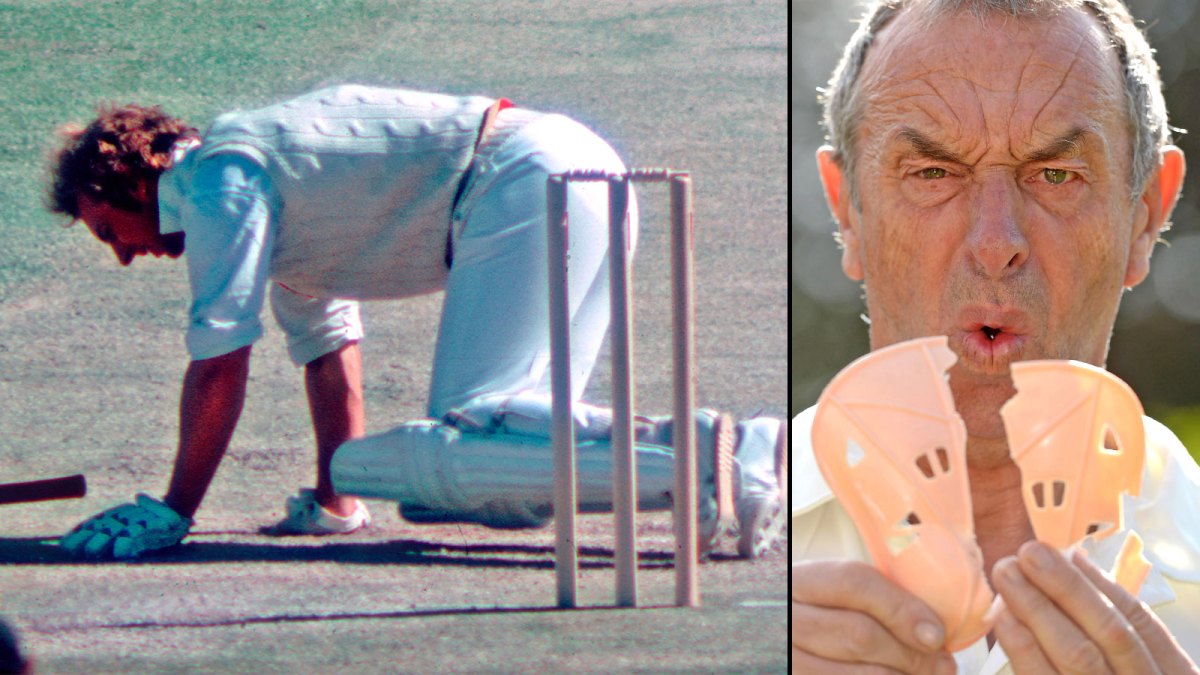
The two of them were going along quite nicely at 52 for no wicket when Lloyd’s luck ran out as a Thomson thunderbolt struck him flush on the box. His body jack-knifed back before he tumbled forward onto the ground, where he writhed in agony. Eventually he was helped to his feet and led from the field.

Lloyd was forced to leave the field after being struck by Thomson, although he later returned to increase his second-innings score to 35
PATRICK EAGAR/POPPERFOTO VIA GETTY IMAGES
Under the back-page headline, “Now Lloyd Cops It”, the Daily Mirror correspondent Peter Laker noted: “It was agonisingly evident to all … that Lloyd’s cricket was over for the day”.
As the tour lurched from one crisis to another, Lloyd’s undignified exit came to epitomise — if the pun can be pardoned — English cricket’s emasculation. Confronted by two of the deadliest fast bowlers in the world sharing 58 wickets in the series, Mike Denness’s team had little to counter them with. Amazingly, England’s selectors had chosen not to select their own fastest bowler, John Snow, who instead looked on from the press box.
In Lloyd’s later retelling of an event that has passed into folklore, the protector cracked in cruel fashion: “We wore little pink plastic boxes, which were totally unsuitable for the job. It cracked open and what I had inside fired through before the box snapped shut again like a guillotine.”
Once back in the sanctuary of the dressing room, Lloyd found out what Bernard Thomas, England’s physiotherapist, regarded as the best available treatment. “He handed me a pint pot filled with iced water. Let’s just say he wasn’t suggesting I drink it.”
Bizarrely, a few hours later, Lloyd and Thomson were heading to the cinema together. One player from each team had been designated to appear at a screening of a new Barry Humphries film, and they were the ones who had been chosen. The film was called Barry McKenzie Holds His Own (I’m not making this up, I promise). “We were even introduced together on stage,” Lloyd recalls.
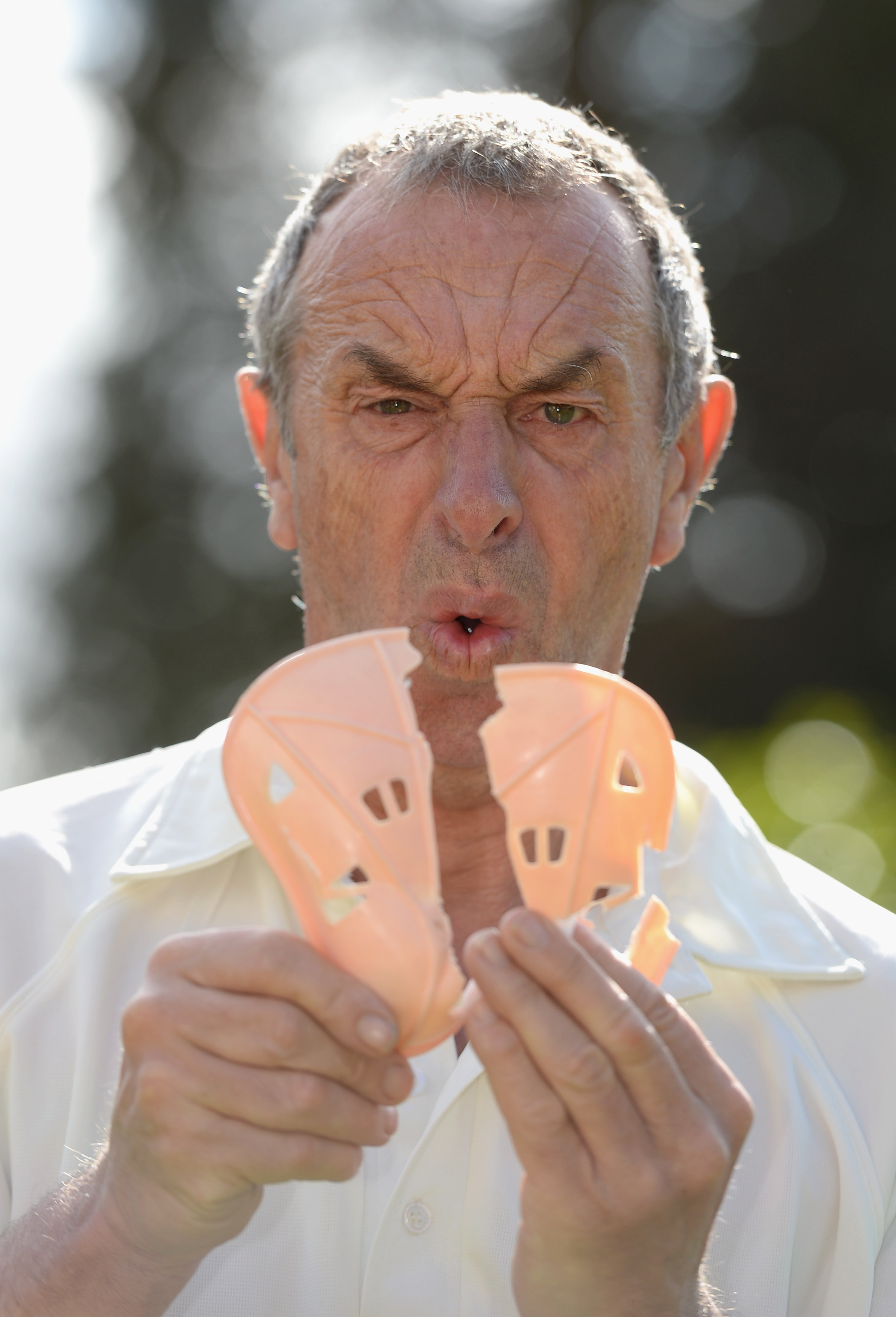
Years later, Lloyd shows off the offending box
GARETH COPLEY/GETTY IMAGES
In popular imagination, a series Australia won 4-1 has gone down as one of unbridled hostility, as Ian Chappell’s team sought vengeance for their defeat by Ray Illingworth’s side of 1970-71, but the spirit between the players was actually remarkably good considering the ferocity of Australia’s methods.
“They were a tough, uncompromising team, but they were a good bunch to play against, very well led by Ian Chappell,” Lloyd says. “The idea that they were nasty wasn’t right. There was plenty of pantomime stuff but it wasn’t malicious. I’m still mates with Ian Chappell. Rod Marsh was great with me and Dennis [Lillee] I would see when I went to Perth.”
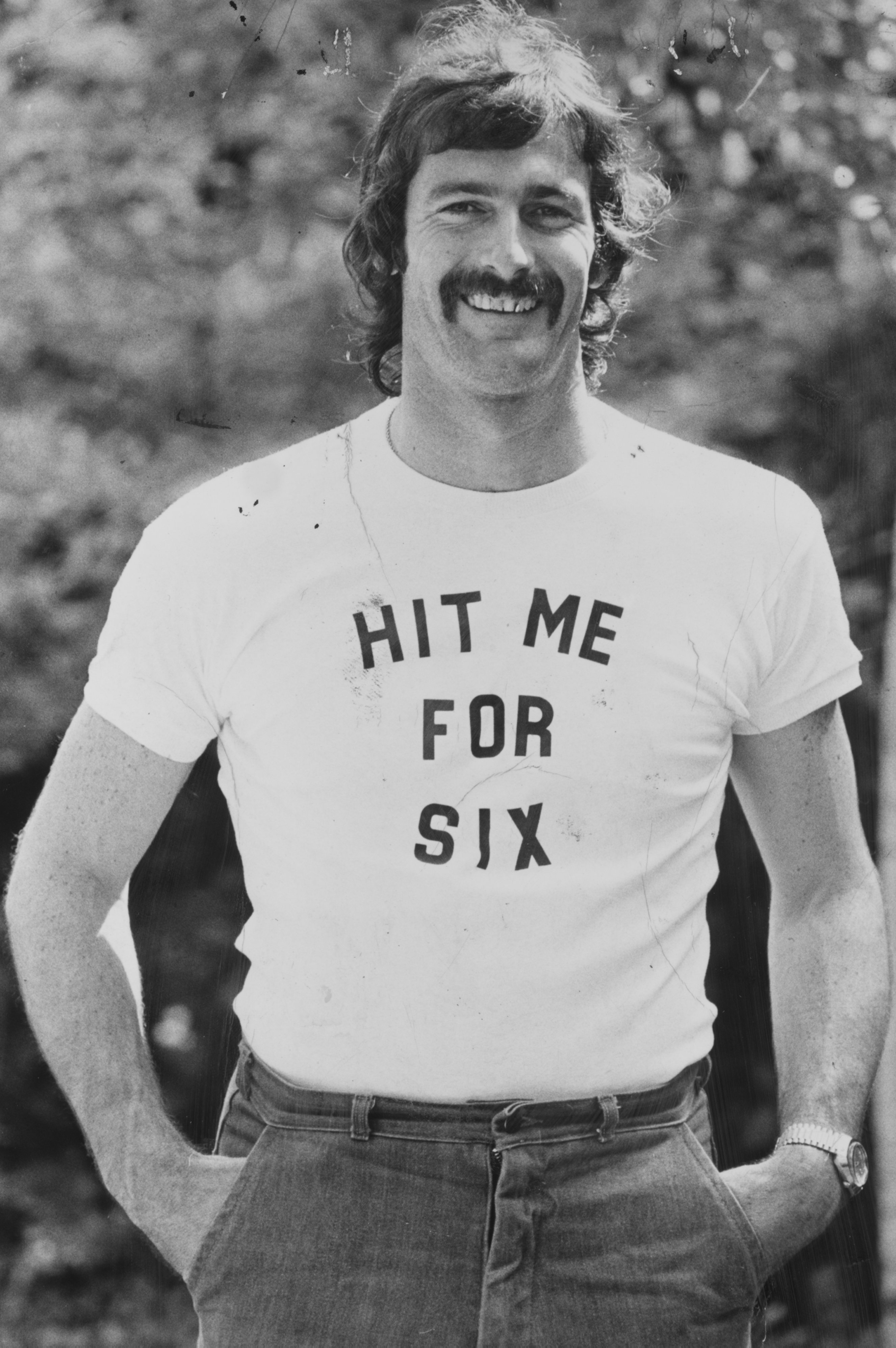
Lillee, pictured, combined with Thomson to take 58 wickets between them in the series
NEWS GROUP NEWSPAPERS LTD
The day after being struck “amidships”, Lloyd was reported as saying of Thomson: “He’s a good lad. I like him. But on the field I don’t expect him to apologise for hitting me any more than he would expect me to apologise if I hit him for four.” The Australia fielders had immediately rushed to see if Lloyd was OK, and although Thomson stood slightly apart from the huddle he admitted after the game that he had been worried about him.
The next day was a rest day, during which England announced Lloyd would be fit to resume his innings, and this duly happened early on the fourth morning after Tony Greig was out.
Thomson greeted him with a bouncer, but he managed to stay long enough to raise his score from 17 to 35 before he was caught by Greg Chappell off Max Walker, another vital cog in the Australian pace attack. Walker’s action was a whirl of arms and legs, earning him the nickname “Tangles”.
Remarkably this was one of 13 catches held by Australia’s slips and gullies, who on such a quick, bouncy pitch could stand far back and cover a lot of ground. Lloyd fell to catches in the cordon in all eight of his innings in the series. “They didn’t miss much,” he said dolefully.
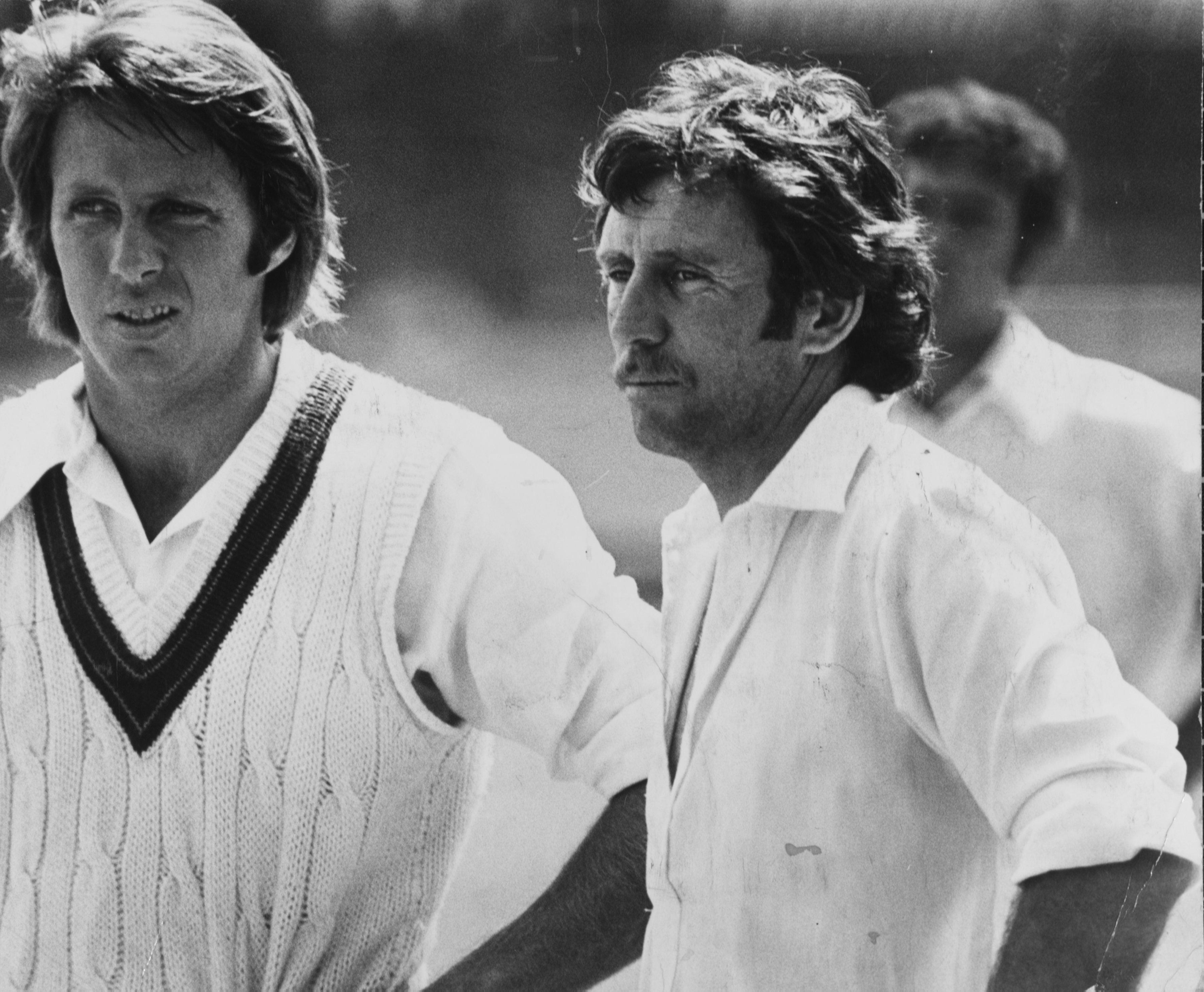
Thomson, left, and Ian Chappell
NEWS GROUP NEWSPAPERS LTD
The rest of the tour only got worse. The third Test in Melbourne ended in a thrilling draw, with Australia eight down but only eight runs from victory, but England expended a lot of energy in the cause.
Denness even recalled seeing Lloyd, who posted a century stand with Amiss in the second innings, visibly shaking after returning to the dressing room, suffering from what can only have been a form of shellshock. After the game, Denness took the extraordinary step of dropping himself for Sydney, although he would return and score runs in England’s consolation win in the final Test.
Lloyd’s misfortunes were not over. In a match against New South Wales before the fifth Test, he was fielding at short leg when he ricked his neck taking evasive action as Alan Turner went to hook Bob Willis. “I jerked my head to one side and it stayed in that position. After that, whenever I was in the team room or at the hotel I had to wear this hydraulic contraption on my shoulders that stretched my neck.
“By the time I got back to England it had set. I couldn’t stand sideways [at the crease], so I stood very much square-on from then on, which actually helped me a bit. You disregarded front-foot drives through extra cover, but if anybody bowled short you were in a great position to cut, or shovel it through mid-wicket, or sweep. I had two operations on my neck, one of which went wrong, and I still have problems with it now.”
There is a coda to this winter-from-hell story. Lloyd was not picked for any of the Tests the following summer, also against Australia, and in fact never played Test cricket again, but he did captain Lancashire to victory in the Gillette Cup final. This led to him making visits to local cricket clubs to show off the trophy, during which he would relate some dressing-room tales. These appearances went down so well that they soon morphed into after-dinner speeches to bigger audiences that proved an even bigger hit. The comedic career of David “Bumble” Lloyd was born.
Naturally, tales from his Australia tour featured prominently in his talks, and especially the one about how Thomson nearly deprived him of his manhood. A line about him asking Bernard Thomas to “get rid of the pain, but keep the swelling” was a fictional add-on, but always brought the house down.
Lloyd and Thomson have many times since shared a commentary box, and often a stage, usually at breakfast events during tours to Australia, when they would dispense yarns while Thomson turned the air blue with language that most speakers would never get away with.
Even then, Thomson still seemed to get the final word. “He gets the shits with me, Thommo,” adds Lloyd, who will be in Australia this winter from the third Test onwards doing media work. “I love him to bits but I don’t think he’s keen on me because he keeps saying, ‘He’s been making money out of me hitting him in the bollocks, when the bloke has no talent’. You just have to shrug your shoulders and let it go.”
The Ashes: First Test
Optus Stadium, Perth
Starts Friday, 2.20am
TV TNT Sports