
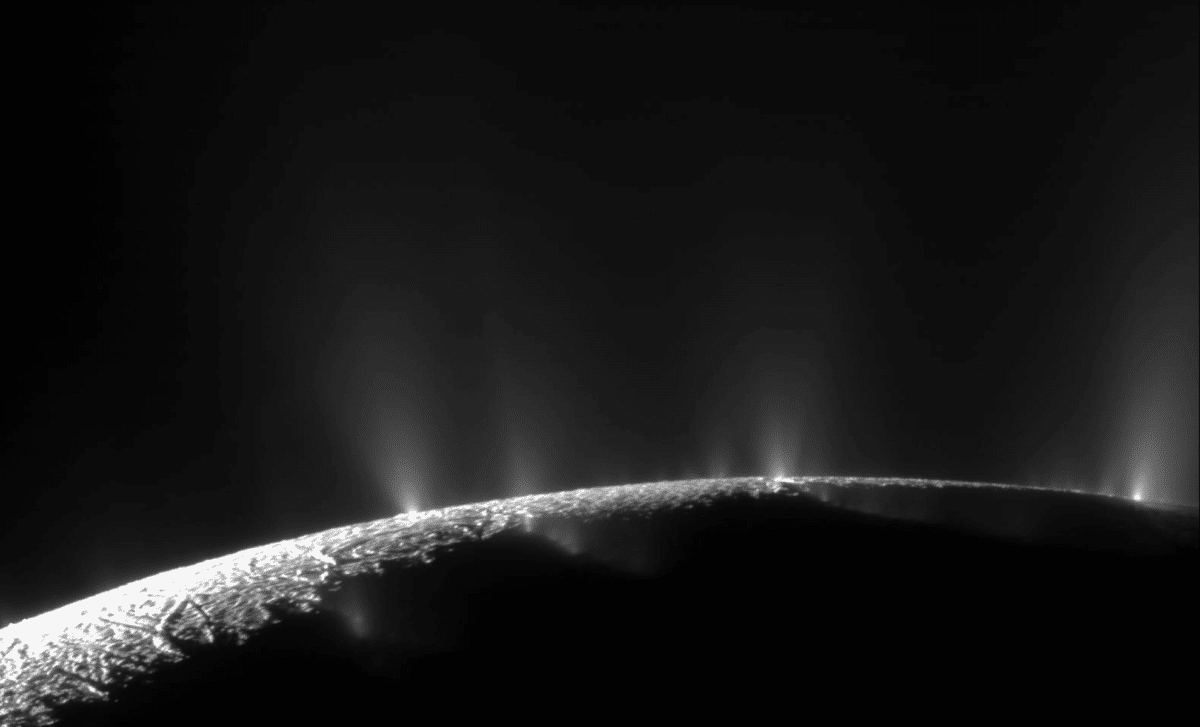
In a groundbreaking study, NASA’s Cassini mission reveals new discoveries about the organic chemistry on Enceladus, one of Saturn’s moons. Published Wednesday in Nature Astronomy and further detailed in a NASA article, the findings show how freshly ejected particles from Enceladus’ subsurface ocean could hold clues to the possibility of life beyond Earth. This new analysis adds to the growing body of evidence suggesting that Enceladus may harbor the conditions necessary for biological processes.
Fresh Organic Compounds From Enceladus’ Ocean
NASA’s Cassini spacecraft, which spent over 13 years exploring Saturn and its moons, has provided scientists with extraordinary insights into the potential for life in the outer solar system. The recent study published in Nature Astronomy and explored in greater detail by NASA focuses on organic molecules found in particles ejected from Enceladus’ icy plumes. These plumes, originating from the moon’s subsurface ocean, have long intrigued researchers due to their potential to harbor chemical ingredients necessary for life.
One of the key revelations of the study is the discovery of organic compounds that were just minutes old when collected by the Cassini spacecraft. These findings contrast sharply with earlier data, which had shown organics that were years old and potentially altered by intense radiation. Nozair Khawaja, lead author of the study from the Freie Universität Berlin, explains:
“Previously, we detected organics in ice grains that were years old and potentially altered by the intense radiation environment surrounding them. These new organic compounds were just minutes old, found in ice that was fresh from the ocean below Enceladus’ surface.”
This fresh data represents a significant leap forward, providing more accurate insights into the chemical composition of Enceladus’ ocean and its potential to support life. These newly discovered organic molecules are part of a complex family of compounds that could serve as building blocks for more complex biochemical processes—just the kind of chemistry astrobiologists are searching for when exploring distant moons.
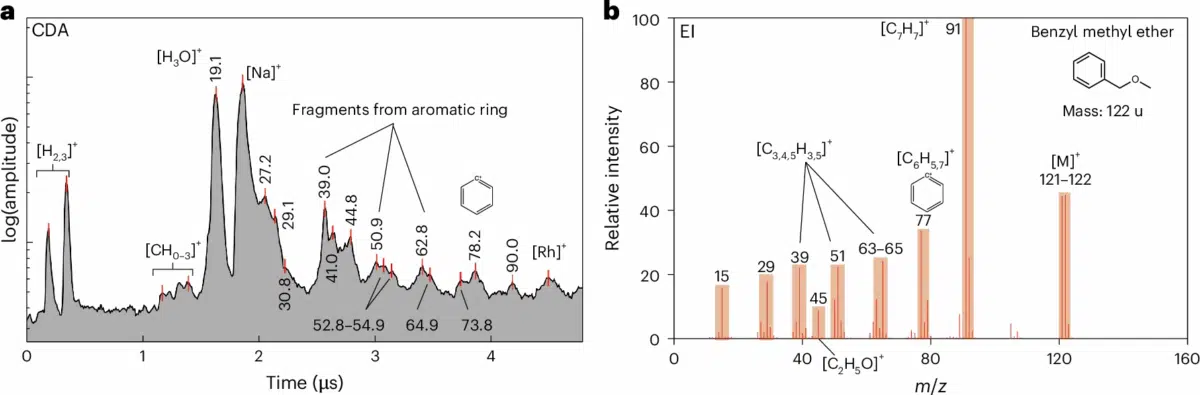 a, CDA mass spectrum of a single plume ice grain characteristic of monocyclic aromatic compounds. b, An EI spectrum of benzyl methyl ether, which exhibits similar spectral features. Note that, for all figures, mass values are assigned to organic-related, and other notable, peaks to account for differences in the x-axis parameters between CDA and standard EI mass spectra.
(Nature Astronomy)
A Step Closer to Understanding Enceladus’ Habitability
Enceladus has long been a prime candidate in the search for extraterrestrial life. Beneath its frozen surface, scientists have found evidence of a global ocean, warmed by tidal forces from Saturn’s gravity. The presence of water, energy, and key chemicals in this subsurface ocean makes Enceladus a fascinating target for astrobiology. With these new findings, the focus shifts to understanding whether the ocean’s organic chemistry could lead to the formation of life.
Frank Postberg, coauthor of the study, further elaborates on the importance of these findings:
“These molecules we found in the freshly ejected material prove that the complex organic molecules Cassini detected in Saturn’s E ring are not just a product of long exposure to space, but are readily available in Enceladus’ ocean.”
This suggests that organic molecules essential for life may be abundant and accessible in the moon’s subsurface ocean, without the need for the extended exposure to space radiation that was previously considered necessary for their formation.
Scientists are now tasked with understanding how these organic molecules interact with the ocean’s chemistry. The possibility that they could participate in complex biochemical reactions opens exciting avenues for the study of life in environments far different from Earth.
The Role of Cassini’s Groundbreaking Flybys
Cassini’s mission is known for its incredible flybys, each one providing invaluable data about Saturn and its moons. During one particular flyby in 2008, Cassini passed through Enceladus’ icy plumes at an astonishing speed of 11 miles per second (18 kilometers per second). This rapid flyby allowed the spacecraft to collect pristine samples of ice grains directly from the plume, providing a closer look at the chemistry of the particles before they had a chance to be altered by space radiation.
The energy from Cassini’s high-speed encounter caused the ice grains to vaporize and ionize, enabling scientists to analyze them using the spacecraft’s mass spectrometer. This technique provided detailed data on the composition of these particles, offering a glimpse into the active chemistry happening in the moon’s ocean.
The study’s ability to examine these fresh organic compounds has added an important layer to our understanding of Enceladus, reinforcing the idea that the moon’s ocean is not only capable of supporting complex molecules but may also be active with ongoing chemical reactions.
Enceladus and the Search for Life Beyond Earth
The detection of organic molecules on Enceladus is a significant step in the search for life beyond Earth. Organic molecules, which form the backbone of all known life, are crucial in understanding the potential for life elsewhere in the solar system. Enceladus, with its active ocean and chemical diversity, is emerging as one of the most promising places to search for extraterrestrial life.
These recent findings bolster the idea that life could exist in environments very different from Earth, such as icy moons orbiting distant planets. As researchers continue to study the compounds found in Enceladus’ plumes, they will refine their understanding of how life might arise under extreme conditions. The discovery that fresh organic molecules are being formed in Enceladus’ ocean suggests that this distant moon may hold even more secrets, waiting to be uncovered by future missions.
The Legacy of the Cassini Mission
The Cassini spacecraft has revolutionized our understanding of Saturn and its moons, providing critical insights into Enceladus, Titan, and the surrounding rings. Launched in 1997, Cassini’s 13-year mission was a collaboration between NASA, the European Space Agency (ESA), and the Italian Space Agency (ASI). The spacecraft’s daring flybys, including the one through Enceladus’ plumes, have enabled scientists to gather crucial data that will shape the future of space exploration.
Although Cassini’s mission ended in 2017, its legacy lives on through the data it collected, which continues to influence research in astrobiology, planetary science, and the search for life beyond Earth. The discoveries made through Cassini’s exploration of Enceladus will undoubtedly guide future missions to icy moons and planets in our quest to answer one of humanity’s oldest questions: Are we alone in the universe?