
Harvey joins the cohort
Harvey, an AI platform, is being launched at four major law schools in the UK, for students to use in the classroom and for assignments.
The University of Law, King’s College London, Oxford University Faculty of Law, and BPP University have partnered with Harvey, to integrate AI into their legal courses. It follows the adoption of Harvey in over 25 law schools in the US, including the likes of Stanford, University of Chicago and Notre Dame Law School.
“Harvey is helping us give every one of our students and staff the opportunity to engage directly with the technologies transforming legal practice,” said Professor Dan Hunter, Dean of The Dickson Poon School of Law at King’s College London. He added that it would ensure “AI literacy is not a specialist skill but a core element of modern legal education that prepares our graduates to lead the profession in an era defined by LLMs and AI systems.” As long as it doesn’t end up replacing them.
The use of AI is now prevalent across City firms. Allen & Overy (pre-merger with Shearman) and Macfarlanes were early adopters of Harvey, having partnered with the technology business in 2023. This year Shoosmiths sought to encourage staff to use Microsoft Copilot by providing an extra bonus pot of £1million, if they collectively make one million ‘prompts’ on the AI tool.
For its law school program, Harvey states that it can help students “draft and refine briefs” and “prepare for discussions and oral arguments with suggested questions and positions”, much like a class swot helpfully allowing other students to crib his notes:
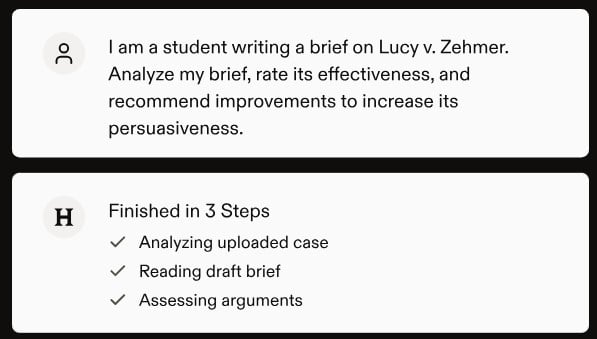
Harvey has “an AI-powered legal tutor” as well, which allows students to “ask simple questions to study for exams”.
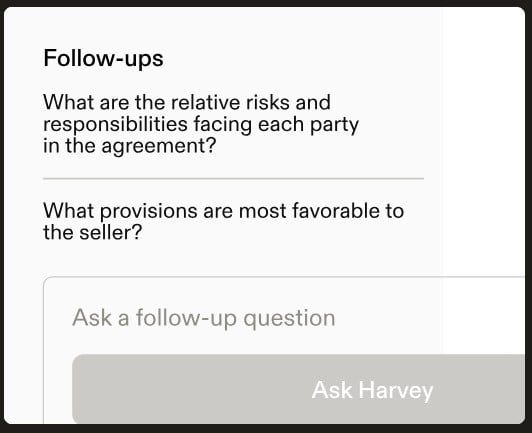
Some human tutors might be worried this could mean Harvey is after their jobs; but he’s also seeking to ingratiate himself in the staff common room, by giving teachers “hands-on class assignments that connect concepts to practice”:
RollOnFriday asked the University of Law how they planned to roll-out Harvey. A spokesman said that students would not be “outsourcing their legal education to AI but using it as a tool to assist them”.
The ULaw spokesman said that, in reality, students often start an assignment with a Google search as they have “grown up with it”, instead of an approved legal database. However, they could now use Harvey as a “much more reliable yet still familiar and accessible starting point.”
AI will also be used in SQE workshops at the university where it can create “a great first draft” of written clauses, for students to “review and critically analyse”, thus freeing them up to “cover much more ground” in the session. And Harvey can summarise long and complex documents, to also save time.
As a practical example, a ULaw student could be set the task of having to organise a bundle, “the sort you’d get on day one of a training contract”, and they could then ask AI to check and query its contents.
“This is where the profession is heading,” said the ULaw spokesman, “towards the ‘one-screen lawyer,’ someone who knows the law but also knows how to make sense of the knowledge around them and use the tools that bring it all together.”
Peter Crisp, Deputy Vice Chancellor of law at ULaw said: “We encourage students to question AI, use it wisely, and to apply it confidently in both legal practice and everyday life”.
ULaw’s approach seems sensible given that firms have said that expert supervision is still required, and the SRA has warned lawyers not to rely on machine learning.
And while it’s not uncommon for students to experiment at university, they should be wary that it’s not just drugs that can cause hallucinations.