
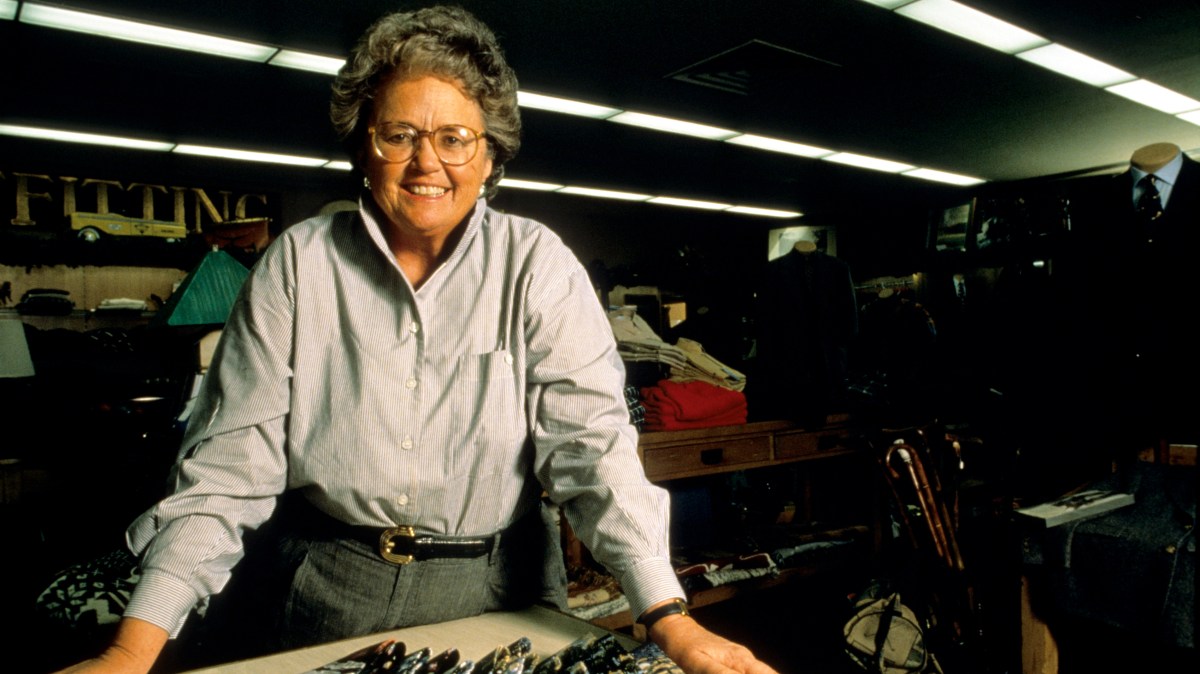
A life devoted to playing, promoting and regulating American golf was a privilege and pleasure for Judy Bell that required the occasional sacrifice.
Bell was in Paris in 1994, acting as a chaperone to a promising teenager named Tiger Woods while he competed in the World Amateur Team Championship. Feeling homesick, the Californian decided he wanted to eat at McDonald’s. Every day.
It was not the gastronomic option that Bell had in mind for her visit to the French capital, but she indulged Woods and gamely munched fries with him. The sated starlet helped to drive the United States to victory. “Tiger was just a kid. And he was a good kid,” she recalled to a journalist.
Such supportive behaviour was characteristic of an administrator who was often called “the First Lady of Golf”. This was both the name of an accolade bestowed on her by the Professional Golfers’ Association of America in 2001 for her service to the sport and a nod to her history-making status. In 1996, Bell became the first female president of the United States Golf Association (USGA), which was founded 102 years earlier.
Despite the sport’s stubborn traditionalism, her appointment was mostly seen as logical rather than controversial, for the affable and voluble Bell enjoyed the respect of colleagues across the globe and within a national governing body she served for decades. She had volunteered for various USGA committees since 1961 and officiated at important tournaments. In 1987, she became the first woman elected to the USGA executive committee.
Bell’s pioneering ascent did not immediately open the doors of the world’s most exclusive and exclusionary clubhouses. In 2003, the Masters attracted a high-profile protest by a women’s rights group against the Augusta National club’s all-male membership. Augusta National did not admit its first female members until 2012. The USGA, meanwhile, did not appoint its second woman president until 2016.
USGA presidents were typically afforded honorary membership of the Royal and Ancient (R&A) Golf Club of St Andrews. Instead, the club, which at the time only admitted men, presented Bell with a gemstone brooch. Her treatment was referenced by Baroness Crawley in the House of Lords as an example of “a surprisingly strong and persistent set of prejudices against women in modern Britain” by private clubs during a 2002 debate on proposals to amend the Sex Discrimination Act of 1975. “In that instance, diamonds rather than men seemed to be a girl’s best friend,” the Labour peer observed.
Peter Dawson, the R&A secretary at the time, insisted that ending the all-male rule, even for someone as eminently qualified as Bell, would have smacked of “tokenism” and “social engineering”. While others pressed her case on behalf of women everywhere, Bell was far too polite and diplomatic to kick up a fuss. “I don’t care if Augusta is all men. I am comfortable with separation,” she told The Times in 2003. “Men or women have a right to decide who is in their club … I can’t see how being a member of the R&A could affect the way I functioned. I was welcomed there. I was comfortable. I didn’t have any trouble asking hard questions.”

Bell playing at the USGA Women’s Golf Tournament at the Lakewood Country Club, Denver, in 1965
AP
Answering patronising queries was another matter. At an Open Championship dinner during her tenure as president, she sat next to a R&A member who was “sort of full of himself”, she wrote in her 2002 autobiography, Breaking the Mold. “And what exactly do you do with the USGA?” he inquired. When she told him, “the fellow almost fell off his chair, but he was condescending to me as a woman, I thought, and he had pushed my buttons a little too much.” In 2014, the R&A voted to admit its first women members. It made Bell an honorary member the following year, 14 years after her induction into the World Golf Hall of Fame.
Judith May Bell was born in Wichita, Kansas, in 1936, to Carl, a grocer and meat wholesaler, and Mariam (née Champlin), a president of the Kansas women’s golf association. Judy, who took orders and worked on the cash register at the shop from the age of ten, was the youngest of four children and the only girl. “We had a basketball court out in back — a goal up on the garage — and we played basketball,” she told the Colorado Golf Association. “It wasn’t like, ‘She’s my little sister, don’t push her.’ There was none of that stuff. They beat me up. Honestly, I got toughened up by them. When I became president of the USGA, my three brothers would equal the board, so to speak. They got me ready.”
She co-founded a student basketball league for girls, but golf was her primary obsession, and she soon became a leading amateur. Her parents covered her costs so she could participate in tournaments as far afield as Florida, with impeccable conduct expected in return. Her mother once saw Bell throw a club at the driving range and grounded her for a week.
Bell became the Kansas women’s amateur champion at the age of 15. Fitting her studies around her blossoming game, she graduated from Wichita State University in 1961 with a psychology degree. In 1964, she set a single-round record at the US Women’s Open at San Diego Country Club with a six-under score of 67. The mark stood for 14 years. Bell played on the US Curtis Cup teams that claimed convincing victories over Great Britain & Ireland in 1960 and 1962, but captained her country to two heavy losses in the prestigious amateur contest in 1986 and 1988.
The Ladies Professional Golf Association was founded in the US in 1950, but Bell remained an amateur, going into business as a clothing retailer. She co-owned retail outlets linked to a golf resort in Colorado Springs with her close friend, Barbara McIntire, an outstanding amateur player.
The USGA awarded Bell its highest honour, the Bob Jones Award for distinguished sportsmanship, in 2016. She is survived by four nephews and three nieces. The centrepiece of her two-year stint as USGA president was the establishment of a more-than $65 million [about £49m today] grassroots grants programme that continued her long-term efforts to make the game more accessible to disadvantaged and underserved communities. “I’ve never looked at golf in a gender way,” she told The Washington Post in 1997. “I’ve played golf with boys and men all my life. In my heart, I believe golf is for everyone.”
Judy Bell, golf administrator and player, was born on September 23, 1936. She died after a long period of declining health on November 3, 2025, aged 89