
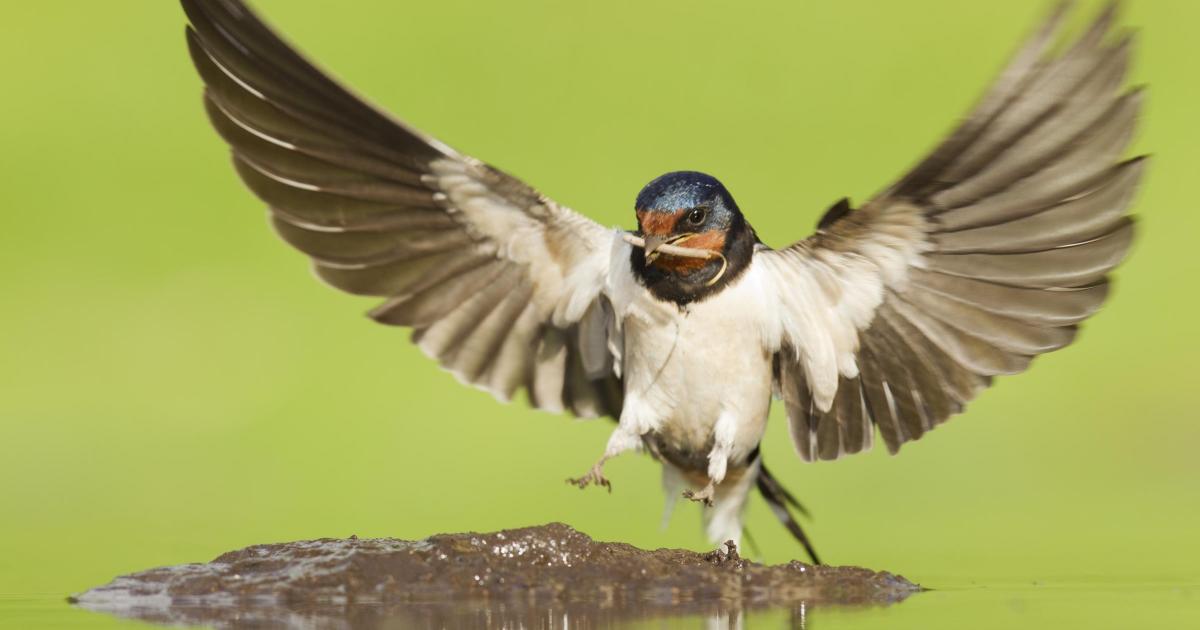
Fledgling survival among swallows is very low; recruitment to the breeding population the next spring, far lower still. By now this swallow, who spent half a minute in my hair, may well be dead. Certainly, if alive, the swallow has no memory of me. But for me the encounter was profound. And I would like to imagine that this swallow – bound so fleetingly to me – is still alive.
I would like to imagine that this seeming fragile bird is now far south in Africa. Perhaps it woke this morning, in a stand of reedy grasses by a swamp, among a bustling flock of other swallows. Perhaps it heard the wild whoops of hyenas in the night, the deep grunt of a lion. Perhaps it’s swooping, as you read, above the glossy rumps of buffalos by a muddy pool. Or else above a schoolyard, where white-shirted children hurtle noisily beneath the sweaty sun.
Four months ago, this ink-backed bird was egg yolk in a Norfolk nest of grass and mud. Two months ago it tumbled from its nest and landed in my hair. And now – I hope with all my being – it is in Africa, its calls lost among the grating guineafowl and the constant purr of ring-necked doves. If this is not a miracle, I do not know what is.
It is November. Marshes all around our Norfolk coast and in the Broads and Fens are bright with wigeon now. They too are miracles. The UK’s winter population, numbering almost half a million birds, has mostly bred in Russia or in Scandinavia, often in the northern margin of the taiga forest, where trees give way to permafrost and tundra. Here, in spring, each female chose a boggy pool by which to nest. She made a little hollow, lined with grass and down, and laid a clutch of ice-white eggs.
Wigeon. (Image: John Asheton)
Her golden-headed ducklings – hatched after 25 days of incubation – spent six weeks growing in these lonely wetlands of the north. Unlike the swallows in the passage by my home, they fed themselves from hatching, zooming across peaty water, hunting summer swarms of midges. At just under 50 days of age they learned to fly and, barely any older, migrated south to us.
And here they are, with us, in Norfolk. On the south edge of the tundra, these young wigeon lived and grew beside the wolverine, the brown bear and the elk. Here they share our Norfolk marshes with great flocks of lapwings, starlings, teal and golden plover, drawn from breeding grounds across the north of Europe to our mild Atlantic winter. Each is a miracle. ‘After all,’ Rohinton Mistry writes, ‘who is to say what makes a miracle and what makes a coincidence?’
We can blunder through our lives, meeting our material needs, seeing pretty things, and even sometimes having swallows land right on our heads, and never once perceive a miracle. Or we can stand in awe of nature all around us and within us. We can look with wonder on the Earth and all the beings who share it. We can thank – aloud and unashamed – the soil, the rain, the sun, the grass, the seasons and the tide for all the miraculous gifts they give us.
We can live with miracles. Because we do.
Go outside – do it, right now – and find 10 miracles. It won’t be hard. For miracles are everywhere. It’s just the knowledge of them we’ve lost. Through generations without number, humans have sat beneath the stars in wonder. Our ancestors have marvelled at the autumn coming of the geese and ducks, so fat from summer on the unknown tundra, so good to eat. They’ve spoken to the plants and trees, asking them for healing. And made offerings to the streams, the sun, the fleet-hoofed herds.
I am not suggesting we return to pre-scientific understanding of the world. Quite the opposite. For scientists see miracles everywhere. This is why they look, and look again, and ask, until they understand. Nor am I advocating wishy-washy rituals based – at best – on flimsy knowledge of our ancient forebears and their cultures.
I’m merely saying we live with miracles, if we know to look. And that this looking makes the whole world new. More crucially – at this time of escalating climate change and catastrophic biodiversity decline – looking for miracles binds us to the living world. Not in an abstract way, but in a way that’s lived and felt and known deep in our intermingled genes, in the water flowing through us all, the sun-forged sugars in our blood, and in the whistling wigeon hordes that pluck our coastal marshes’ muddy grass.
Swallows hatched and raised in Norfolk this year will have already migrated to Africa. (Image: Jon Hawkins, Surrey Hills Photography)
Two months ago, a fledgling swallow landed on my head and our two lives were – briefly but forever – bound. Now – how I hope – this swallow is 6,000 miles away in Southern Africa. In my mind I’ve travelled with this dauntless little bird: from my open kitchen door, across the Mediterranean and Sahara, and down through Africa’s fertile fields and forests.
Everywhere we’ve flown is changing fast, every habitat we’ve visited in some way threatened. These bare facts threaten my little swallow too – my miracle – and all its kind, and all the countless miracles that bless our lives. In seeing miracles we’re bound not only to our planet and its living things but also to the gathering battle for them all. Beyond the wonder and the awe, we see a duty to our fellow beings and to the miraculous places where they live.
Go out. Find miracles. See nature – so familiar – all anew. And make yourselves a promise, never to stop seeing miracles. Nor ever to stop fighting for them all.