
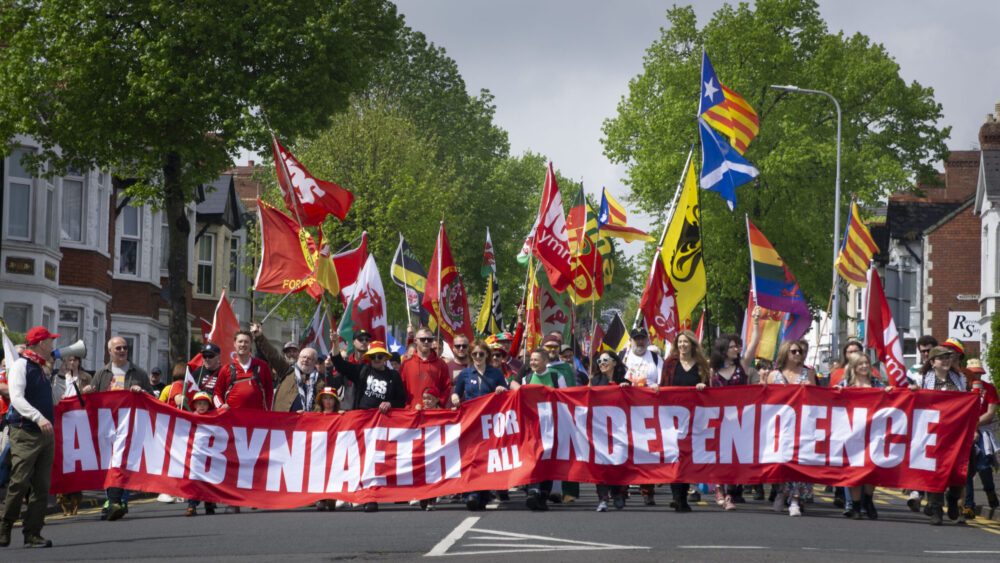
 March for Independence in Barry. Credit: YesCymru
Rob Hughes, director YesCymru
It was with great interest recently, that we read Mike Hedges’ take on independence in his article for Nation.Cymru.
Mike has historically been averse to the further transfer of powers to the Senedd and has been vocal about his opposition to the transfer of the Crown Estates to Wales, claiming that any transfer will automatically directly affect the Block Grant.
In the case of Scotland, contrary to what Mike has said, this is not true. In Scotland a separate fiscal arrangement has been agreed with Scotland contributing a set figure per annum, rather than having a reduction in the block grant.
So, when Mike questions whether Wales should be independent, it is worth questioning his motives. But better still, let’s take him on over the reasons he has given for deciding independence is not in Wales’ interests.
Currency
Mike asks what currency an independent Wales would use. The answer to that is the currency that we, as a nation, want to use. There are numerous examples. Currently there are 180 different currencies used in the world, it is completely feasible for Wales to create and use its own currency, giving us full fiscal control and allow us to set interest rates and manage inflation.
A good example of how effective this can be is looking at economic recovery in Iceland after the banking crisis of 2008. This could be pegged to another currency, as in the case of Ireland after independence. We could also use currency substitution. A number of countries use other countries’ currencies, with El Salvador, Ecuador, Timor-Leste, Marshall Islands, Palau and Micronesia using the US Dollar, and Kosovo, Montenegro, Andorra, San Marino, Vatican City and Monaco using the Euro. So, the question of currency is not an obstacle to independence, rather an opportunity to follow a path that best suits an independent Wales.
A Central Bank
Mike asks what the central bank would be to act as Lender of Last Resort and set interest rates. Regardless of which currently path we choose, Wales will need a Central Bank. Its role will be dependent on the choice of currency path we choose. With our own currency, our Central Bank will be the lender of last resort. If we don’t have our own currency, our Lender of Last Resort will be the bank that issues the currency we use, for example the ECB (European Central Bank) or the Bank of England. Again, these are established practices across the world, with each having their own advantages and limitations.
Civil Service
An independent Wales will still require a Civil Service. We may decide to outsource some of our requirements. It is possible that the Remaining UK (rUK) will also outsource some of its requirements. UK Passports are currently produced in Poland. The Royal Mint, until recently has been supplying over 60 countries’ coin currencies. The rUK, as will Wales, will continue to require DVLA and Royal Mint, with the expertise and infrastructure already in place. If not, the transfer of English-based agencies to Wales will compensate for any loss. However, we do need to build our private sector to support our public sector. It is worth noting that, if currently, our Private Sector needs strengthening, that is a result of UK membership which has failed to develop the economy in Wales and will continue to do so. Full control of our Civil Service will be a benefit to Wales, as Mike seems to recognise.
Armed Forces
The Armed Forces in Wales have a proud history. As Mike points out, Wales is over-represented in the British Armed Forces, with 7% of personnel for 5% of the population.
One of the most important functions of government is to protect its citizens. Defence goes beyond fighter jets and warships – it also involves safeguarding people from harm in all its forms, whether from military threats, natural disasters, or cyberattacks. What Does Wales Need Defending From? On paper, Wales is situated in one of the safest regions in the world. While we do not face a high risk of attack, the global security landscape is more uncertain now than at any time since the 1930s. It is unclear whether NATO can still depend on the United States to play a full role, and the implications of this for the alliance remain uncertain. Reducing reliance on the US will require making defence a higher priority than it has been in the past.
Old threats have also resurfaced, such as an expansionist and aggressive Russia, while new risks are becoming increasingly significant. These include: Climate change – leading to flooding, coastal erosion, wildfires, and extreme weather events, cyberattacks – targeting critical infrastructure, businesses, and public services and Online misinformation campaigns – designed to destabilise democracies and influence elections. Some nations operate without a standing military.
For example, Costa Rica (population 5.2 million) has not had a military since 1949, and Iceland has been without one since 1869. However, if Wales were to establish its own defence force, what might it look like? What Would the Welsh Defence Forces Do? While the military would have a combat role, it would also play a key role in supporting foreign policy.
Decades of UK foreign policy failures – from the Iraq War to the chaotic withdrawal from Afghanistan – have damaged Wales by association. Independence would allow Wales to take a different approach, focusing on peacekeeping and disaster relief. Wales could follow Ireland’s example by becoming a centre of excellence for humanitarian military training, while also supporting domestic priorities.
It is worth noting that the UK ranks 12th in the world for military spending per capita.41 Despite no regiments being based in Wales, the UK Government spends a proportional £2.7 billion per year on defence in Wales42 – more than annual spending on education (£2.2 billion in 2023/24) and over six times the policing budget in Wales (£434 million in 2023/24). The Irish Defence Forces budget is approximately €1.3 billion per year.
If Wales were to join NATO and meet the alliance’s 2% of GDP target, its defence budget would be around £1.7 billion per year.44 An independent Wales could also introduce constitutional safeguards limiting politicians’ powers to send troops into combat. In the UK, the Prime Minister can deploy forces without parliamentary approval. A Welsh constitution could ensure that the Senedd must approve any use of war powers.
National Debt
How Much of the UK’s National Debt Would Wales Inherit? A common question about independence is whether Wales would be burdened with a share of the UK’s national debt. As of 2023, the UK’s national debt stands at over £2.7 trillion, much of which has been built up over many years due to decisions made by successive UK governments.
This argument has been used in the context of Scottish independence as the UK has not signed or ratified a treaty called the Vienna Convention on the Succession of States with respect to State Property, Archives and Debts. 50 J Fitzgerald, S. Kenny, “Till debt do us part”: financial implications of the divorce of the Irish Free State from the United Kingdom, 1922–1926, European Review of Economic History, Volume 24, Issue 4, November 2020, Pages 818–842.
There is no rule saying Wales must take on any of this debt – it would be part of negotiations. Some nations, like Ireland after 1922, took on little or no UK debt when they became independent to smooth the creation of Northern Ireland.50 Some nations have agreed to take on a share, but this was often balanced by receiving assets such as foreign reserves, infrastructure, or state-owned institutions. Independence would give Wales control over our own borrowing based on our needs. This means we could decide where to invest, whether in infrastructure, public services, or growing our economy.
A question that Mike seems to have missed is that is we take a share of national debt, we would entitled to 5% of national assets, which would be of great net value to an independent Wales.
Customs Union
An independent Wales would be an outward looking nation and would look to create customs unions which work for the people of Wales, not only with rUK but also with the EU. Although membership of customs unions will ultimate be in the hands of the Welsh electorate, we foresee a constructive and open approach to seamless daily cross-border for travel and work, such as the Nordic Passport Control Agreement between Norway, Finland, Sweden and Denmark and agreements Czechia and Slovakia.
Pensions and other benefits
Mike asks how payments will be made for people who have paid NI contributions when living in both Wales and rUK. Right now, benefits and disability support are controlled by Westminster. This includes payments like Universal Credit, Personal Independence Payment (PIP), Carer’s Allowance, and Jobseeker’s Allowance. The Welsh Government has no power to change these systems. Many people believe the UK benefits system is slow, unfair, and difficult to access, especially for disabled people. Some policies, such as benefit sanctions and strict assessments, push vulnerable people into hardship. An independent Wales could design a system based on fairness, dignity, and efficiency.
For example, we could: Improve support for carers and give GPs more power to assess disability benefits. If resources allow, introduce a universal basic income or a guaranteed minimum income.
Many people worry about whether pensions would still be paid after independence. State pensions would be a key part of independence negotiations. According to Legal & General (24th October 2024, website), State pensions are based on National Insurance contributions. Anyone who has paid into the system should be entitled to their state pension, regardless of where they live. Over one million UK state pensions are paid to people living abroad already.
Private and workplace pensions are also legally protected, meaning they must pay out what members have earned. In the future, Wales could make retirement security a national priority. This could include creating a Welsh state pension, possibly supported by new funding sources like a sovereign wealth fund.
Security and National Bodies
Mike seems to answer the question himself on the basis of border agencies. We agree that they would need to be split up or we co-operate with the UK to provide a cross-border agency.
VAT and Duties
Mike notes that a method will be needed to align these duties in order to stop large-scale cross-border movement of goods. Again, this creates job opportunities in Wales with the added benefit of VAT being paid in Wales will stay in Wales, giving a boost to the Welsh economy.
Mike talks about Project Fear and Brexit. YesCymru look at independence more as Project Hope, offering a real chance for Wales to create positive futures for our citizens, and creates an economy which starts to lift our children pout of poverty.
As for Brexit, an independent Wales is the antithesis of Brexit, with an open and engaging Wales looking to venture out into the wider world, rather than retreating into a corner. So, Mike, we are ready for the challenge, and we are ready for the debate. And let’s make Wales work for everyone in Wales.
Support our Nation today
For the price of a cup of coffee a month you can help us create an
independent, not-for-profit, national news service for the people of Wales, by
the people of Wales.