
Everyone has their own unique approach to cooking the Thanksgiving turkey.
But with time short and oven space at a premium, experts have turned to an unlikely source to find a better way of roasting your bird.
In the comedy classic, Bean, Mr Bean crams an enormous turkey into a microwave – with hilariously disastrous results.
And as baffling as it may seem, Mr Bean may have been on to something.
Scientists say it is perfectly safe to cook your turkey in the microwave, and it certainly won’t explode as Mr Bean’s bird does.
Using the right techniques and proper seasoning, you can make a roast that tastes almost as good as one made in the oven in a fraction of the time.
Dr Primrose Freestone, a microbiologist at the University of Leicester, told Daily Mail: ‘Turkey can be cooked in a microwave, either whole or in parts.
‘But there are some safety points that need to be considered to avoid food poisoning from an undercooked turkey.’
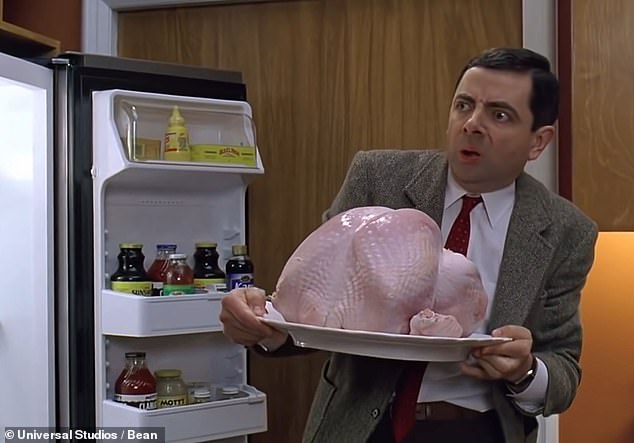
With Thanksgiving just around the corner, busy cooks are looking for any way to save a few extra minutes. Now, scientists say that Mr Bean might have shown us a better way to cook our birds
How to cook a turkey in the microwave
In terms of safety, as long as you heat it all the way through, it doesn’t matter how you cook your turkey.
Dr Freestone says: ‘The turkey is cooked when the food thermometer reaches a minimum internal temperature of 165°F or 75°C in the thickest part of the turkey thigh or breast.
‘Reaching this temperature is essential as this heat will ensure the killing of food poisoning bacteria that may be present on and within the turkey.’
For a large bird like a turkey, it is particularly important to ensure heat penetrates all the way through to the body cavity, which Dr Freestone calls a ‘jungle of food poisoning bacteria’.
So make sure you don’t stuff the bird, or try to cook a turkey that is too large for your microwave.
The United States Department of Agriculture (USDA) says that a 5.4 to 6.4 kilogram (12–14 lbs) turkey is the maximum that should be cooked in a microwave.
Make sure there is about two to three inches of clearance around the bird at the top and sides.
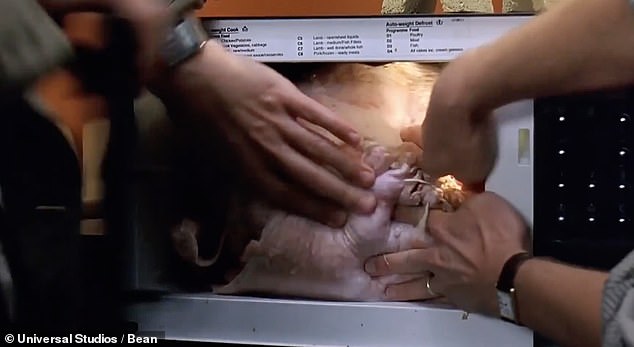
In the comedy classic, Bean, Mr Bean crams an enormous turkey into a microwave – with hilariously disastrous results. But experts say this would really work
How to safely cook a turkey in the microwave Take a turkey that is no larger than 6.4 kilograms, season thoroughly, but do not stuff the cavity.Place the turkey inside a microwave–safe steam bag and rest on a plastic or ceramic tray.Microwave turkey for 22 minutes per kilogram (10 minutes per pound), rotating every 15 minutes if needed.Check the temperature of the thigh and breast, and cook further until both reach 75°C (165°F).Once cooked, rest for 20 minutes before carving. <!- – ad: https://mads.dailymail.co.uk/v8/us/sciencetech/none/article/other/mpu_factbox.html?id=mpu_factbox_1 – ->
Advertisement
This is probably where Mr Bean went wrong, stuffing a huge bird into the small appli
For the best results, season the turkey thoroughly and place it in a microwave–safe plastic bag with plenty of aromatics.
This will keep all the steam in and distribute the heat evenly so that you get a juicy and flavourful ‘roast’.
To cook it thoroughly, place the turkey in the microwave and set it to 50 per cent power for about 22 minutes per kilogram (or 10 minutes per pound).
If your microwave doesn’t rotate, take it out and turn it around every 15 minutes to ensure it is heated evenly.
Once the time is up, check the thickest part of the breast and thigh with a meat thermometer.
It is really important that you check the internal temperature of the bird since different microwaves will cook at different rates, and you need to ensure it reaches a safe level.
If it is ready, remove it from the microwave and let it rest for 20 minutes before carving.
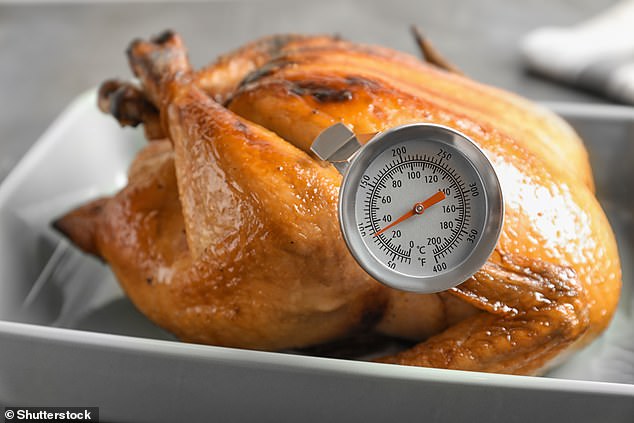
The turkey is cooked when the food thermometer reaches a minimum internal temperature of 165°F or 75°C in the thickest part of the turkey thigh or breast. This should take about 22 minutes per kilogram in the microwave (stock image)

According to the USDA, you shouldn’t microwave a turkey that is larger than 5.4 to 6.4 kilograms (12–14 lbs). That means Mr Bean’s enormous turkey
Is this safe?
Although cooking a turkey with a microwave might sound dangerous, there is no reason to be concerned.
Microwaves are a form of electromagnetic radiation, just like visible light, but with a significantly larger wavelength.
This type of radiation is readily absorbed by the water molecules in our food, which causes them to vibrate.
As the molecules vibrate, they heat up and cook the food from the inside out.
Even though you are blasting your food with quite powerful radiation, this isn’t the same type of radiation that produces lingering harmful effects.
Unlike so–called ‘ionising’ radiation, microwaves don’t cause molecules to become radioactive.
That means eating turkey that has been cooked in the microwave is no more dangerous than one that was cooked in the oven.
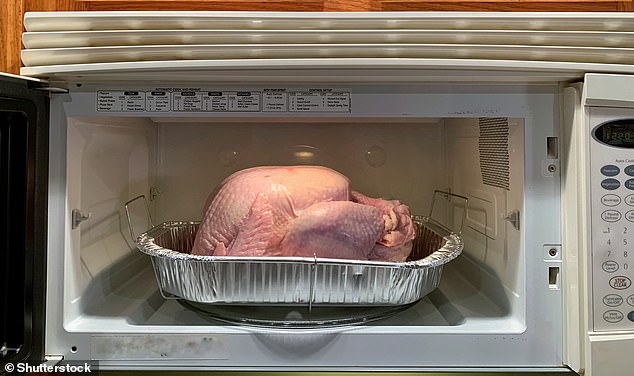
Cooking a turkey in the microwave is perfectly safe so long as the meat reaches the right temperature. Remember, do not put anything metal in the microwave
Remember, do not put anything metal in the microwave since the electromagnetic radiation from the microwaves will produce powerful sparks.
That means you must not place your turkey on a metal roasting tray or use a leave–in meat thermometer.
The only potential danger of using the microwave is that the meat won’t cook evenly, and there will be some cooler areas where bacteria can thrive.
That means cooking an entire large bird does have an increased risk of food poisoning if you don’t want to overcook some parts of the animal.
Dr Freestone added: ‘I would never cook a whole chicken or turkey just in the microwave as you can’t be sure how far the microwave heat penetrates into the bird’s gut cavity.
‘Turkey joints can be cooked in a microwavable dish with a lid or clingfilm cover.’
TIPS FOR AVOIDING GETTING FOOD POISONING
1. Keep a clean work space
Germs can survive across all of the different surfaces in the kitchen, so it’s essential to keep the cooking area and your hands clean.
2. Avoid cross-contamination
Raw meat, poultry, seafood and eggs can spread germs to ready-to-eat foods if not kept separate.
The CDC recommends using separate cutting boards and plates when handling these ingredients.
They should also be stored separately in the fridge.
3. Use a thermometer
To cook food safely, the internal temperature must get high enough to kill the germs that could cause food poisoning.
The correct internal temperature varies by ingredient, and only sure-fire way to tell if food is safely cooked is to use a food thermometer.
4. Store food properly
Storing food properly is essential to combating harmful bacteria.
Perishable food should be refrigerated within two hours of when it was purchased, and the refrigerator should be set to below 40°F.
5. Don’t rely solely on expiration dates
Expiration dates aren’t the only indication of when a food item should be thrown away.
If something seems to have a strange smell or colour, it’s probably better to be safe and pitch it.
6. Don’t thaw frozen food on the counter
Thawing frozen foods on the counter allows bacteria to multiply quickly in the outer parts as they reach room temperature.
Frozen foods should be thawed in the refrigerator, in cold water, or in the microwave.