
Article Summary: The Tiny “Mini Shuttle” China Fears Most: What the X-37B Really Does
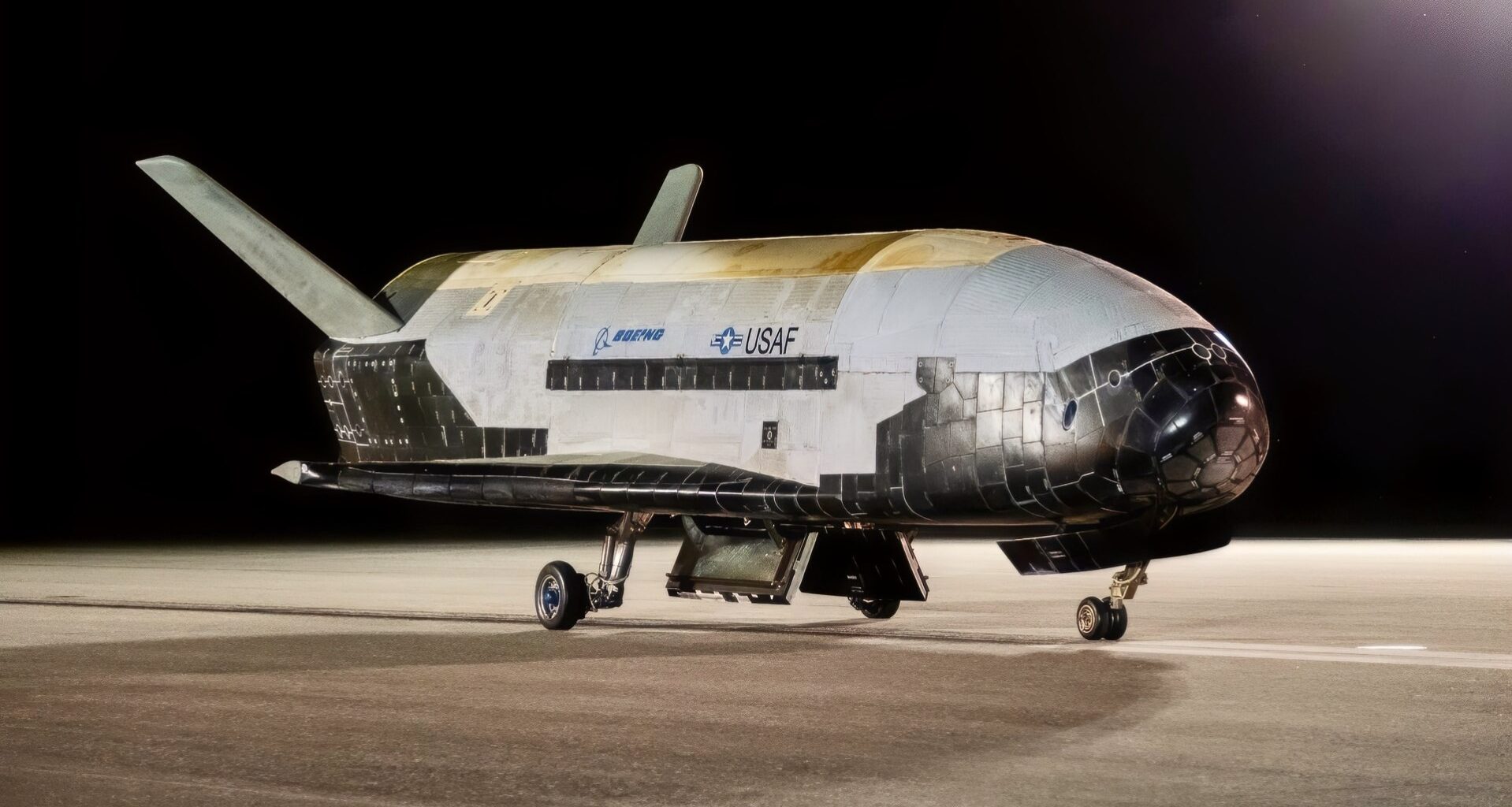
-America’s X-37B space plane looks like a scaled-down shuttle, but it has become one of the most consequential military programs of the post-Cold War era.
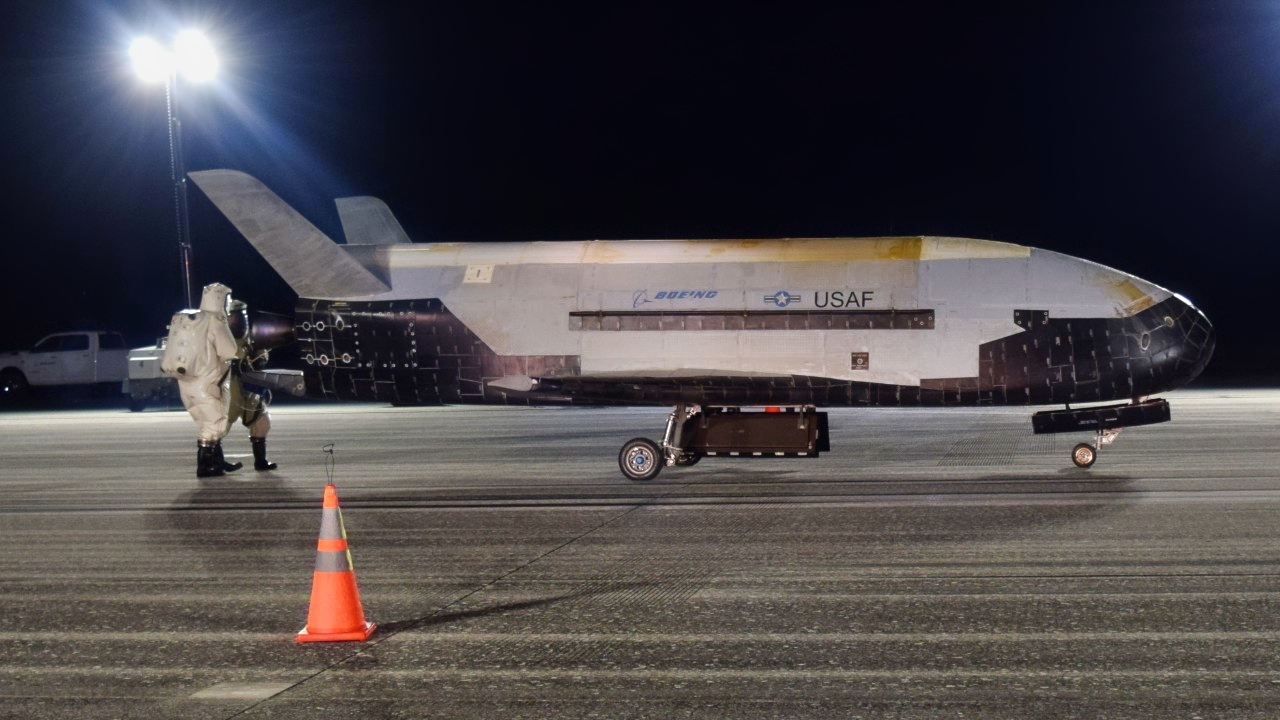
The Air Force’s X-37B Orbital Test Vehicle Mission 5 successfully landed at NASA’s Kennedy Space Center Shuttle Landing Facility Oct. 27, 2019. The X-37B OTV is an experimental test program to demonstrate technologies for a reliable, reusable, unmanned space test platform for the U.S. Air Force.
-Born as a NASA technology demonstrator and reborn as a classified testbed, the unmanned vehicle has quietly rewritten the playbook for long-duration, maneuverable missions in orbit.
-This piece walks through why the X-37B was built, what we actually know about its missions, why China and Russia treat it like a potential space weapon, and how it is shaping the next phase of great-power competition above the atmosphere.
-It also looks at what comes next for the program.
X-37B: The Quiet Birth of America’s Secret Space Plane
If you ever looked at the X-37B from across a hangar, it feels almost underwhelming.
It’s about a quarter the size of the old Space Shuttle, with the same basic silhouette: a blunt nose, short wings, a payload bay behind the cockpit. It rides into space on the nose of a rocket, glides home to a runway, and rolls to a stop like a miniature shuttle.
On paper, that sounds like a neat engineering project, not a geopolitical game-changer.
The origins fit that tame story. In the late 1990s, NASA was still trying to figure out what came after the Shuttle. The agency wanted to experiment with new thermal protection materials, more automated flight controls, reusable structures, and the mechanics of a space plane that could launch often without a full standing army of technicians. Boeing won the job to build a small demonstrator called X-37.
Then the world changed.
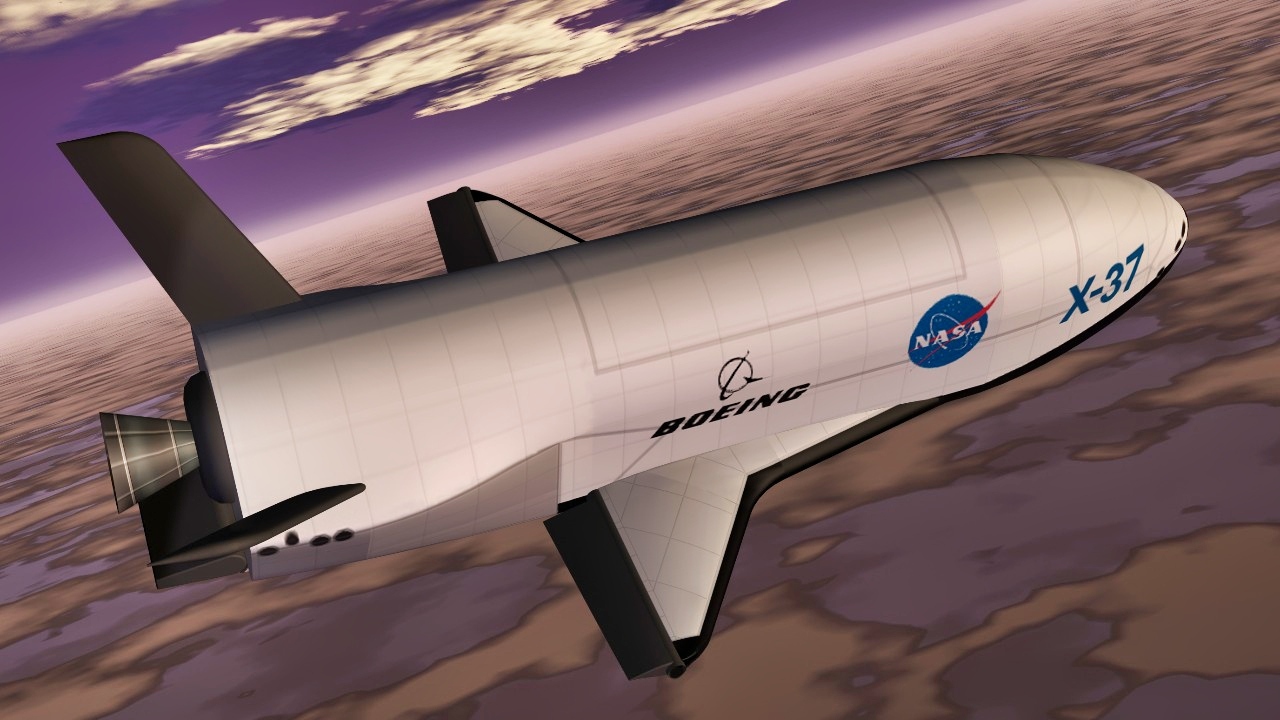
X-37B. Image Credit: Creative Commons.
As the Shuttle program aged, budgets tightened, and priorities shifted toward other exploration projects, NASA’s appetite for a small reusable test space plane evaporated. But the idea itself did not die. The Defense Department saw obvious value in an unmanned vehicle that could reach orbit, remain there for extended periods, host various payloads, and return intact.
By the mid-2000s, the X-37 program had migrated out of NASA and into the darker corners of the Pentagon, under DARPA and then under the Air Force’s Rapid Capabilities Office. The vehicle was resized, hardened, and reorganized into what we now know as the X-37B: a reusable Orbital Test Vehicle designed first and foremost to serve national security.
What started as a civil technology demonstrator became what looks like a flexible military tool.
The Missions We Actually Know About
A lot of what the X-37B does is classified.
That is by design.
But for a supposedly “mysterious” space plane, we actually know quite a bit from basic facts the government has released and from simple things like launch and landing notices.
Two X-37B vehicles exist. Each is roughly 29 feet long with a wingspan of about 15 feet. They operate in low Earth orbit, launched on conventional rockets, then return to land on a runway in California or Florida.
The first orbital mission, designated OTV-1, launched in 2010 and stayed in orbit for around seven months. That alone proved that an unmanned space plane could go up, autonomously operate for a long time, and land itself without a pilot.
OTV-2 stretched things further. It spent roughly 15 months on orbit before returning. OTV-3 and OTV-4 pushed endurance into the 600- to 700-day range. At that point, what had started as a shuttle-shaped curiosity had become something else: a platform that could camp out in space for a year or two at a time, doing whatever it was tasked to do.
The sixth mission, OTV-6, was the coming-of-age flight. It launched with an additional service module strapped to the back of the vehicle. That extra structure provided more power and space for experiments — essentially a plug-on “backpack” for the space plane.
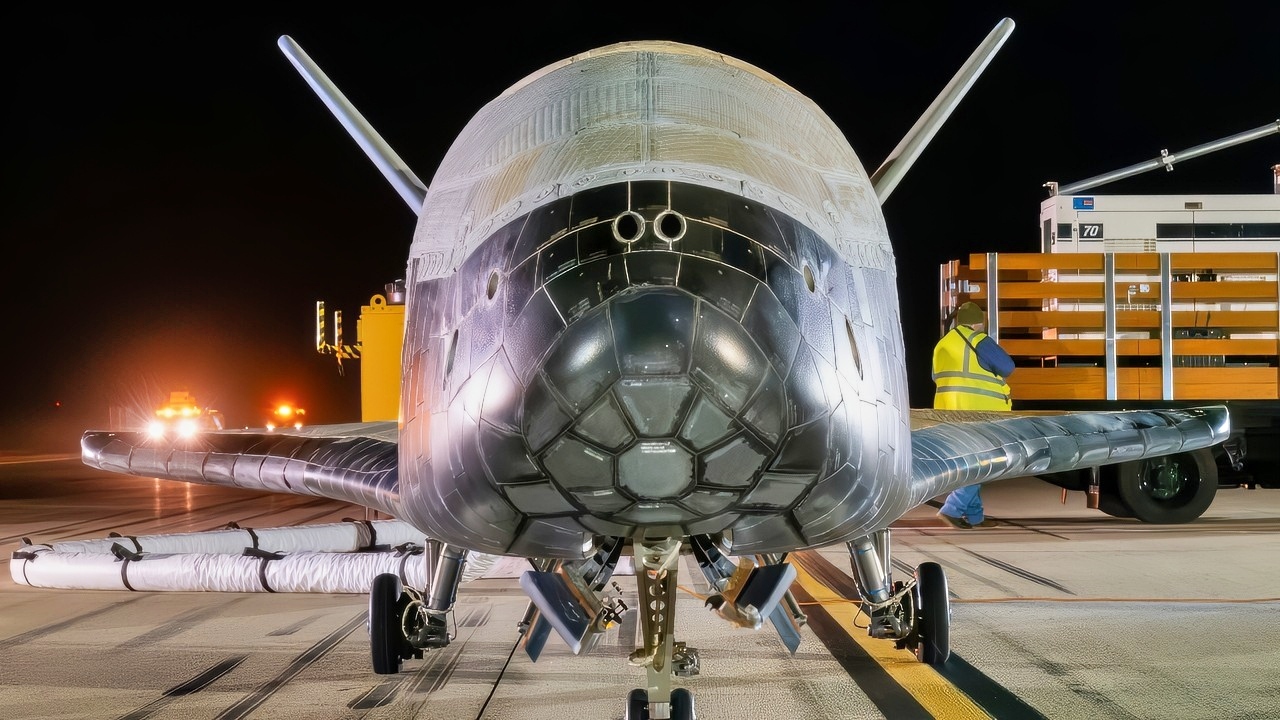
X-37B. Image Credit: Creative Commons.
On that mission, the X-37B carried a mix of payloads that tell you a lot about what the Pentagon cares about:
A materials experiment to see how different surfaces stand up to long-duration exposure in space.
A radiation study examining effects on plant seeds, which sounds esoteric until you remember that space radiation is a major problem for any long-duration mission.
A space-to-ground solar power demonstration, testing whether you can beam energy down from orbit — the kind of technology that could one day support forward bases or hard-to-reach locations.
A small satellite with multiple experimental payloads on board, effectively hitchhiking on the X-37B for its own mission set.
When OTV-6 finally landed after more than 900 days in space, it had set a new record for a reusable space plane. It also confirmed that the X-37B was not just a one-trick vehicle. It could carry very different payloads on different flights and support them for years.
The seventh flight, OTV-7, upped the ante in another direction. Launched on a heavy-lift rocket, the vehicle went into a much higher and more elliptical orbit than earlier missions. It then carried out a series of aerobraking maneuvers, dipping into the upper atmosphere repeatedly to change its orbit without burning large amounts of fuel.
That is precisely the maneuvering you care about if you are thinking seriously about contested operations in orbit: the ability to move between orbital regimes, adjust your track, and potentially rendezvous with or avoid other spacecraft, all while conserving precious propellant.
OTV-7 landed in early 2025 after more than a year in space.
By late summer, OTV-8 was already on the pad and had returned home. That kind of tempo says more than any press release. The X-37B is no longer a science experiment. It is a standing capability.
Why China and Russia Whisper About ‘Space Weapons’
Given all that, you can understand why America’s competitors do not see the X-37B as a benign science project.
From Moscow’s perspective, a vehicle that can quietly ride to orbit on a standard launcher, shift its path, open a payload bay, and stay on station for years might as well have “dual-use” stamped on the side. Russian officials have publicly mused that the United States could use the X-37B as a “space bomber,” carrying nuclear weapons in orbit and swooping down to attack without warning.
Strategically, that particular scenario doesn’t make much sense. An orbital bomber is less efficient, more vulnerable, and more expensive than the ballistic missiles and submarine-launched systems Washington already fields. It would also cross a politically radioactive line on putting weapons in orbit.
But from a Russian or Chinese planner’s standpoint, the details almost don’t matter. In their threat assessments, they have to assume the worst-case uses of any platform that looks even remotely plausible.
More serious and grounded concerns center on what the X-37B could do to other countries’ satellites.
An unmanned space plane with a small internal bay could:
-Carry sensors to inspect foreign satellites at close range.
-Test small “inspector” spacecraft that can be released near a target and loiter there.
-Experiment with cyber or electronic-warfare payloads designed to interfere with another satellite’s operations.
It does not take much imagination to turn that into a co-orbital anti-satellite capability. Whether or not the United States actually does that with X-37B today, China and Russia have to plan for the possibility that it could tomorrow.
Pair that with the program’s secrecy and you have a perfect fuel for paranoia. When you don’t know exactly what a rival is doing overhead, you fill in the gaps with your fears.
China’s Shenlong: The ‘Divine Dragon’ Joins the Game
Beijing has not just complained about X-37B. It has built its own answer.
China’s reusable space plane program, often referred to under the name Shenlong (“Divine Dragon”), emerged from the shadows over the last decade. What began as cryptic images of a small lifting-body test article under the wing of an H-6 bomber has matured into what appears to be an operational space plane launched on Long March rockets.
Chinese launches in 2020, 2022, and 2023 featured a reusable spacecraft going to orbit, releasing one or more small objects, performing proximity maneuvers, and then landing on a runway in western China months later. On at least one mission, the space plane deployed a subsatellite, flew nearby for a period, and then retrieved or closely approached it again before returning to Earth.
If that sounds familiar, it should. The mission profile echoes much of what the X-37B has been doing for years: long-duration flights, on-orbit experimentation, payload deployment and recovery, and runway landings.
We do not know how capable Shenlong is compared to X-37B in terms of endurance, payload mass, or maneuvering. But in a sense, that’s not the point. The message is simple: China is not going to let the United States have a monopoly on reusable military space planes.
In Beijing’s own open statements and internal writings, reusable spacecraft are tied directly to strategic competition. They are framed as platforms that can support both civil and military missions, from satellite servicing and debris removal to more “sensitive” tasks. That dual-use framing should sound familiar. It is exactly how the United States describes the X-37B.
Now, both sides have an incentive to assume the other’s space plane is a weapon and their own is mostly a testbed.
That is how arms races start in new domains.
What the X-37B Is Really Doing for American Power
Set aside the drama and ask a basic question: what does the X-37B actually buy the United States that a conventional satellite cannot?
First, it provides a reusable, recoverable orbital laboratory. Traditional satellites are mostly one-way trips. You launch them, they do their work, and eventually they die in orbit or burn up on reentry. If you want to test a new sensor, a new material, or a new propulsion system, you get one shot at it.
With X-37B, you can:
-Take a prototype payload to orbit.
Run it for months or years in real conditions.
-Bring it home.
-Physically tear it apart and see what worked and what failed.
That may sound mundane, but for cutting-edge technologies it is priceless. It accelerates learning and reduces risk for future programs that will go up and stay up for good.
Second, the X-37B forces the U.S. military to learn how to operate reusable spacecraft as if they were aircraft. Every mission means planning orbital profiles, handling autonomous reentry and landing, turning the vehicle around, integrating new experiments, and doing it repeatedly.
If the future really includes larger space planes, cargo vehicles, or rapid-response orbital systems, somebody has to build the procedures and institutional memory first. X-37B is doing that job now.
Third, and most important, the space plane is helping the United States likely explore how to fight — and ride out a fight — in a contested space environment.
The kinds of technologies flown on recent missions tell a clear story: better power systems, more efficient propulsion, resilient communications, alternative navigation when GPS is jammed, and the ability to maneuver between orbits economically. All of that feeds directly into a world where potential adversaries are building ways to blind, jam, or destroy U.S. satellites.
In that sense, X-37B is less a “space weapon” in the Hollywood sense and more an insurance policy: a platform for figuring out how you maintain an edge when space is no longer a sanctuary.
The Future: From Exotic Toy to Template
The X-37B’s future is not written in stone, but a few paths are already visible.
One path is simply more of the same — but at higher tempo and increasing ambition. If the recent cadence holds, we can expect the vehicle to fly regularly, host more advanced experiments, and integrate more directly with Space Force operations and doctrine. It could become, in effect, a permanent experimental fixture: whenever you need to test something in orbit with the option to bring it home, you put it on the next X-37B ride.
Another path is evolutionary. Engineers have already sketched ideas for larger derivatives with bigger payload bays or specialized roles. Whether or not those specific designs fly, the lessons from X-37B will feed into whatever comes next: orbital servicing vehicles, rapid-launch inspection craft, or even future crewed space planes that piggyback on the same technologies.
The more interesting evolution will be conceptual. Spaceplanes push everyone — the United States, China, Russia, and others — to think differently about how you structure a space architecture. Instead of a pure diet of big, fragile satellites in predictable orbits, you can imagine a mix of:
-Conventional constellations.
-Small, proliferated satellites.
-A handful of maneuverable, reusable vehicles that can surge where needed.
That kind of mix could make space more resilient. It could also make it more tense, as each side tries to interpret what the other’s moving pieces are doing overhead.
For Washington, the challenge will be balancing the benefits of the X-37B against the risk of further fueling suspicion and counter-moves. Some additional transparency around broad mission categories, combined with serious work on norms and red lines in space, would be wise.
But even if diplomats get traction, the technical and operational momentum is not going away. The X-37B has already shown that reusable, long-duration space planes are not science fiction. They are here, they work, and they are becoming part of the fabric of military space operations.
The next time you see that odd little black “mini shuttle” landing in the middle of the night in Florida (not far from where I live), remember: the real story may not be what it did on that particular mission. The real story is that it’s quietly teaching the United States how to live — and compete — in the kind of space environment China and Russia are racing to build.
About the Author: Harry J. Kazianis
Harry J. Kazianis (@Grecianformula) is Editor-In-Chief and President of National Security Journal. He was the former Senior Director of National Security Affairs at the Center for the National Interest (CFTNI), a foreign policy think tank founded by Richard Nixon based in Washington, DC. Harry has over a decade of experience in think tanks and national security publishing. His ideas have been published in the NY Times, The Washington Post, The Wall Street Journal, CNN, and many other outlets worldwide. He has held positions at CSIS, the Heritage Foundation, the University of Nottingham, and several other institutions related to national security research and studies. He is the former Executive Editor of the National Interest and the Diplomat. He holds a Master’s degree focusing on international affairs from Harvard University.