
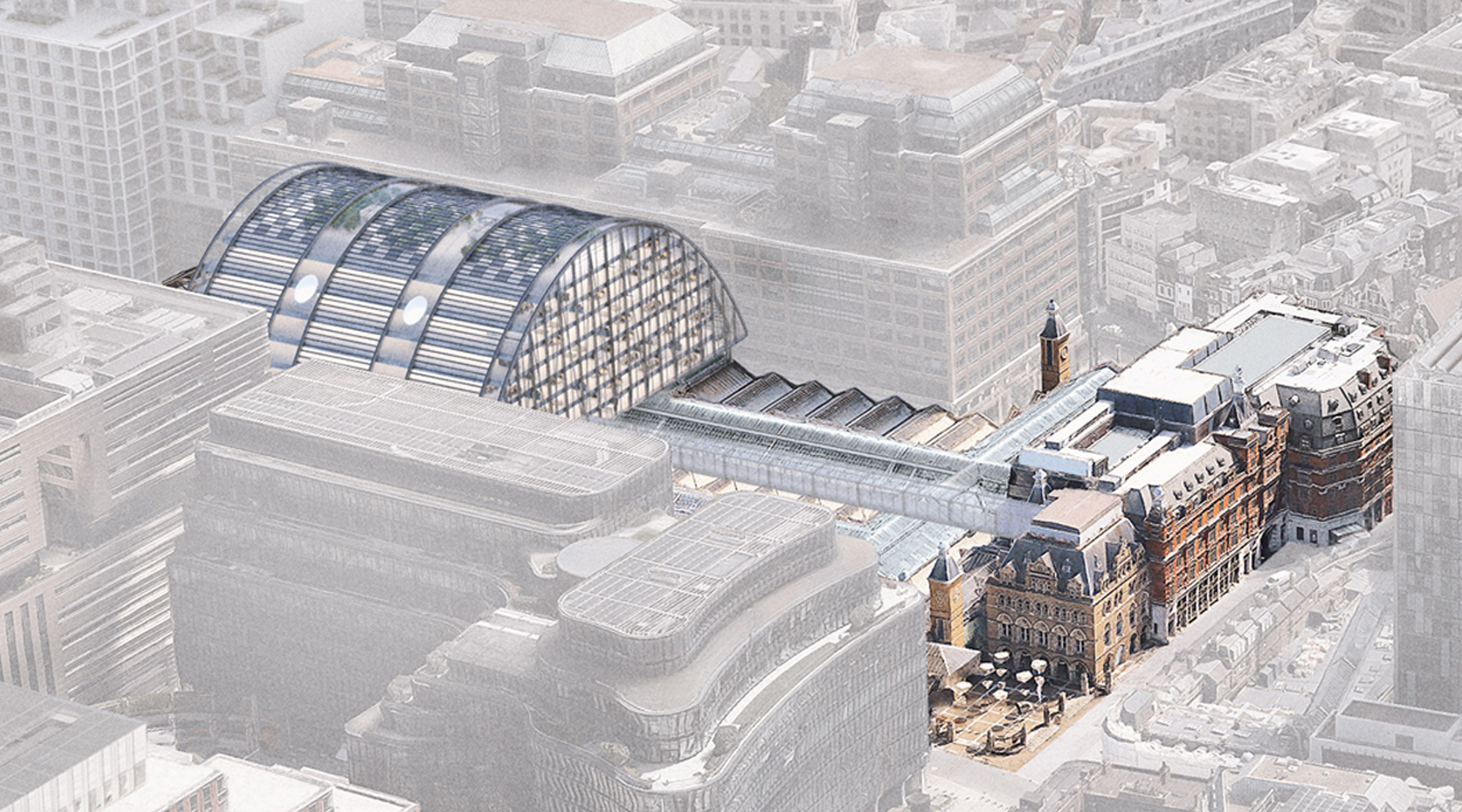
An alternative vision for an oversite office development of Liverpool Street station has been unveiled, offering what its designers claim is a less disruptive route to funding an upgrade of the railway station.
 (c) John McAslan + Partners
The concept, drawn up by architects John McAslan + Partners (JMP), which had previously worked on King’s Cross Station, and engineering firm Expedition, proposes a series of station improvements and accessibility upgrades delivered without, they say, the years of upheaval associated with building a tower through the concourse.
The scheme has been welcomed by Sir Tim Smit, founder of the Eden Project, along with several heritage and sustainability experts, who argue that debate over the station’s future has so far been dominated by a single idea: large-scale demolition and the construction of a 20-storey tower above the station.
Network Rail’s own proposal for a 20-storey office block built over the concourse is expected to be decided by the City of London’s planning committee early next year. The proposers of the new scheme are calling on Network Rail to pause its current planning process to consider this and other possible alternatives.
The new scheme would move the office and retail space above the existing roof and be accessed via the restored 50 Liverpool Street building, allowing construction to proceed without demolishing the trainshed or driving new support columns through the concourse.
50 Liverpool Street is the 1990s Victorian-looking building on the corner of the tube station, with an entrance to the main station, occupied by McDonald’s on the ground floor.
At the centre of the plan is a low-profile vaulted structure designed to echo classic railway architecture and the neighbouring 1990 SOM building at Exchange Square. The design suspends nine floors of cross-laminated timber from a lightweight steel frame, creating a low-carbon building with no need for internal columns or structural intervention in the platforms below. The mezzanine retail layer would be removed to declutter the concourse, with a new publicly accessible landscaped walkway offering long, uninterrupted views through the trainshed.
The vision, the team says, aims to reflect the same spirit of invention that defined the early railway age, which marks its 200th anniversary this year.
Chris Wise, senior director at Expedition Engineering and the engineer behind the JMP concept, said: “Our engineering would bridge the main Victorian trainshed without touching it, efficiently supporting the clear span of 90m with a series of tied parabolic arches, rather than the heavy transfer trusses often used for air rights projects. Inside the new building, instead of heavy columns, our floors are hung from the arches. All is carried on a series of tall piloti columns, designed at a civic scale to land away from the twin roofs of the Victorian station structure.”
Although not finalised, their early cost estimates suggest the revised design could cost around half the £ 1.2 billion price of the current proposal.