
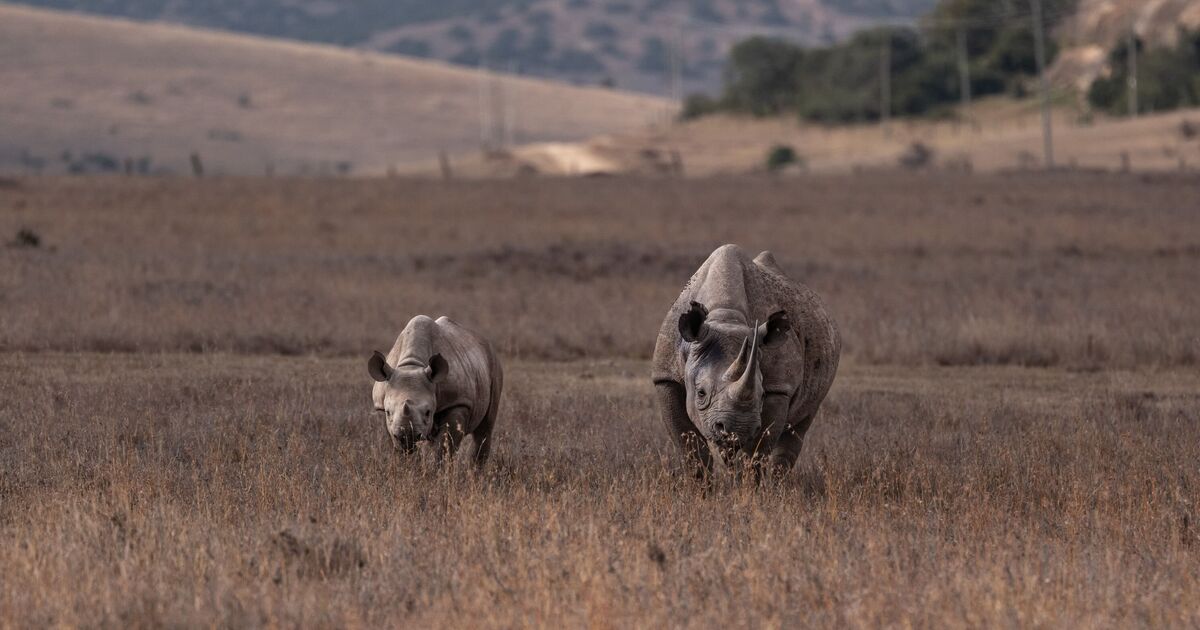
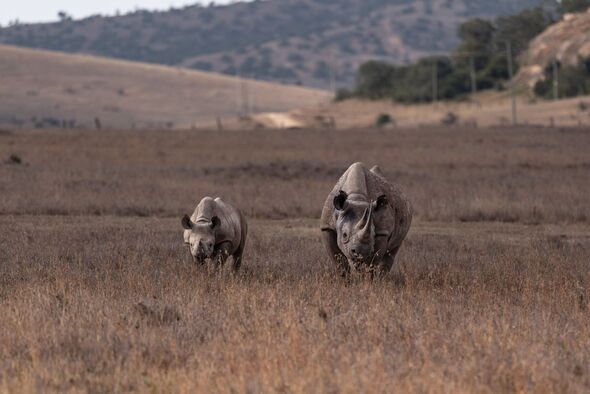
Black rhinos in the relative safety of Loisaba Conservancy, Kenya (Image: Dustoff Films)
Wildlife rangers are the unsung heroes of the natural world. These astonishingly courageous people voluntarily risk their lives every single day to protect endangered species from poachers and habitat loss. Now a new feature-length documentary narrated by Hollywood star Tom Hardy highlights the awe-inspiring bravery of rangers responsible for protecting one animal pushed to the brink of extinction – the black rhino.
Released in cinemas today, Rhino follows the wildlife monitors as they attempt to save the widely adored megafauna from poachers after their numbers dwindled to just over 6,000 in the wild. Tom Martienssen, the British director of the eco-thriller, spent four years embedded with rangers at the Borana Conservancy in Kenya and witnessed first-hand the death-defying extremities faced by the frequently outgunned wildlife rangers.
He takes up the story. “One morning we were filming with a ranger called Johnson Sururu and his team. We left them to do something else, and they got ambushed by poachers later that night. Johnson was killed, and every single other person in the team was injured. The danger there is very real. We knew that if we drove into an ambush, we would probably be killed.”
The documentary includes very moving footage from Johnson’s funeral. As his wife howls with grief and is held back by relatives, the preacher declares: “I want to recognise the conservancies for their efforts. If it were not for their protection, there would be no communities left.”
In a poignant moment, the camera homes in on Johnson’s boots, which have been placed on top of his coffin as a tribute. The film is dedicated to the 36-year-old’s memory.
We also follow two committed Kenyan rangers Ramson Kiloku, who goes by his surname, and Rita Kulamu who are among those selfless scouts who choose to put themselves in harm’s way. Tom underscores that the 150 rangers who die every year are fighting not for riches or glory, but for nature. They represent the very best of us.
“I have filmed rangers in Kenya, Nigeria, Cameroon, Mozambique and Zimbabwe, and the thing that really strikes me with all of them is that they’re fighting for something intangible,” says the Emmy award-winning director, who did two tours in Afghanistan with the RAF’s Medical Emergency Response Team before becoming a BBC reporter and cameraman.
“They all know how dangerous their job is. Every single person in those teams has lost friends, and yet they’re still willing to go out and put their life on the line to protect a bigger concept.
“They’re protecting rhinos, but they’re also protecting what’s left of the natural world. They all really appreciate that and are really motivated by it.”
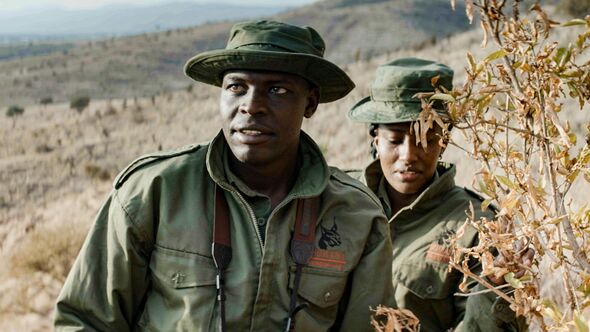
Devoted rhino rangers Ramson Kiloku and Rita Kulamu (Image: -)
Tom, who grew up in Newark in Nottinghamshire and whose father’s job as a vet endowed him with a lifelong love of animals, gives an example of Kiloku’s dedication to the job.
“He got knocked off his quad bike by a rhino and ended up in hospital,” he says. “Four days later, he was back doing the same job – except this time he was on a motorbike instead of a quad bike because his quad bike had been destroyed by the rhino!”
Despite the rangers’ unswerving support for the cause, the odds are heavily stacked against them. Indeed, the statistics behind the illicit international wildlife trade are distressing. Poachers make up to $20 billion a year from this illegal and immoral business. A single rhino horn can reach a staggering $100,000 (£75,000) on the black market, sold by organised criminal gangs to medicine markets in the Far East.
Rhino horn has been used in traditional Chinese medicine for two millennia to treat various disorders and illnesses, despite no evidence to show they work. The problem has only got worse since a false story recently circulated that rhino horn powder cured a prominent (but unnamed) politician’s cancer. That myth has seen the value of rhino horn rocket to a level way above the price of gold.
The appalling result of this is that a rhino is slaughtered somewhere in Africa every 16 hours. At the same time, a wildlife ranger is killed every 48 hours. Shocking doesn’t even begin to cover it. It seems like an unwinnable war.
But all is not lost. The rangers have been valiantly turning the tide in Kenya. Around 5% of the global population of black rhinos are being butchered each year. In the last three years alone, 1,900 rhinos have been poached across Africa. By contrast, not a single one has been killed in Kenya for a decade.
It is a success story well worth celebrating. Between 1970 and 1980, 98% of Kenya’s black rhinos fell victim to human greed. At the time, there were just 300 of the creatures left in the country. Now the population is finally flourishing again thanks to the introduction of serious penalties for poaching, new fenced enclosures and the authorisation of lethal force, which has scared off many potential poachers.
But it has also created new problems. As we see in the documentary, the very fences that saved the animals now hem them in, so rhinos in Kiloku’s and Rita’s 10-square-kilometre haven now risk killing each other in a fight to the death for territory.
In one last throw of the dice, Kiloku and Rita’s team hatch a daring plan to relocate a crash of rhinos to the Loisaba Conservancy, a new sanctuary 60 miles west of Borana.
As criminal violence spins out of control and the demand for outlawed rhino horn remorselessly increases, it is a potentially lethal journey. But the team’s devotion to their job is phenomenal with rangers making patrols every single night. “Then they’ll spend the whole day doing training and they’ll only get two hours’ sleep,” says Tom.
“That’s the kind of commitment you see from soldiers in a war zone. It’s so admirable, because they’ll sacrifice anything to protect these rhinos.”
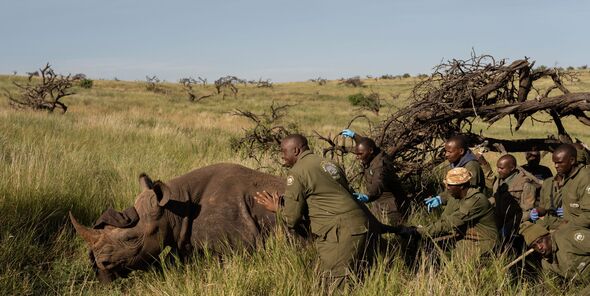
Rangers working to relocate of a crash of rhinos to the Loisaba Conservancy (Image: Copyright David Chancellor)
That includes one scout, who runs the radio room at Borana, insisting on working even though he lost a leg after being bitten by a puff adder. Kiloku’s details why he is so wedded to his vocation. “I feel really bad because we have very few rhinos left on earth, that’s why we try to protect them day and night,” he says. “We want to make sure all the rhinos and their habitats are safe.”
The ranger, who grew up in this part of Kenya and has a very close connection with the land, adds: “If there were no rhinos here in Borana, I couldn’t be here.”
Kiloku is an expert tracker who can pick up the sound of rhinos chewing from a great distance. He’s determined that his son and future generations will be inspired by the black rhinos in the same way that he has been.
Rita, who is university-educated, shares this dedication. “It’s beautiful just being in nature,” she smiles. “I love it when I see we’ve helped a certain animal exist in this landscape. We are supposed to share this space with these animals.”
Heartwarmingly, their sterling work is now being rewarded. The number of rhinos in Kenya recently exceeded 1,000 for the first time in half a century.
Using tranquiliser darts and trucks, Kiloku and Rita’s team succeed in translocating 21 black rhinos to their new home at Loisaba. The team even revives a struggling rhino by using CPR, which involves two scouts jumping up and down on the creature’s chest.
Watching the rhinos trot across the savannah without a care in the world, it is not hard to see why the scouts are so impassioned about defending these majestic beasts.
The rangers who defend these magnificent creatures also have friends in high places including Prince William, the patron of the Tusk Trust and founder of United for Wildlife, a project tackling unlawful wildlife smuggling in Africa.
In a speech in June, the Duke of Cambridge lauded the monitors. “Around the world, rangers work steadily on the front lines of conservation,” he said. “They are confronting a devastating rhino poaching crisis that threatens the survival of this awe-inspiring species.”
Prince William added that the rangers are “guardians who are not only taking on poachers, but also caring for the baby orphaned rhinos they leave behind. The rangers’ stories show hope can prevail through dedication, care and courage, even in the face of enormous challenges’.”
Tom echoes how vital it is to conserve the rhino. “In saving this keystone species, you’re saving the entire habitat that exists below it,” he says. “If you want rhinos to exist in a wild habitat, then you need everything underneath them to be working properly as well.
“That’s why they are a very important symbol. Unless their habitat is perfect, they will die. And so, seeing them thrive proves that all the rangers’ efforts have worked.”
In spite of the huge difficulties confronting the rangers every single day, Tom believes their story offers hope for the future. “We can win and we can save the natural world,” he says. “I don’t want to live in a world where we don’t have wild spaces and we don’t have rhinos.”
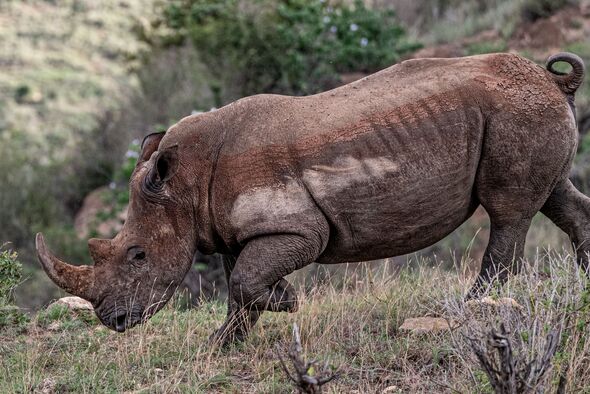
A black rhino with markings that help the rangers identify them in the wild. (Image: Dustoff Films)