
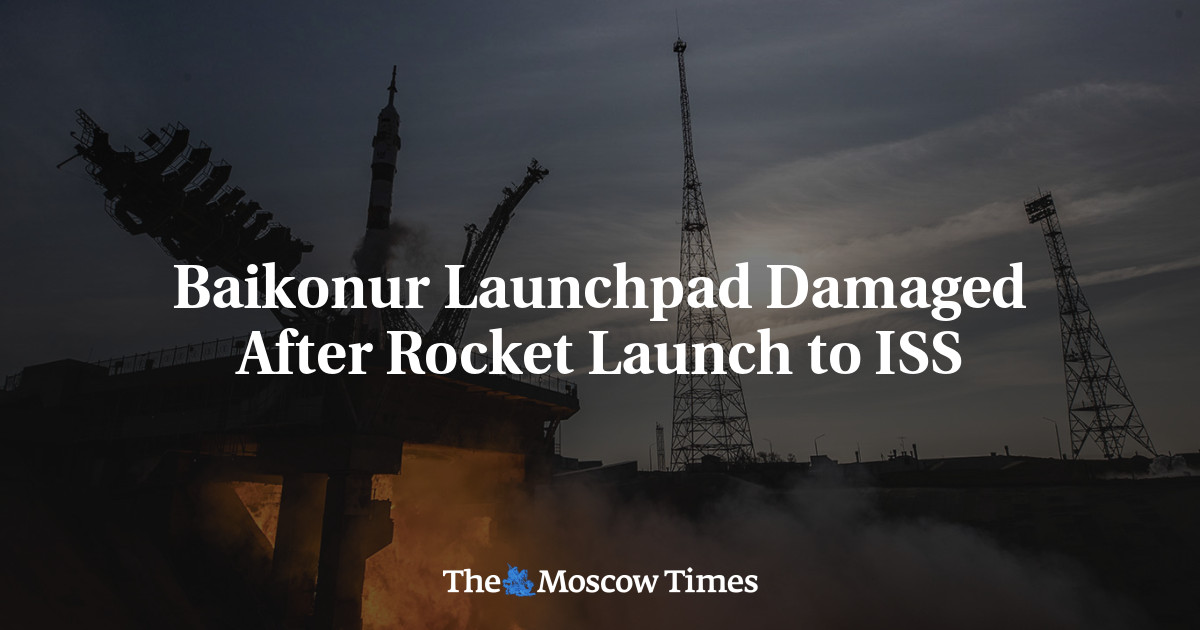
Russia’s Baikonur cosmodrome in Kazakhstan was damaged on Thursday following the launch of a manned Soyuz rocket to the International Space Station, the Roscosmos space agency said.
The Soyuz MS-28, which was carrying Russian cosmonauts Sergei Kud-Sverchkov and Sergei Mikayev, along with NASA astronaut Chris Williams, took off from Baikonur at 12:27 Moscow time and successfully docked with the ISS later in the day.
“Damage to several elements of the launch pad was detected,” Roscosmos said hours after the crew arrived at the ISS. “An assessment of the condition of the launch complex is currently underway.”
The space agency said it has “all necessary spare parts” and vowed to repair the cosmodrome “in the near future.”
According to the science news outlet N+1, Baikonur is Russia’s only operational launch pad for crewed Soyuz missions to the ISS, suggesting the damage may cause delays for future launches.
The outlet reported that the service cabin beneath the launch pad, which is used to access the rocket’s lower stages, was likely destroyed during the launch.
Russia pays Kazakhstan $115 million annually to lease Baikonur, which it has used since the Soviet era to launch astronauts to the ISS, one of the last remaining areas of collaboration between Russia and the West.
The Soviet-built facility, located in southern Kazakhstan, played a central role in Cold War space milestones, including the launches of Yuri Gagarin, the first human in space, in 1961, and Valentina Tereshkova, the first woman in space, in 1963.
Efforts to modernize the cosmodrome have faced delays due to chronic underfunding and geopolitical uncertainty following Russia’s 2014 annexation of Crimea and its 2022 invasion of Ukraine.
AFP contributed reporting.