
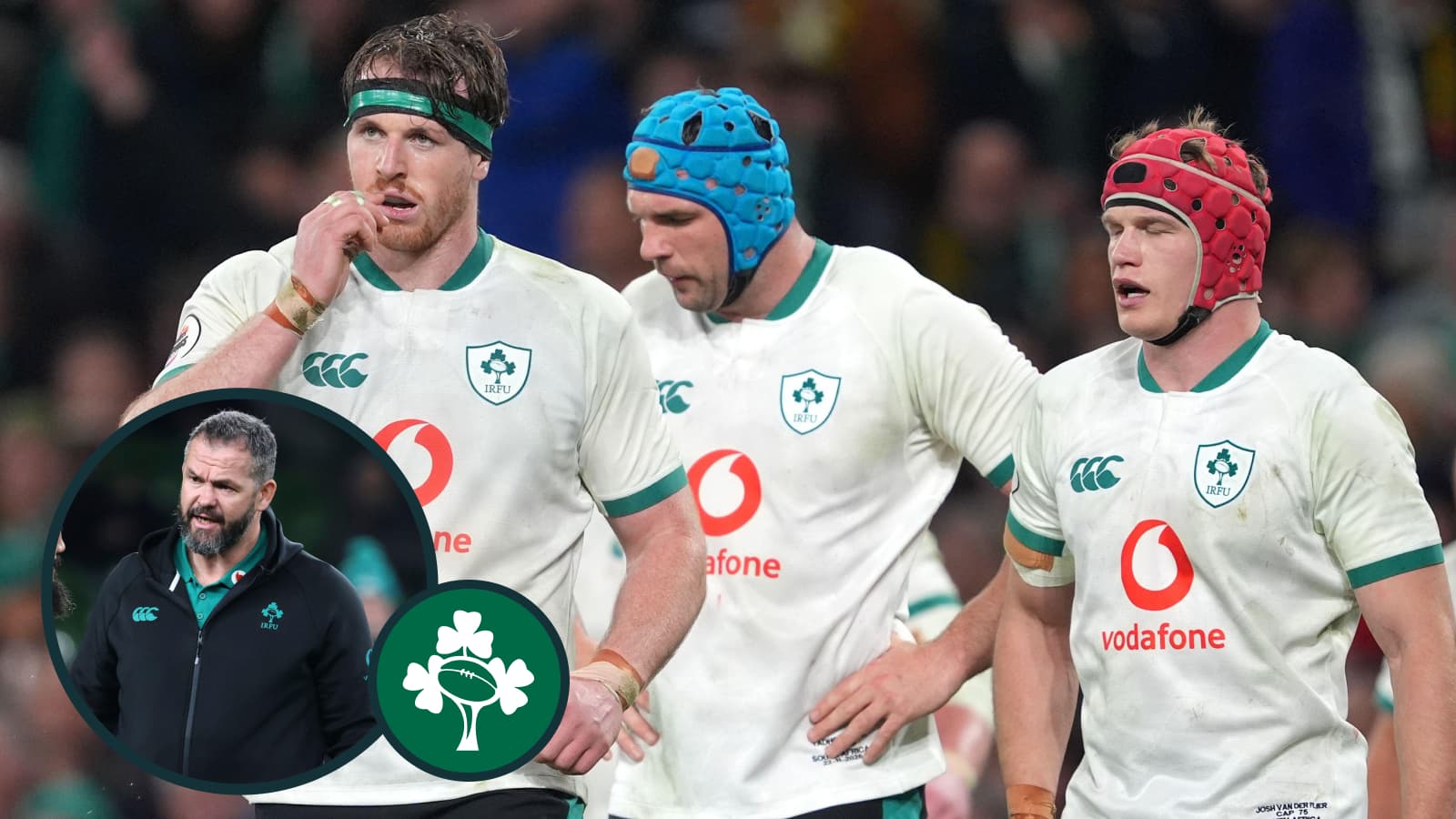
Following the conclusion of the 2025 Autumn Nations Series, we are updating you on the state of the participating nations. Next up, it’s Andy Farrell’s Ireland.
The Irish came into their four-match schedule hoping for a head coach return bump, as Farrell was back at the helm following his British and Irish Lions sabbatical.
However, the anticipated lift never materialised, and Ireland, who were ranked third coming into the window, slipped to fourth. There can be no complaints, as they were comfortably beaten by the No.1 South Africa and the No.2 New Zealand.
There was the high point of hammering Australia by a record scoreline, but the win over Japan was laboured, leaving Ireland with a disappointing two wins from four record.
This outcome has given Farrell with plenty to do to inject a freshened-up approach in time for the 2026 Six Nations, which starts away to France on February 5.
Sacha Feinberg-Mngomezulu call ‘set the tone’ as Nigel Owens believes officials got two calls wrong
Autumn Nations Series summary
Despite Farrell making his first misstep of the schedule by naming his Ireland squad before Munster hammered Leinster in the United Rugby Championship, November still began optimistically as Ireland headed to Chicago with the ambition of recreating the historic 2016 win over the All Blacks in the Windy City.
It only took a few minutes for that optimism to be dented as Tadhg Beirne was red-carded for his head clash with Beauden Barrett. It was decided a few days later that the 20-minute red card was unwarranted, but by then that damage had long been done.
In a fixture that never lived up to hype, Ireland dug in and were leading 13-7 with an hour of low-frills rugby played.
However, the worry about the clinical way their defence had been exposed for the 19th minute Ardie Savea try hadn’t subsided, and the leakage of three tries to the All Blacks in a brutal 15-minute spell coming down the finishing straight left them well beaten.
This defensive fragility returned the following weekend in Dublin, where a 17-point lead against the Japanese was cut to seven in the blink of an eye just before the interval.
With Jacob Stockdale also yellow-carded, Ireland were vulnerable, but Eddie Jones’ side didn’t have the blueprint to take advantage. The home side instead eventually ran away with the match as the bench, led by Sam Prendergast, had too much energy for the out-of-breath visitors.
That bench, this time with Jack Crowley as the back-up 10 to the promoted Prendergast, was again influential the following weekend when blitzing Australia late on. Mack Hansen’s first-half hat-trick had laid the foundation, but with the Irish defence still not in sync, the cushion was only 19-14.
A couple of kicks were needed to calm nerves before three tries in the closing 12 minutes made it a record 27-point win – quite the welcome difference from the three-point margins of victory over the Wallabies in 2022 and 2024 at the same ground.
With the win came the renewed confidence that beating the Springboks was mission possible, but no one could have imagined the influence that Matthew Carley would wield.
Four first-half cards – a 20-minute red and three yellows – left Ireland down to 12 players and trailing 7-19 at the break following the concession of a penalty try by their demolished scrum.
No one could fault their defiance on the resumption not to implode. However, while coach Farrell made a big deal of Ireland ‘winning’ the second half 6-5, especially as they copped a fourth yellow card following another scrum malfunction, the truth was they had been battered and the 13-point margin of defeat was flattering.
Ex-Ireland star on ‘bizarre’ moment that ‘totally defeated all of my mindset’ about the Springboks
Standout players
Thirty-three players were capped by Farrell over the course of the four matches – 27 as starters – but no one stood out as the top, top man across the series. Instead, there were several candidates who caught the eye here and there.
We’ll start in the backs where Hansen’s hat-trick against his native Wallabies was supreme. It was a first Test start at full-back for the Aussie who had made his name on the Irish wing, but his ability to join the line at just the perfect moment was easy on the eye during that November 15 first half.
Next up for kudos is Tommy O’Brien. With the Lions on in the summer, the 27-year-old made an off-the-beaten-track Test debut in Georgia, but his talent was recognised in November when he was the only Irish back to start in all four matches.
His exposure didn’t end well; his inexperience at international level was painfully evident in the tackle where he was left poleaxed by South Africa’s Canan Moodie and off for a failed HIA that many felt should have been accompanied by a yellow card for bad tackle tech.
However, he enthusiastically did more than enough across the month before that incident to suggest he can go on and be an Irish favourite.
Midfielder Tom Farrell wasn’t a standout in terms of the level of play he produced, but he deserves a mention for the incredible level of patience it took for him to keep working at his game at club level and eventually earn the reward of a debut cap at the age of 32. That is no mean feat in a sport where the odds are stacked against older players making a belated breakthrough.
Switching to the forwards, Beirne is the go-to attraction. He was stitched up by the thoroughly inadequate foul play review officer in Chicago, who bogusly felt the high tackle merited a 20-minute red when it didn’t – as proven at the subsequent disciplinary.
The second row bounced back, though, to put in 80-minute shifts in the following three games, and his form was recognised by his selection as the only Irishman in the World Rugby Dream Team of 2025.
Beirne was just one of four players to start all four Ireland matches in November – O’Brien, James Ryan and Ryan Baird – were the other three and his importance can’t be underestimated.
Caelan Doris is also in this standout category, even though his best will only come in the Six Nations in February when he is fully back up to speed. His surgery-needing shoulder injury last May was a Lions-ruining hammer blow, but it said so much about his ability that he returned to play at Test level without needing club action to shake off the cobwebs.
After benching against the All Blacks, he started and captained Ireland in the following three matches. His efforts against Japan and Australia were excellent before the cards farce versus South Africa rendered that game a damage limitation exercise rather than a let’s have a proper go affair.
His captaincy in this dire situation, which included an Ireland 12 up against a South African 15 at one stage, deserves several pats on the back as the Irish could easily have capitulated and gotten a scoreboard hammering, but they didn’t.
⌚️ Nick Timoney scored his 5th try for Ireland in his 5th appearance in an Irish shirt in his side’s victory over Japan in Dublin 📷💪#Breitling #DefiningMoment @Breitling pic.twitter.com/oAhv2yQgri
— Quilter Nations Series (@QuilterNations) November 10, 2025
We’ll finish this category by referencing four Test rookies we would like to see more of next year. There is a consensus that the Test ceiling for 30-year-old Nick Timoney isn’t very high, but he has never underwhelmed in his fleeting appearances and deserves more of a show so that a definitive assessment can be made.
Two others in this please-play-him-more situation are Cian Prendergast and Gus McCarthy. With Ryan having severely harmed his CV with his unnecessary red card shenanigans versus the Springboks, there is an appetite for Cian Prendergast to be given more of a chance. His rawness certainly wasn’t an issue with his team under the pump last weekend.
Also, there is a composure about fellow rookie McCarthy, who arrived off the bench to deliver a try against Japan following an afternoon where Ireland’s ongoing lineout inaccuracies continued with Ronan Kelleher in the starting role. McCarthy is surely now the better long-term bet than Kelleher as the back-up behind Dan Sheehan.
Finally, a word for Paddy McCarthy. Getting yellow-carded for his second-half scrummaging against South Africa wasn’t a good look for the prop.
But there was great relief in his preceding three runs off the bench versus the All Blacks and Japan and as a starter against Australia that Ireland finally have a loosehead to fill the void that left them selecting Cian Healy as the back-up to Andrew Porter long past his sell-by date.
Matt Williams: Springboks performance was ‘masterful’ but World Rugby must depower the scrum
Stat leaders
Out-half Crowley was Ireland’s leading scorer, accounting for 31 (one try, four penalties and seven conversions) of the 113 points scored, with full-back Hansen the top try-scorer with three of their total of 14.
It’s the team stats, though, that provide the devil in the details of this Irish November. There has been a concern about the lineout stretching back to Rugby World Cup 2023 and the winning of just 43 of their 54 Autumn Nations Series throws is a concern heading into 2026.
The game against Australia, where they finished 10/10, was the only game they could take set-piece comfort from.
Then there is the discipline issue. Under previous boss Joe Schmidt, the Irish had a reputation for striving to be squeaky clean on every occasion. So well behaved were they that they once gave up just three measly penalties versus Australia in 2016.
Those are long ago times, judging by the naughtiness of November 2025. Ireland conceded 46 penalties compared to the opposition’s 40 and suffered two red cards and six yellows in contrast to just three yellows to the opposition.
The blame for this fall-off is that they no longer dictate matches as they did a few years ago, when they were regularly a World Rugby No.1 team that won the Six Nations back-to-back and were favourites going into RWC 2023.
In the good books of the referees, they scored tries for fun. But the game has now changed, and the go-forward enjoyed in the Mike Catt era isn’t the same with Andrew Goodman in charge of the attack. As a consequence, the defence is suffering badly at times.
In their two big games this November against the All Blacks and the Springboks, Ireland were beaten two to eight on the try count. That is a massive difference, and it hurt.
The concession of the scrum penalty try to the Boks additionally highlighted how, aside from lineout, Ireland have another set-piece that is rather delicate and capable of literally being a dreadful pain in the neck.
Ex-Ireland star: Springboks expose ‘long-term’ issue which shows IRFU’s ‘limitation’
What Schalk Burger ‘loved’ about James Ryan’s red card while ex-Springbok hits out at ‘dirty play’
Success story
This part won’t take long, as the past month simply wasn’t a success for Ireland. The jury is still very much out on the out-half situation as neither Crowley nor Prendergast stood out in the two matches that really mattered most.
The Irish attack was also generally laboured, their set-piece underwhelming, their discipline sketchy under pressure, and the spiel spun by boss Farrell at odds with that was plain to see for the fans.
Ireland did show ticker in keeping the margin of their two defeats down, but they are in a state of flux, not helped by Farrell’s business elsewhere with the Lions. 2025 will go down as a year to be forgotten at a time when Irish standards are so, so high.
Main regret
No one can genuinely make the argument that Ireland are definitely further down the track and building towards a successful 2027 Rugby World Cup compared to where they were at the end of November 2024 when Farrell signed off and began his costly Lions sabbatical.
As great as it sounds that so many Irish players went on to become Test series winners on that trip to Australia, the business of minding the house at home was frustratingly left unattended.
In Ireland’s four main matches of 2025 – at home to England and France in the Six Nations, and then in the USA versus New Zealand and at home to South Africa in the Autumn Nations Series – the displays have left much to be desired. There was a 20-minute power surge to demolish England and 10 promising, early first-half minutes without reward against South Africa, but that was it.
Instead of kicking on this year, Ireland, with Farrell distracted by the Lions and coming across tetchy in some of his Irish media dealings since then, have fallen behind, and the fear is they will slip further with 2026 heralding away Six Nations trips to France and England, a trip to New Zealand and then another home clash with South Africa.
There was little or nothing in Ireland’s play overall to suggest that they have the necessary change-up in gear currently within their armoury to remain competitive at the very top of the game.
None of Farrell’s assistants covered themselves in glory with their work this November, including the latest recruit Johnny Sexton, and the giddy chat that existed a few years ago about Ireland’s supposed exciting strength in depth has been laid bare for what it is – a myth.
There was only ever a limited supply of talent, and it hasn’t been blooded into the mix quickly enough. This left Farrell deciding he was best served by relying on his established Leinster favourites, and too many of them left him down in recent weeks by being off the pace and lacking precision. Added to that, Baird doesn’t yet have Peter O’Mahony-like gravitas.
A collective rethink is needed over the winter.
Results
Ireland LOST 13-26 v New Zealand (Chicago)
Ireland WON 41-10 v Japan (Dublin)
Ireland WON 49-19 v Australia (Dublin)
Ireland LOST 13-24 v South Africa (Dublin)