
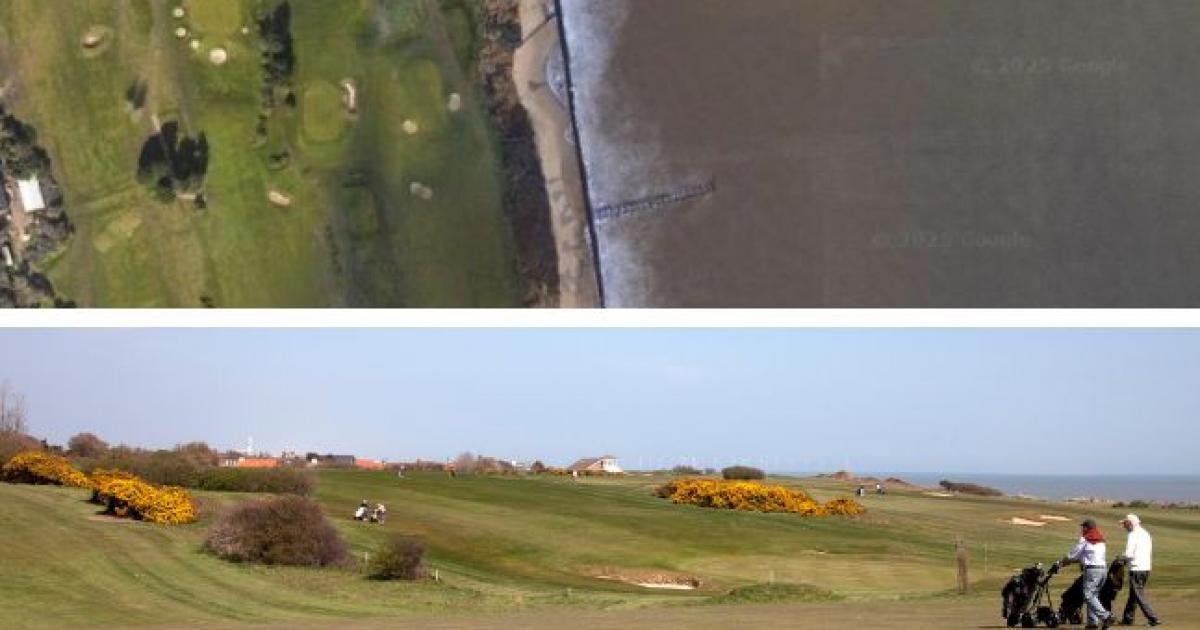
At Gorleston Golf Club – Britain’s most easterly course, perched uncertainly on a windswept clifftop – the obstacles aren’t just bunkers, but the encroaching North Sea itself.
Coastal erosion has already claimed one tee, and now two more holes are at risk of being washed away.
The precarious location of the land has led the club to draw up plans to build a pair of replacement tees.
Gorleston Golf Club is planning to build two new holes to counter the threat of coastal erosion at the site. (Image: Archant)
Club president Howard Thornton has submitted a proposal to Great Yarmouth Borough Council to lay out two new holes further inland.
A document submitted with the application says the golf course has suffered from coastal erosion for years.
In 2020, plans were approved for five new holes after the club bought 20 hectares of land – but the holes were never created.
Dunes supporting Gorleston Golf Club broke up and fell away in March 2021. (Image: HM Coastguard)
One year later, sand dunes supporting the course collapsed, forcing the club to move its tees further inland.
More recent instability has left one of its tees no longer in use and it appears likely the club will eventually lose another two holes.
The new application says that developing two new greens and two new tees would allow play to continue on the existing 18 hole course with no disruption to golfers while the new construction works take place.
More: Golf club burglar tried to steal hundreds of litres of groundsman’s diesel
People enjoying a round at Gorleston Golf Club. (Image: Archant)
If planning is approved, the club hopes to start work in spring 2026, with the holes completed by the summer and then opened for play in 2028.
Gorleston Golf Club was formed in 1906 and the existing course was first laid out in 1913.
During the world wars, parts of the course were ploughed up for farming, and it was 1948 before all 18 holes became playable again.
In the early 2000s, amid concerns about the threat of coastal erosion, the club bought a 50-acre site where they developed two new holes.