
As a child, I experienced unwanted intrusive thoughts about stabbing my mom. I know now these thoughts are called “obsessions” and are indicative of pediatric obsessive-compulsive disorder, but I grew up in the ’90s when mental illness was the butt of jokes in movies like “What About Bob?” and people derisively called psychiatrists “shrinks.”
An academic database search for “intrusive thoughts” prior to the year 2000 yields 275 hits. The same search after 2000 yields 4,488 hits. It’s no surprise, then, that my culture did not provide me with context for these violent thoughts.
So, I worked with the tool I had: Catholicism. In bed at night, I prayed, clutching the crucifix of the plastic rosary I received for my first communion — turquoise and pink beads — and asked God to stop the “bad thoughts.”
Whenever I walked into the kitchen of our suburban Ohio home, I swung a wide berth around the knife drawer. If knives were in the sink or in the drying rack, I averted my eyes. When I walked up the stairwell to our second floor, I counted my steps — odd numbers meant I’d never think “the thought” again. But of course, I thought “the thought” again.
I grew up in a consistently loving and supportive household, so within this safe space, I worked up the courage to confide in my mom. I started with a white lie: I couldn’t stop thinking about killing our beloved family dog, Bandit. To my mom’s credit, she didn’t freak out. This gave me the guts to confess that I was plagued by thoughts of stabbing her. She responded in pragmatic Midwestern fashion. She didn’t think I’d be strong enough to commit a violent act like stabbing — it would require a lot of strength to push a blade through skin and muscle, not to mention the sternum, if I was going for the heart.
As a teenager, I developed a fear that I would “go crazy” and often tested my sanity by staring down three ceramic ducks adorning the top track of our sliding shower door. I’d will the ducks to talk to me, and if they didn’t talk to me, that meant I wasn’t crazy.
As an adult, I became the 1 in 5 women who suffers from postpartum depression. My access to effective treatment was stalled by an ob-gyn who dismissed my symptoms because I “didn’t have a history of mental illness.” Of course, I know now, I did have a history of mental illness — and a plentiful one at that. What I was missing was a diagnosis.
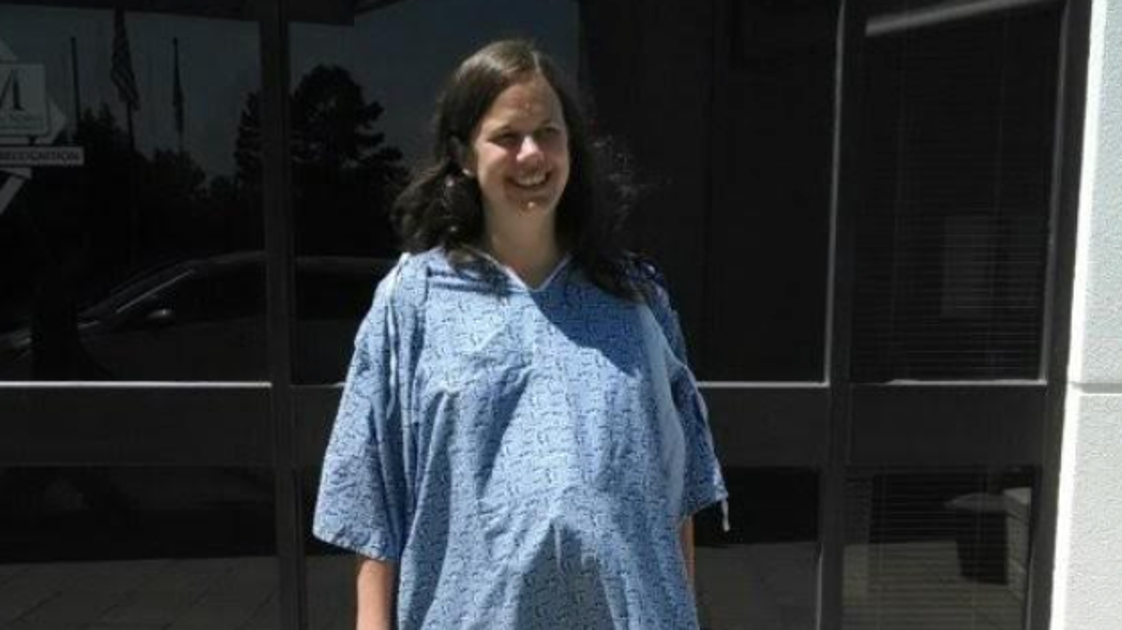
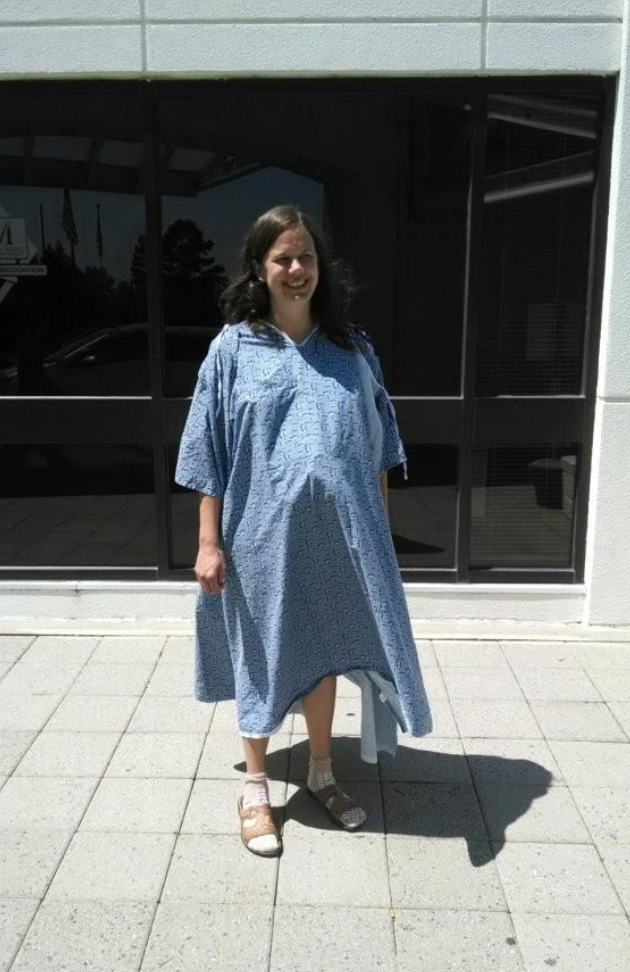 The author outside the hospital before giving birth to her daughter (Durham, North Carolina, 2014).
Photo courtesy of Bridget Bell
To effectively advocate for our own present, it is crucial to understand our own history. This is why I have decided to be candid about my mental health struggles with my children, particularly with my daughter, whose birth was the catalyst that sent me into the spinning, stifling haze of perinatal mood and anxiety disorders (PMADs).
When I Google “talking to your kids about postpartum depression,” the only hits involve conversations about PPD when the sufferer is in the throes of it with headlines like “Why Is Mommy Sad?” This information is important, but babies become toddlers and toddlers become children and children become tweens. I had my daughter in 2014 — she turned 11 this summer. Years after the fact, what do we tell the child whose birth triggered PPD?
I am not ashamed that I suffered from postpartum depression, and I am not interested in pretending it never happened. We would be falling victim to the same powers that suppress vital discourse about mental health if we keep PMAD experiences from the children whose births provoked said crises.
When I was caught in the echo chamber of PPD, I ruminated on the fear that I might pass my mental illness to my daughter. She was already my visual replica — my then-husband and I joked that she arose from my body without any of his DNA — and I fixated on the idea that she might inherit my mind, too.
When my daughter was in preschool, it became increasingly apparent that she had, indeed, inherited aspects of my mind. I recognized myself in the worries she started to voice. Even though my family is now agnostic, we live in the South, where it’s difficult to find a preschool that isn’t affiliated with a church. As part of my daughter’s school program, the kids attended “Godly Play,” which meant that a sweet, elderly woman taught them Bible stories by acting them out with rudimentarily carved wooden figurines. My daughter hated it. She took the lessons literally, and so when she heard “Jesus says to love everyone,” she thought that meant if she didn’t literally love everyone, she was a bad person.
When we walked down the street, she’d tug my hand and say, “Mommy. See that man?” pointing to a random person.
“I’m worried because I don’t think I love him.”
Some iteration of this thought became the focal point of almost every conversation I had with my daughter for an exhausting, stressful stretch of time. She obsessed that she was a “bad person”; I grew more and more weary as the target of her compulsive reassurance seeking. Eventually, my therapist pointed out what now feels obvious: that because of my mental health struggles, I was uniquely equipped to help my daughter with her anxiety.
I’m a poet, so as part of my recovery process from postpartum depression, I wrote. The first poem I wrote about maternal mental health, “To My Daughter on Her One-Month Birthday,” reveled in the triumph of a speaker whose debilitating depression had subsided to the point that she could cook dinner. From that first poem, the drafts piled up. The more I wrote, the more I fell in love with the idea of publishing a book of poems about my experience that could help other people.
Writers who share intimate details of their lives must grapple with the impact of this sharing on their loved ones. When my collection was accepted for publication, I was ecstatic, but a new worry hooked itself into my brain. How would I explain to my daughter that her birth triggered a major depressive episode? How would I explain lines like:
Some nights I bow over the crib. Almost prostrate,
I whisper, You have changed everything,
and I hate you for it. Then shame
I feared my daughter would fixate on phrases like “and I hate you for it,” that she wouldn’t understand a poem’s speaker is not always the author, that the book is based on my experience but is also based on collective experiences.
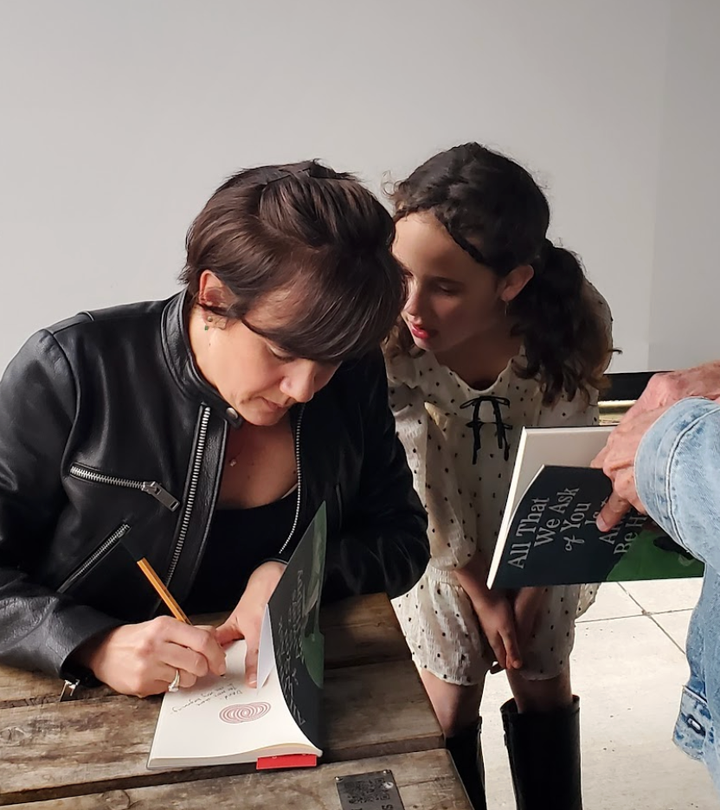 The author and her daughter at the book launch at Ponysaurus Brewing (Durham, North Carolina, 2025).
Photo courtesy of Sally Stark-Dreyfus
This is the complex legacy of perinatal mood disorders. Even after recovery, even after the “the gray smog dissipates and a fullness rises,” that trauma is now etched into a person’s history. It’s not like I could say, “It’s OK, honey, I wasn’t actually sad” or “I didn’t actually imagine abandoning you.” Because my sadness was “etched bone-deep” and I did:
I leave with the stars, follow their amber-iris eyes,
sneak out with a tiptoe creep
then pedal to the metal in my old CRV.
I needed to explain to my daughter that my symptoms and experiences were very real and very valid, but that I also always loved her, and those two conflicting ideas could be true at once. I fantasized about running away, and I was terrified and heartbroken by the idea of running away.
Nuances are difficult. The Catholic culture I grew up in was very much rooted in right vs. wrong, black vs. white, good vs. bad, happy vs. sad. Any exploration of the emotionally complex gray area between polarities was coated in a thick layer of guilt. To be both happy and sad about an experience, I also had to feel guilty for not just feeling happy.
Weeks before my publication date, the first shipment of books arrived in a heavy cardboard box. I dreamt about this moment for decades like some women dream about their wedding day. What would the cover look like in print? How would the paper feel? My aunt filmed on her phone while my kids bounced off the sofa, and I carefully slid a box cutter under the taped-down cardboard flaps.
I lifted the brown packing paper and bubble wrap off the books and squealed. It felt precious, serendipitous, joyful that both my kids could witness the birth of this book into my hands. My daughter grabbed a copy. “Wait!” I shouted, panicked. “You can’t read it yet. I need to do it with you.”
And we did. Not page by page and not in one sitting, but at her pace. When we tackled the poems, she wanted me to read her “the worst parts,” meaning the darkest, potentially most painful parts for her to hear. I did. We talked through lines like “everywhere there are always women who stare down at their babies / and wish them away, begging to wake up years earlier / lonely and free.”
I emphasized over and over that a person is not their mental illness, that I have always loved her, but I was sick after her birth, and I needed medical attention to get better.
I held my book release party at a local brewery, Ponysaurus, where I also tend bar: a big open yard, picnic tables, cold pints of beer and pizza. For the reading portion of the launch, I selected poems that focused more on healing and less on the troubling symptoms of PPD, but I still carried an anxiety boulder in the weeks leading up to the event. As my daughter’s go-to emotional support person, I knew I wouldn’t be available to her in the way she might need me to be. This made me worried but also resentful — I didn’t want her anxiety to usurp my celebration. I wanted this day to be mine.
I brought this up with her therapist, while my daughter sat on the floor fidgeting with NeeDoh. We decided we needed some “safe” people that my daughter could talk to in case she started to “spin out.” I’ve cultivated an amazing group of women around me who are my pillars, and subsequently, my daughter is also held up by these women. From this network, she and I picked a few who would be her points of contact if she needed support.
As is often the case with anxiety, my fears did not come to fruition. My daughter loves to be in charge; I put her at the head of the task force circulating the party, unabashedly asking, “Did you buy my mom’s book yet?” She flitted from person to person, selling books and stickers, taking $20 bills, finding me, handing me wads of cash. She was thriving. She was in her element.
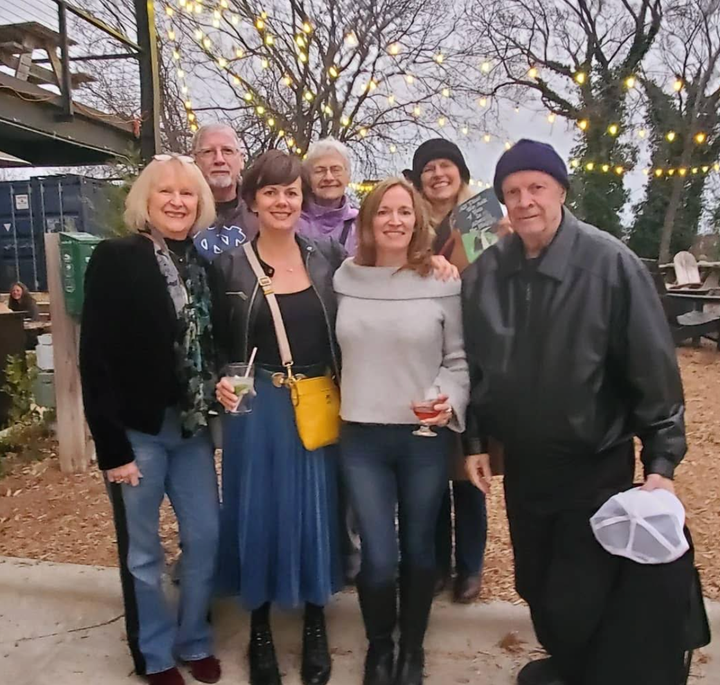 The author (front with yellow bag) and her parents, sister, aunts and uncle at the book launch at Ponysaurus Brewing (Durham, North Carolina, 2025).
Photo courtesy of Shannon Bell
Months later, after the initial whirlwind of the book’s release, my daughter, son and I gathered at one end of our long dinner table — the other end messy with life: markers, stacks of art projects, flower buds fallen from an old bouquet, two soccer playing cards, a computer charger.
I asked my daughter, “How do you feel about the book?”
She looked perplexed. “What do you mean? Like, do I like it?”
“No, like how does it make you feel? Are you upset that I was upset after you were born?”
She paused. Poked her macaroni salad.
“At first it made me sad, but now it doesn’t bother me.”
My son performed an armpit fart. The dog nosed my thigh, hoping for a table scrap. I exhaled. I will keep checking in with her about the poems; feelings evolve, and she might not be OK down the road, but I am confident I made the right choice in telling her about my postpartum depression. I know we are going to be OK.
Bridget Bell is the author of the poetry collection “All That We Ask of You Is to Always Be Happy” (CavanKerry Press 2025), which the New York Times Book Review called an “urgent, clear-eyed debut.” She teaches composition and literature at Durham Technical Community College, proofreads manuscripts for Four Way Books, and pours pints at Ponysaurus Brewing. You can find her online at bridgetbellpoetry.com or on Instagram at @bridgetkbell.
Do you have a compelling personal story you’d like to see published on HuffPost? Find out what we’re looking for here and send us a pitch at pitch@huffpost.com.