
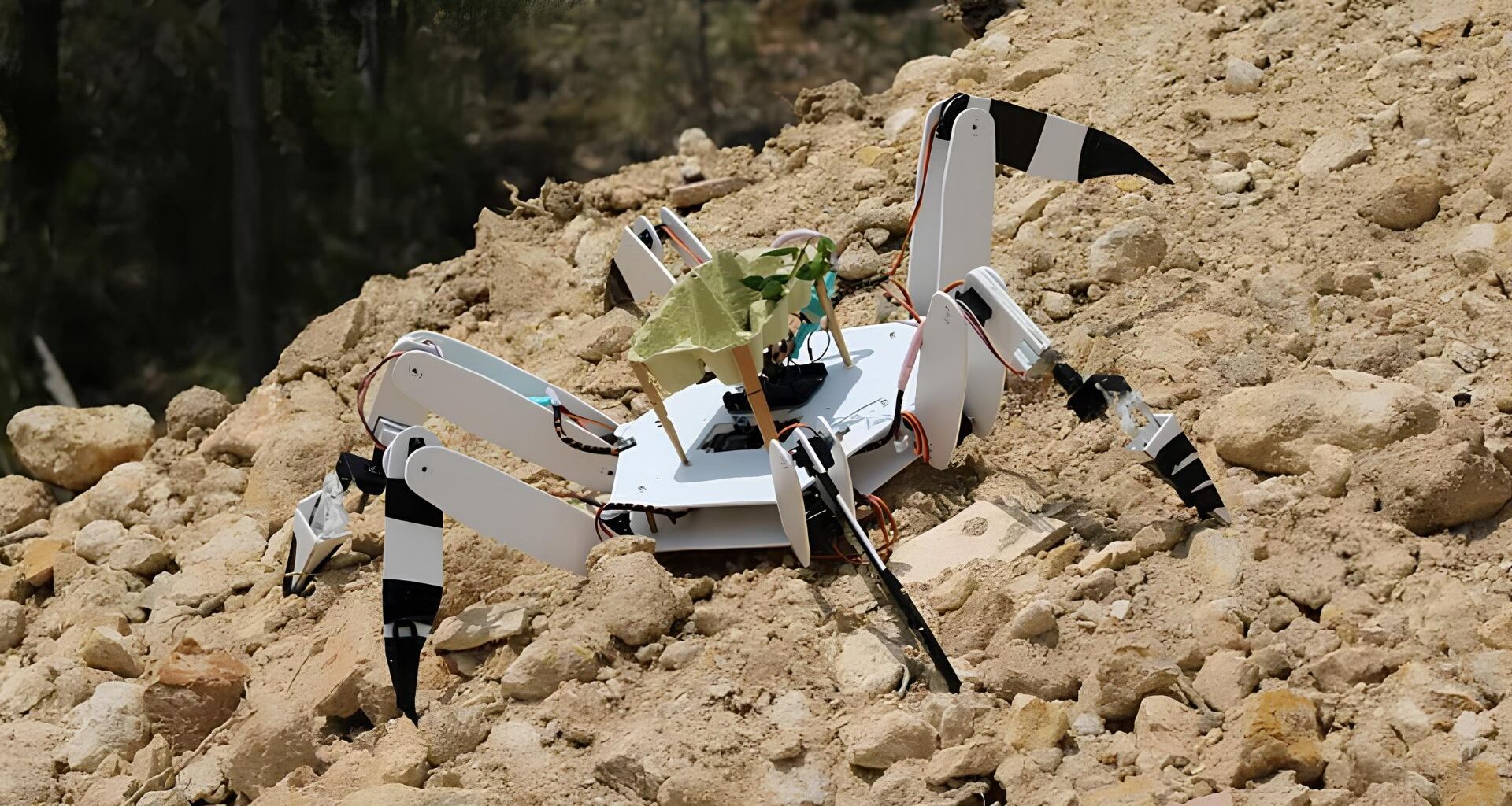
A pair of 19-year-old innovators from Portugal has developed a new all-terrain reforestation robot designed to plant trees in wildfire-damaged areas that are too steep or dangerous for people or heavy machinery to enter.
The robot, called Trovador, is a six-legged, AI-enabled planting system created by college students Marta Bernardino and Sebastião Mendonça, who began the project after witnessing repeated forest loss near their homes outside Lisbon.
Portugal is one of Europe’s most wildfire-affected countries. A 2024 study by University of Lisbon atmospheric scientist Carlos C. DaCamara found that more than 1.2 million acres burned between 1980 and 2023, equivalent to 54 percent of its territory.
In 2017 alone, the country lost 32,000 acres of tree cover, with wildfires responsible for 75 percent of that destruction. Many of these fires occur in steep, rugged terrain that volunteers and forestry crews cannot access.
“Steep terrain prevents manual planting and heavy machinery from reaching most of Portugal’s burned areas,” the duo explains in a recent crowdfunding video describing their work. With more than 60 percent of Portugal’s forests located on difficult slopes, conventional replanting methods have struggled to keep pace with recurring fires and degraded soil.
A six-legged robot built for terrain humans can’t reach
The two students began prototyping Trovador in 2023 to address the terrain issue directly. Their first €15 prototype, built from recycled parts, planted saplings 28 percent faster than humans, with a reported 90 percent survival rate and no post-planting care required.
Smithsonian Magazine reported that this initial result drove the pair to develop a more robust version capable of operating autonomously on slopes up to 45 degrees.
“We build all-terrain robots that carry baby trees on their backs and plant them autonomously across difficult terrain,” Bernardino says in the report.
Trovador’s hexapod design distributes weight evenly across the soil, preventing compaction associated with tractors or other heavy vehicles, which can disrupt water infiltration and oxygen supply.
The robot uses a depth camera to map obstacles and adjust its path in real time, and its AI system analyzes soil pH and humidity before initiating a three-step dig-place-tamp planting sequence.
The team says this method has been validated to achieve 85-90% survival in field trials and the existing literature.
Drones have been explored for aerial seeding, but they disperse thousands of seeds per acre with low precision. Bernardino notes that “drones… scatter seeds with low precision—wasting one of the most scarce natural resources,” and that some pilot projects have shown survival rates of 0-20 percent. Trovador instead plants rooted saplings one by one, reducing wastage and targeting micro-niches where survival is more likely.
With the robot capable of planting up to 200 saplings per hour, Trovador also uploads GPS coordinates, soil data, and battery information to the cloud, enabling remote monitoring. Future updates will allow the robot to automatically avoid excessively dry patches and focus on areas with better growth potential.
 An image on the team’s website shows what appears to be a newer iteration or a new concept of the Trovador robot.
From prototype to market
The project has already attracted significant attention. The students became finalists in National Geographic’s 2024 Slingshot Challenge, securing a $10,000 grant, and were recognized with a major European robotics sustainability award. Environmental experts see potential in the system but note the need for further field testing.
Landscape architect Miguel Jerónimo, coordinator of Renature projects at the Group for Studies on Spatial Planning and the Environment in Portugal, told Smithsonian that the concept “offers a practical framework for reforestation in areas that are unsafe or difficult for people to access,” but he cautions that durability, mobility through dense vegetation, and long-term performance must be proven before widespread deployment.
Cost is another concern. Bernardino and Mendonça, however, plan to address this by offering Trovador as a service rather than a hardware product. Under their model, municipalities, insurers, forestry firms, and NGOs can outline an area in an app, select native species, and receive a quote for “trees-in-the-ground.”
The team expects the approach to be significantly cheaper than manual planting and more cost-effective than drone-based methods once seed wastage is accounted for.
The developers are now refining their minimum viable product after summer field tests in Lisbon. Their goal is to deploy Trovador in large-scale restoration projects by 2026, creating, in Bernardino’s words, reforestation that is “fast, precise, audit-ready and scalable to the millions of hectares climate models say we must restore this decade.”