
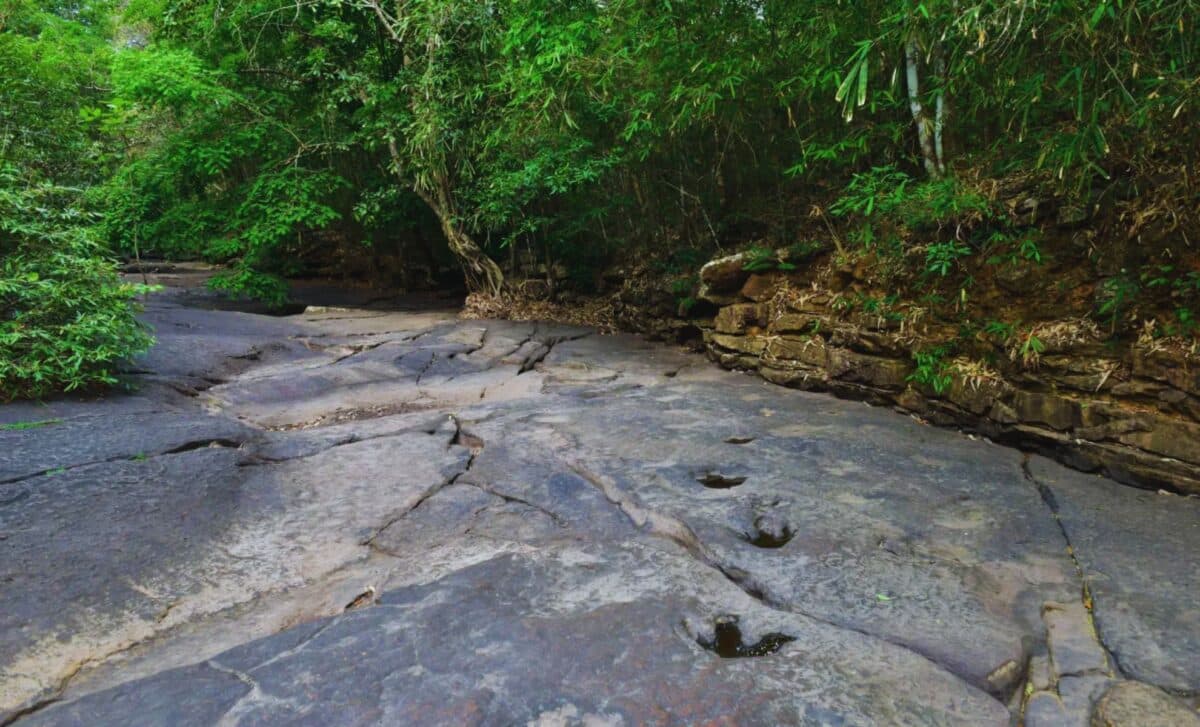
For years, paleontologists speculated about the presence of dinosaurs in the Amazon, but solid proof had been elusive. That changed when researchers from the Federal University of Roraima (UFRR) unearthed over ten ancient dinosaur footprints in northern Brazil, traces that date back more than 103 million years.
The footprints were found in the Tacutu Basin, an area in the northern part of the state of Roraima, near the town of Bonfim. For researchers, this marks the first concrete evidence that dinosaurs actually lived in the Amazon. It’s a groundbreaking find, considering how difficult it has been for scientists to preserve fossils in this region.
A Priceless Discovery in the Least Likely Spot
The Amazon, with its dense rainforest and unpredictable weather, has always been a difficult place for paleontologists to work. Fossils are hard to come by in such a climate. The tropical rain, intense heat, and constant erosion often destroy what little fossil material exists.
🦕 Groundbreaking discovery in Brazil: Scientists find dinosaur footprints in the Amazon rainforest for the first time, dating back over 100 million years. A major leap for paleontology in South America. 🌿🦖 #Fossils #Amazon #Dinosaurs #ScienceNews pic.twitter.com/DvPUg6fTEa
— Tom Marvolo Riddle (@tom_riddle2025) November 20, 2025
As CNN Brazil mentioned, the fossils are best preserved when the rock layers they’re found in remain undisturbed. In places where the rocks are exposed to the elements, like in the Amazon, they typically degrade over time, making fossil preservation a rare occurrence.
“Tacutu was a valley with several river channels that converged. It was a place with abundant water and vegetation,” Lucas Barros, a researcher who recently completed a master’s degree in that subject at the Federal University of Pampa (Unipampa), explained.
But the discovery of dinosaur footprints in the Tacutu Basin offers hope. What made this find so special was the local environment itself. A patch of savanna vegetation helped preserve the footprints.
“If a valley has a lot of moisture, the riverbanks will also be damp. After the animal makes a footprint, it gradually loses moisture and hardens, which allows it to withstand the burial process,” he added.
While the exact species that left these footprints are still unknown, researchers have been able to identify several groups of dinosaurs based on the shape and size of the tracks. These include raptors, bipedal herbivores called ornithopods, and armored dinosaurs known as xireóforos. The diversity of these species suggests that the Amazon was once home to a complex and thriving ecosystem.
How Technology Shaped the Discovery
The footprints, which were first spotted in 2014, didn’t immediately lead to major breakthroughs. Back then, the team lacked the expertise and tools to study the prints in detail. But in 2021, Barros, with the help of his colleagues, revived the project.
They employed photogrammetry, a technique that uses high-resolution images to create 3D models of the footprints. This technology allowed them to digitally map the footprints with incredible accuracy, capturing every fine detail.
“This allows us to digitize the model with high accuracy. It is through this process that we describe the footprints. That’s what I did during my master’s degree: I described the footprints and discovered new outcrops,” explains Professor Vladimir Souza.
The Path Ahead
Despite the excitement around this discovery, there are still plenty of hurdles to overcome. One major issue is gaining access to the land where many of the footprints are located.
Barros pointed out that much of the area is privately owned, and landowners are often reluctant to allow further research. This reluctance to cooperate means that many valuable sites remain off-limits, which could hinder future discoveries.
Still, he estimates that there are hundreds of additional footprints waiting to be uncovered in the region. His team is already looking into other areas, including the Jabuti Indigenous Land, where four promising sites have been found.