
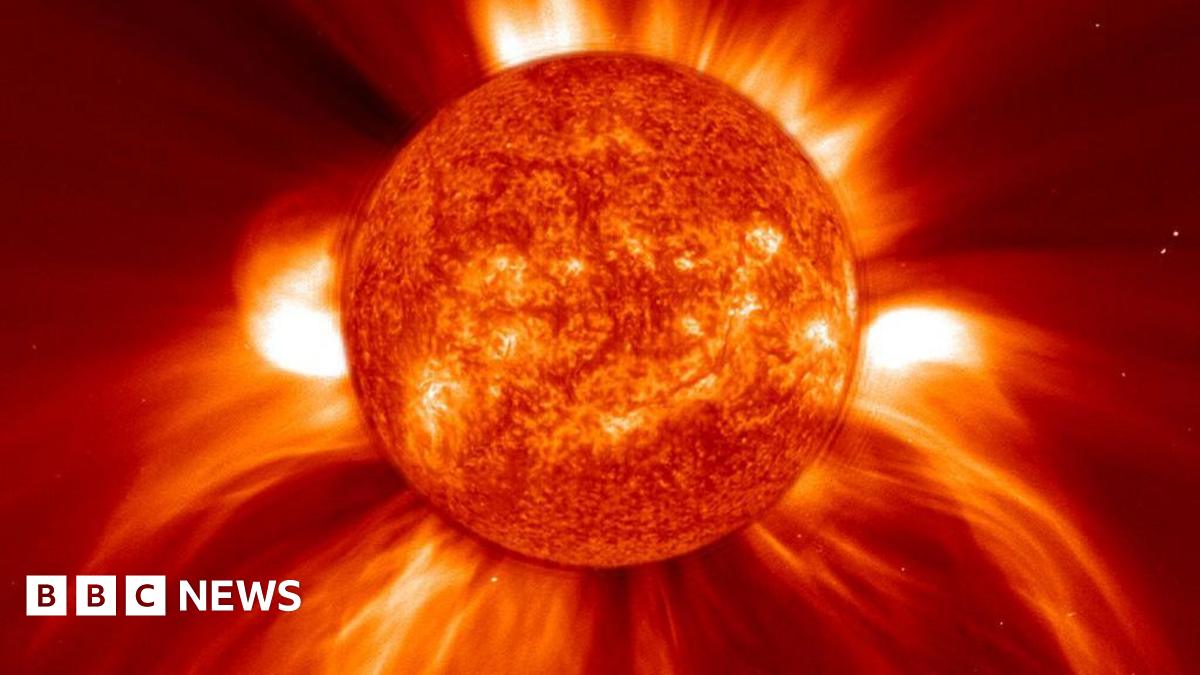
There are other solar missions watching the Sun, but Aditya-L1 has an advantage over others, including the Solar and Heliospheric Observatory sent jointly by Nasa and Esa (European Space Agency), when it comes to watching the corona.
“Aditya-L1’s coronagraph is the exact size that lets it nearly mimic the Moon, fully covering the Sun’s photosphere and allowing it an uninterrupted view of almost all of the corona 24 hours a day, 365 days a year, even during eclipses and occultations,” says Prof Ramesh.
In other words, the coronagraph acts like an artificial Moon, blocking the Sun’s bright surface to let scientists continuously observe its faint outer corona -something the real Moon does only during eclipses.
Moreover, this is the only mission that can study eruptions in visible light, letting it measure a CME’s temperature and heat energy – key clues that show how strong a CME would be if it headed toward Earth, says Prof Ramesh.
To prepare for next year’s peak solar activity period, the IIA collaborated with Nasa to study the data it gathered from one of the largest CMEs that Aditya-L1 has recorded until now.
It originated on 13 September 2024 at 00:30 GMT, Prof Ramesh says. Its mass was 270 million tonnes – the iceberg that sank Titanic was 1.5 million tonnes, he says.
At origin, its temperature was 1.8 million degrees Celsius and the energy content was equivalent to 2.2 million megatons of TNT – in comparison, the atomic bombs on Hiroshima and Nagasaki were 15 kilotons and 21 kilotons respectively.
Even though the numbers make it sound incredibly large, Prof Ramesh describes it as a “medium-sized” one.
The asteroid which wiped out the dinosaurs on Earth was 100 million megatons and during the Sun’s maximum activity cycle, he says, we could see CMEs with energy content equal to even more than that.
“I consider the CME we evaluated to have occurred when the Sun was in the normal activity phase. Now this sets the benchmark that we’ll be using to evaluate what is in store when the maximum activity cycle occurs,” he says.
“The learnings from this will help us work out the countermeasures to be adopted to protect satellites in near space. They will also help us gain a better understanding of near-Earth space,” he adds.
Follow BBC News India on Instagram, external, YouTube, external, Twitter, external and Facebook, external.