
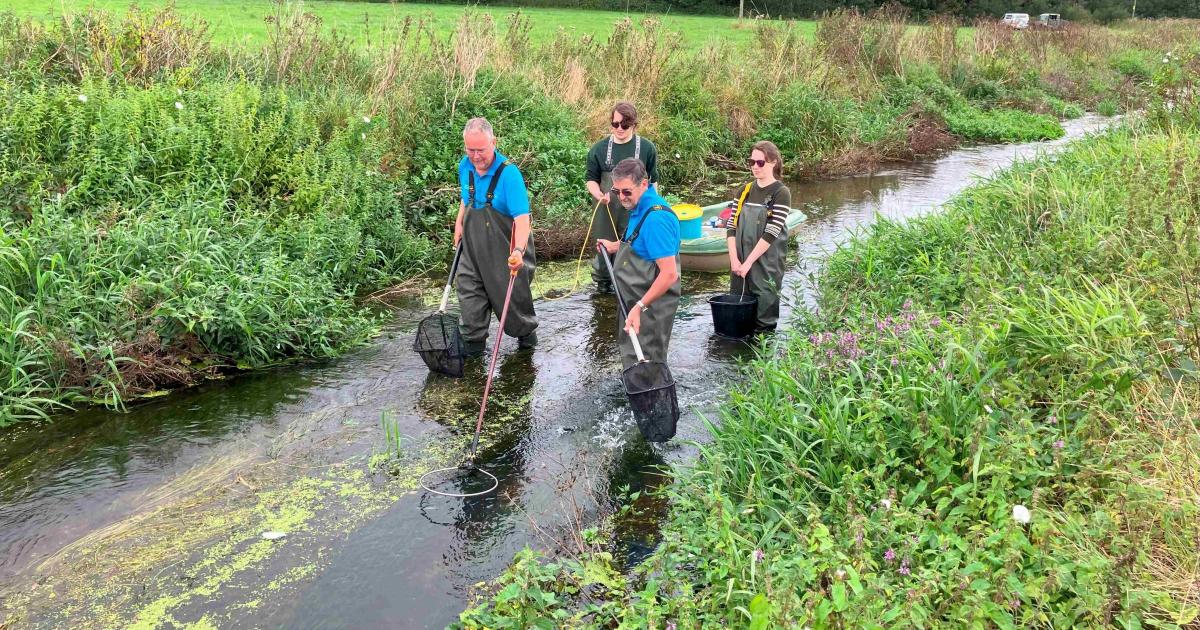
It comes after the Game & Wildlife Conservation (GWCT) released the results of its annual counting and tagging of juvenile wild Atlantic salmon along the Dorset river, which runs from the Dorset Downs at Evershot to Poole Harbour.
Since 2002, the trust has spent four weeks in late summer catching, weighing, measuring and microchipping the juvenile salmon with an aim to tag 10,000 fish.
But this summer only 3,226 were caught – a new record low which follows on from last year’s disappointing total of 4,593 – revealing a dramatic decline in numbers.
GWCT team during their annual salmon count (Image: GWCT)
GWCT’s senior research assistant Will Beaumont, who led the fieldwork, said that last year was the ‘worst we’ve ever had,’ but this year ‘has been catastrophic’.
Numbers of wild Atlantic salmon have crashed by some 80 per cent over the last 40 years and are now classified as endangered in the UK and on the International Union for Conservation of Nature red list along with other threatened species like elephants, pandas and polar bears.
The trust has put this massive decline down to climate change and fishing practices at sea, combined with algae growth and sediment in the river.
Dylan Roberts, head of fisheries at GWCT, added: “This decline is alarming, and if it continues salmon could disappear from our UK rivers in the next 30 years.
“My team has seen first-hand the changes to the physical nature of the River Frome. In recent years, we have seen a huge increase in the growth of algae between spring and autumn which smothers the riverbed, shades and then reduces the growth of plants like water crowfoot, which are crucial habitats for juvenile salmon and the insects upon which they feed.
“We’ve also seen increases in the quantity of sediment, which is mud running from the riverbanks and ploughed fields into the river where it smothers and suffocates salmon eggs.”
A wild Atlantic salmon (Image: Chris Conway)
The trust is working to tackle the issue alongside farmers, such as Ian Baggs, a dairy farmer near Wareham, whose herd grazes the water meadows and fields near the river.
Mr Baggs said that farmers have an ‘obligation to do the right thing’ in order to secure long term sustainability for future generations.
He has already planted deep-rooted grass along the river to avoid silt run off into the river and said he is ‘happy to look at doing more’ and ‘wants to do more’ but called for additional financial support and expert advice.
The GWCT has already developed ‘farmer clusters’ to facilitate groups of landholders to work together to save threatened species in their local area.
Colin Smart, from the Environmental Farmers Group Dorset, said: “We are planning to develop a catchment conservation plan for the Frome with advice and input from GWCT Fisheries. As part of that we are surveying the length of the River Frome to build a picture of where we can make improvements.
“With a sufficient blend of investment from both the private and public sector, the catchment plan has the potential to reverse the catastrophic decline of salmon in the Frome, which is an indication of the poor health of the entire river system.
“Farmers do care about the environment and can make a real difference but also need to produce food and make a living. They need adequate compensation to put the right measures in place.”