
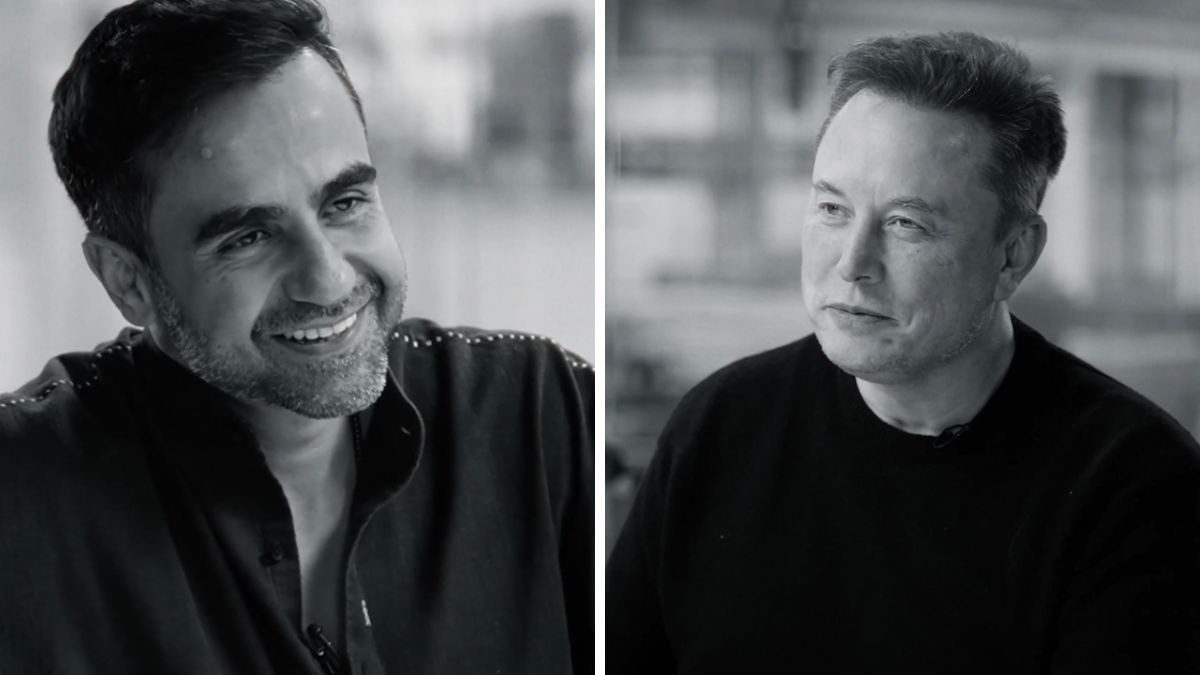
In a country where MBA degrees are still viewed as passports to power, Elon Musk’s take on higher business education might come as a curveball.
Speaking to investor and entrepreneur Nikhil Kamath on the People of WTF podcast, the Tesla and SpaceX CEO suggested that business school may not be the best path for aspiring entrepreneurs — particularly in an age defined by rapid technological change and real-world problem-solving.
“If you want to go to college for social reasons, fine. But for building a company, it’s often unnecessary,” Musk said, adding that experience, persistence, and a willingness to get your hands dirty are far more valuable than polished case studies and theoretical lectures.
Musk’s comments were part of a wide-ranging discussion aimed at India’s next generation of builders — young, ambitious individuals who are increasingly choosing startups over traditional careers. Kamath framed the conversation to offer practical takeaways for this audience, many of whom are debating whether to take on the financial burden and time commitment of an elite MBA.
For Musk, the core issue is one of relevance. “You can learn a lot more by just trying to build something,” he implied, pointing to the speed at which technology, markets, and customer needs are evolving. Traditional curricula often lag behind, and business school frameworks, while structured, may be poorly suited to navigating the unpredictable terrain of entrepreneurship.
His position isn’t new, but it’s particularly resonant in India, where MBA degrees from top-tier institutions like the IIMs or international programs are seen as life-changing. Yet the startup boom has created an alternate playbook — one where engineers, dropouts, and non-traditional founders are building some of the country’s most valuable companies.
Musk’s own career reflects this path. Though he studied physics and economics, it was his early startup experience — coding and selling Zip2, then co-founding PayPal—that laid the foundation for everything that followed. He didn’t go to business school; he built one, trial by fire.
His critique isn’t anti-education — it’s anti-dogma. Musk still believes in learning, but advocates for curiosity-driven, problem-led, and interdisciplinary learning. He’s spoken elsewhere about how too many MBA-trained executives become focused on managing the spreadsheets rather than understanding the product and customer.
This perspective echoes across Silicon Valley, but it’s especially provocative in India, where the premium placed on formal qualifications remains high. Musk’s remarks challenge the idea that credentials guarantee capability, nudging young Indians to look inward: What can you build? What can you solve?
For those who thrive in structured environments or seek networks, an MBA may still hold value. But for founders on a mission, Musk’s advice is clear: skip the classroom, step into the arena.