
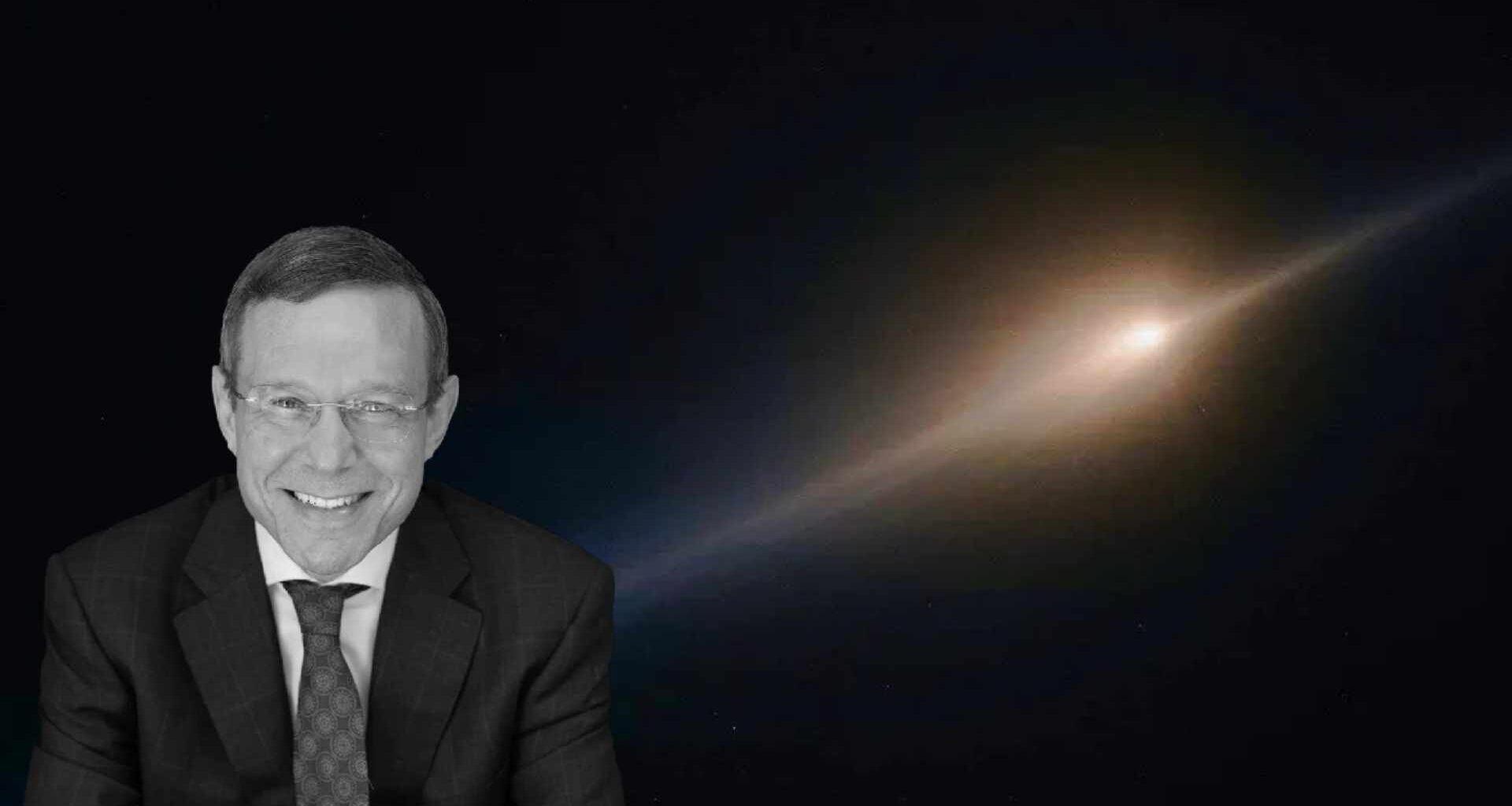
Comet 3I/ATLAS, the third interstellar object since 1I/Oumuamua (2017) and 2I/Borisov (2019), was spotted by the Chile-based Asteroid Terrestrial-Impact Last Alert System, aka ATLAS on July 01, 2025.
The interstellar interloper has failed to bore the researchers and public alike with its anomalous behavior as it cruises through the solar system. Its bizarre behavior has baffled experts, as the exocomet performed perihelion on October 29th, getting the closest to the Sun, on its maneuver to exit the solar system. From multiple jets to its chemical composition and alleged non-gravitational acceleration, there are so far 13 anomalies identified by Harvard astrophysicist Avi Loeb that possibly indicate 3I/ATLAS might just not be what it pretends to be—a comet.
In his latest blog on Medium, Prof. Loeb, the Israeli-American theoretical physicist, unpacked another interesting aspect of the 3I/ATLAS comet. The scientist states that the light from the exocomet shows its pulsating variability with a period of 16.16 (earth) hours. It was first published in August by T. Santana-Ross et al. in a paper entitled Temporal Evolution of the Third Interstellar Comet 3I/ATLAS: Spin, Color, Spectra, and Dust Activity. The observation was done using time series photometry and long-slit spectroscopy. The process involved several ground-based telescopes for the study conducted between 2nd and 29th July. The result of the study is as follows:
We report a spin period of 16.16 ± 0.01 h with a light curve amplitude of approximately 0.3 mag. The comet exhibits increasing dust activity and reddening colors during the observation period with no visible tail detected, likely due to viewing geometry and low dust production. Dust mass-loss rates are estimated between 0.3 and 4.2 kg s⁻¹, consistent with weakly active distant comets. Spectral colors are similar to those of outer Solar System comets and differ from previously reported values for 3I/ATLAS.
Remarking on the observation, Prof Avi Loeb quipped in his blog
the association of this variability with the ellipsoidal shape of the nucleus is not warranted.
He added,
Based on the Hubble Space Telescope image taken on July 21, 2025 (and reported here), most of the light observed from 3I/ATLAS originates from a glowing halo around it, a coma. This coma is transparent so that the nucleus can be seen through it. The fraction of the total light originating from the reflection of sunlight by the nucleus is unknown, because the nucleus size is not resolved in the Hubble image. However, the brightest pixel in the image presumably overlaps with the nucleus and contains a small fraction of the total light.
He further reflects
If the nucleus is spinning over 16.16 hours, why was the periodic variability at a level of tens of percent in total light? Over the past month, images of 3I/ATLAS showed multiple jets. If the mass loss in the jets is pulsed periodically, the resulting coma would display periodic variability in its scattering of sunlight.
Loeb continues in the blog
In the context of a natural comet, this can arise from a sunward jet (anti-tail) that is initiated only when a large pocket of ice on one side of the nucleus is facing the Sun. As a result, the coma will get pumped up every time the ice pocket is facing the Sun. This resembles a heartbeat with a puff of gas and dust serving the role of a stream of “blood” through the coma periodically over the rotation period of 16.16 hours.
Is it something more than a bizarre comet? Loeb remarks,
This heartbeat pattern should have been apparent in a series of well-calibrated snapshots of the coma over several days but none was systematically studied in the published literature. For a technological object, the direction of the pulsing jet could be arbitrary and not necessarily pointing towards the Sun.
A movie showing the periodic brightening of the jets around 3I/ATLAS over several days can reveal whether the jets are natural or technological based on the orientation of the heartbeat pattern relative to the Sun.
Did the Harvard scientist catch another anomaly in the pulsation activity of 3I/ATLAS? We will update if he does.
See Also: 3I/ATLAS: Harvard Astrophysicist Avi Loeb Unpacks The Clearest Captured Images Of The Exocomet