
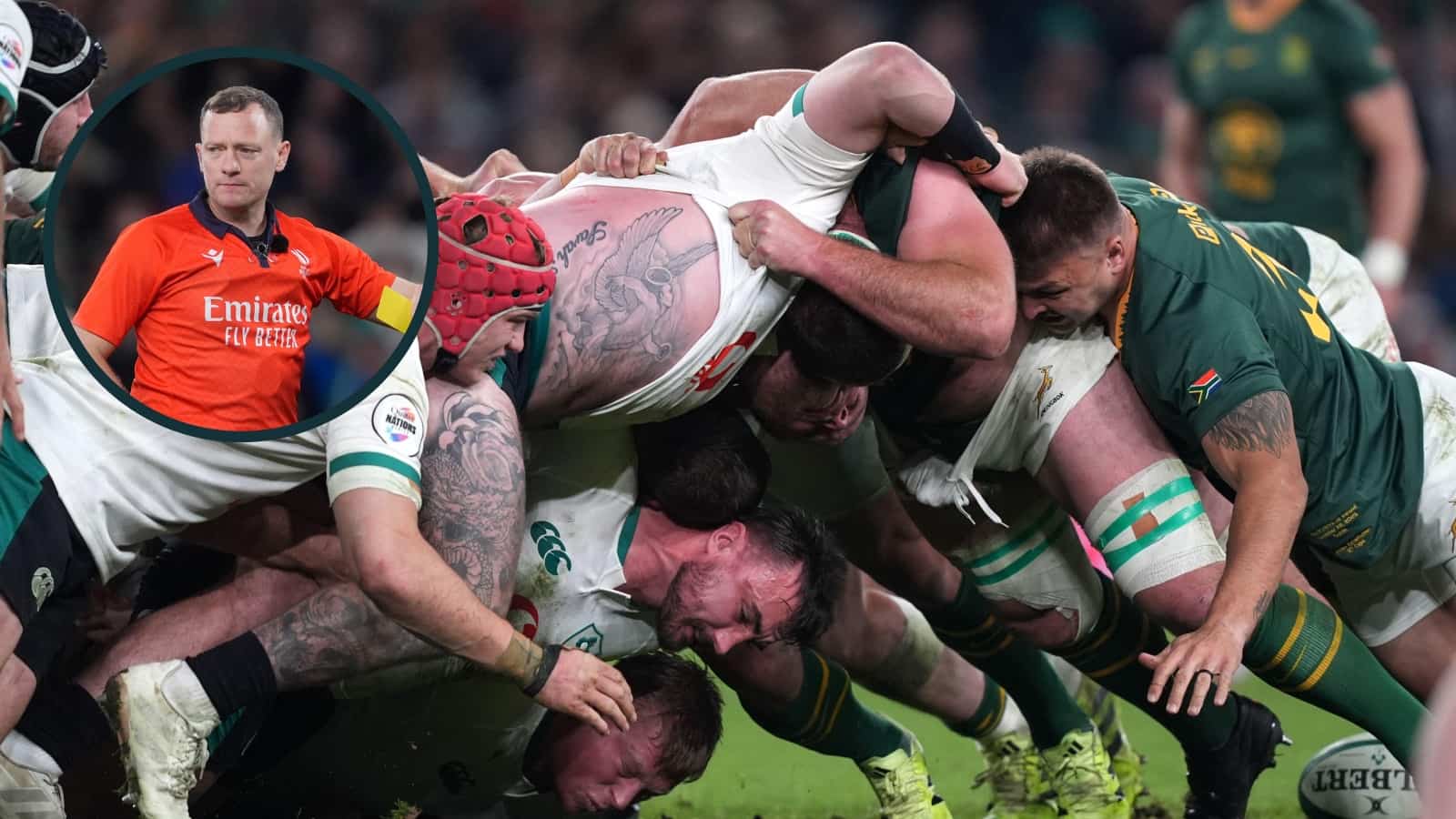
The Six Nations unions are set to call for a review of the laws around yellow cards for scrum infringements following the Springboks’ manhandling of Ireland.
South Africa claimed a 24-13 victory over the Irish at the Aviva Stadium in November, a fixture marred by the six cards issued on the night, including a red card to James Ryan.
Two of the yellow cards were issued to Ireland loosehead props Andrew Porter and Paddy McCarthy, who were sin-binned for repeated indiscretions in the scrums, where the Springboks had clear dominance.
No more cards for weak scrums?
The sin-binning of the two front-rowers has caused much debate, as many believe that players should not be yellow-carded simply for being outpowered at the scrum. The fairness of such sanctions will reportedly be discussed by the Six Nations bigwigs when they meet before the tournament in the new year.
The Times reports that the meeting could result in the Six Nations unions issuing a proposal at World Rugby’s Shape of the Game conference in February, where law changes can be brought in, usually after trials.
It adds that any law changes wouldn’t be pushed through by World Rugby until after the 2027 Rugby World Cup, as per the governing body’s rule, meaning that it would not depower one of the Boks’ most lethal weapons before the tournament.
“In what other sport can you be sent off basically for not being as good or as strong as your opponent?” One senior rugby figure told The Times.
“The dominant scrum is already gaining a penalty as an advantage and then that is compounded by a yellow card. A yellow card should only be shown if a player tries to gain an advantage by breaking the rules or for dangerous tackles.”
The report adds that those who want to review the laws around yellow cards at the scrum don’t want to depower the set-piece, but don’t believe that players should be sin-binned for being weaker or less technically proficient than their opponent.
Nigel Owens’ view
Former referee Nigel Owens weighed in on yellow cards being issued to front rowers who are losing the scrum battle on World Rugby’s Whistle Watch show.
On the show, former Wales centre Jamie Roberts argued that the scrum is possibly the facet in the game where the discrepancy in quality is at its highest.
Owens agreed and stated that front-rowers shouldn’t be yellow carded for simply going backwards in the scrums but often, a team that is being dominated, deploy tactics like collapsing the set-piece to hide the fact that they are the weaker pack. He adds that if a prop is doing everything legally but is still going backwards, they shouldn’t be sin-binned.
“Yeah, you’re right. When I mentioned to you earlier about England v Ireland in Twickenham 2013 or 2014. I think it was one or two penalty tries against Ireland, a lot of penalties in the scrums, and I didn’t bin anybody,” Owens said in reply to Roberts’ statement.
“And the reason why I didn’t bin the player was that I felt that he was doing nothing wrong. He’s just being driven back. He’s losing the battle against a good England front row, and the guy is going back, he’s going up, he’s going down. He’s not taking it down himself; it’s just the force of the like we saw on the weekend, I think.
“If the player isn’t doing anything wrong and is just being beaten, then that shouldn’t be resulting in a yellow card.”
He continued: “If a scrum goes up or down or across, 99.9% of the time you’re going to reward the dominant scrum.
“So, as a defensive scrum, what are you going to do then? We need to take this down or take it up before they show momentum, which means a referee may be a bit more reluctant to reward them because he can’t see the dominance. So that’s why sometimes a lot of scrums will go down pretty early because they don’t want to show the dominance – they don’t want to show that they were more dominant than us.
“That takes a little bit more experienced referee to sort that out, because if a side is going backwards, it’s an easy picture. But when it’s going down pretty on impact, or the ball is going in, it’s much more difficult.”