
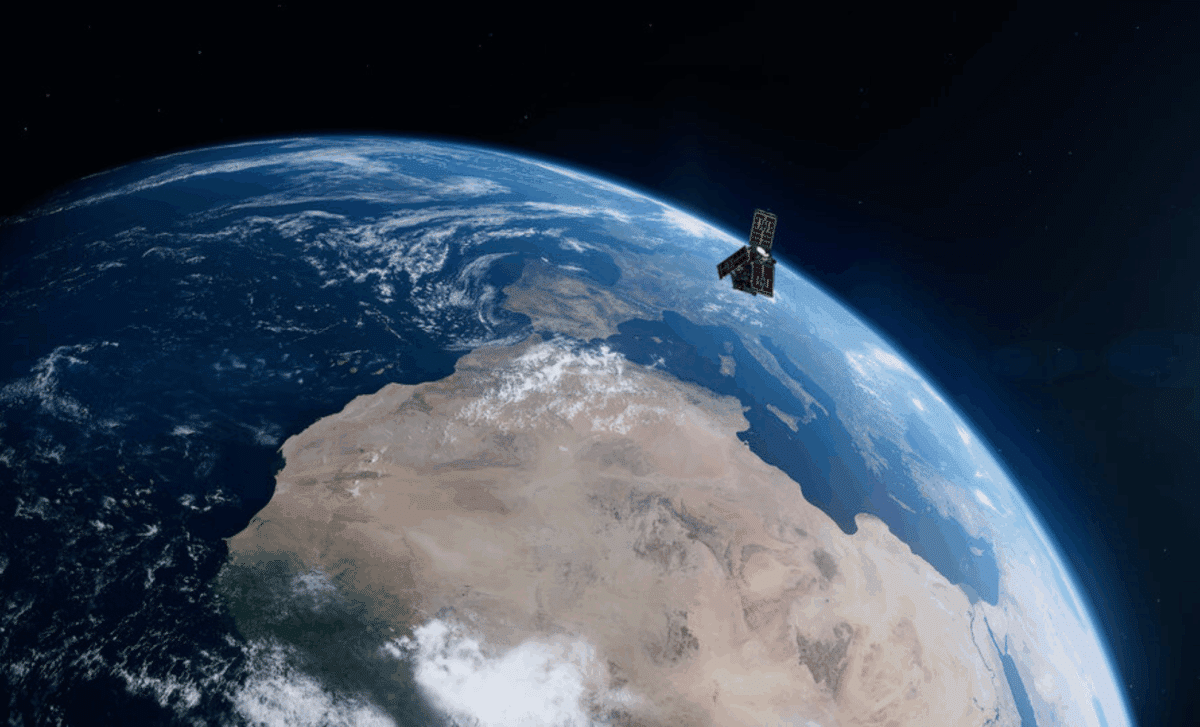
In a significant leap forward for climate research and water cycle monitoring, the European Space Agency (ESA) has successfully launched its HydroGNSS mission. The mission, which took place on November 28, 2025, aims to enhance our understanding of global water availability and provide vital data on how climate change impacts the Earth’s water cycle. HydroGNSS will use innovative satellite technology to “scout” water using Global Navigation Satellite System (GNSS) reflectometry.
ESA’s HydroGNSS Mission: A Leap Forward in Climate Science and Water Cycle Monitoring
ESA’s HydroGNSS mission is the first to launch under the agency’s new Scout program, a series of small, agile, and cost-effective Earth observation satellites. This mission will revolutionize how scientists monitor Earth’s water cycle by using GNSS reflectometry, a technique that captures and analyzes signals reflected off Earth’s surface. By measuring these reflections, HydroGNSS satellites can assess key hydrological variables, such as soil moisture levels, inundation, and biomass.
ESA’s Director of Earth Observation Programmes, Simonetta Cheli, highlighted the importance of this milestone, saying,
“As the first of ESA’s Scout missions to launch, HydroGNSS marks an important milestone for this new family of rapid, low-cost Earth observation missions, and we extend our thanks to the mission’s prime contractor, SSTL.”
With its rapid deployment time and low cost, the Scout program aligns with ESA’s strategic goals to provide efficient and innovative solutions for global challenges.
HydroGNSS will provide real-time, high-resolution data that could significantly improve how we predict and respond to climate-related challenges. Its ability to measure water-related variables such as soil moisture and freeze-thaw states makes it an essential tool for researchers and policy-makers aiming to understand and mitigate the impacts of climate change.
Additionally, the mission will support flood prediction models, which could save lives and resources by providing early warnings and improving disaster preparedness.
GNSS Reflectometry: A Game-Changer for Earth Observation
The HydroGNSS satellites employ an advanced technique known as GNSS reflectometry. This process involves capturing L-band signals from GNSS systems like GPS and Galileo, which are then reflected off Earth’s surface. By comparing the reflected signals to the direct ones, the satellites can map various hydrological features, including soil moisture, water levels, and vegetation health. The reflected signals provide unique insights into Earth’s surface properties, which are essential for understanding the global water cycle and its relationship with climate change.
Each of the two HydroGNSS satellites carries a delay Doppler mapping receiver with two antennas: one that tracks direct GNSS signals and another that collects reflected signals. These signals are processed into detailed maps that provide information on soil moisture, surface water, and other critical hydrological data. This technique enables the satellites to provide near-continuous, high-precision data that can be used for monitoring floods, droughts, and other water-related phenomena.
This innovation marks a step forward in Earth observation, as GNSS reflectometry is much more cost-effective and scalable than traditional satellite observation methods. By using existing GNSS systems to gather data, HydroGNSS significantly reduces the cost and complexity of monitoring Earth’s water cycle. The mission’s small, agile satellites are designed to operate efficiently while providing critical data that can be used across various industries, including agriculture, environmental management, and disaster response.
The Role of HydroGNSS in Understanding Climate Change
One of the primary goals of the HydroGNSS mission is to better understand how climate change affects Earth’s water cycle. Climate change has a profound impact on water resources, from altering precipitation patterns to causing more frequent and severe droughts and floods. By monitoring hydrological variables like soil moisture and freeze-thaw cycles, HydroGNSS can help researchers track these changes in real time.
HydroGNSS will also provide crucial data on wetlands, which play a vital role in the global carbon cycle and climate regulation. Wetlands are often difficult to monitor due to their location and accessibility, but the HydroGNSS satellites can detect these ecosystems by observing areas of inundation and waterlogging. As wetlands are significant sources of methane, monitoring their extent and condition can help mitigate the effects of climate change. Additionally, by tracking freeze-thaw states, HydroGNSS will contribute to understanding the behavior of subsurface permafrost, particularly in high-latitude regions where climate change is most pronounced.
ESA’s Vision for the Future: Fast, Agile, and Cost-Effective Earth Observation Missions
The HydroGNSS mission is a testament to ESA’s vision for the future of Earth observation. As part of the agency’s FutureEO program, the Scout missions are designed to be fast, agile, and cost-efficient. The program aims to deliver valuable data quickly and at a lower cost than traditional, larger missions. HydroGNSS was developed and launched within just three years and with a budget of €35 million, showcasing the potential of small satellites to address global challenges in a timely and cost-effective manner.
“The launch also represents a key step in the evolution of our FutureEO programme, where the Scouts embody a fast, agile, innovative and cost-efficient approach – complementing our larger Earth Explorer research missions,” said Simonetta Cheli. By combining speed, agility, and cost-efficiency, ESA’s Scout missions are setting new standards for Earth observation. These missions will complement ESA’s larger Earth Explorer programs, which focus on in-depth scientific research and long-term data collection.