
This is because the neutron flux – a measure of neutron radiation – rises the higher up in the atmosphere you go, increasing the chance of a strike hitting sensitive parts of the computer equipment on board. Aircraft are more vulnerable to this problem than computer equipment on the ground, although bit flips do occur at ground level, too. The increasing reliance of computers in fly-by-wire systems in aircraft, which use electronics rather than mechanical systems to control the plane in the air, also mean the risk posed by bit flips when they do occur is higher.
The JetBlue incident is reminiscent of a case in 2008 involving an Airbus A330, when a Qantas flight fell hundreds of feet twice within 10 minutes, injuring dozens of passengers. A report by the Australian Transport Safety Bureau that followed could not conclude that a cosmic bit flip was definitely the cause – but it was left as the most likely scenario after several others were more or less ruled out.
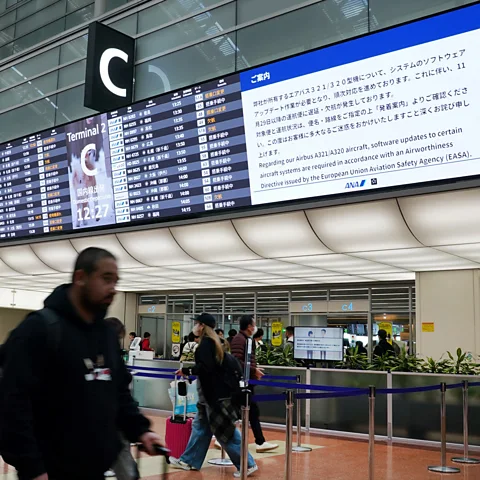 Getty ImagesThe emergency upgrades needed on several types of Airbus aircraft meant flights on many airlines were disrupted around the world (Credit: Getty Images)

Airbus told the BBC that it tested multiple scenarios when attempting to determine what happened to the 30 October 2025 JetBlue flight. In this case also, the company ruled out various possibilities except that of a bit flip. It is hard to attribute the incident to this for sure, however, because careering neutrons leave no trace of their activity behind, says Owens.
An Airbus spokesman stressed “there is no link” between the JetBlue flight and the 2008 Qantas incident. The corrupted electronics on the Qantas flight were situated in a component that tracks and processes flight data. By comparison, the computer error that caused problems for the JetBlue flight occurred in the A320’s Elac system, which controls certain moving parts of an aircraft’s wings to adjust elevation and roll.