
Before leaving for a four-month exchange programme in North Carolina, Ms Sarah Chee was weighing whether to spend $1,000 on health insurance in the US.
The 21-year-old marketing student at the Singapore Management University understood insurance – in theory. “I knew vaguely that buying insurance means paying for peace of mind,” she said. “But what does that really involve?”
Fortunately, she learnt the answer the easy way, before a real-life crisis could hit.
It came through a board game at UOB Privilege Banking’s two-day financial literacy workshop for young adults.
The July workshop featured expert-led sessions on topics ranging from investing and insurance to budgeting and cash flow management. It was attended by 54 participants aged between 18 and 25 from Singapore, Malaysia, Vietnam and Thailand.
The board game, called “Cashflow”, is played by up to six players. It is similar to Monopoly; the aim of the game is to get out of the “rat race”, says Ms Chee.
It brought financial concepts to life. Players assumed different careers and incomes, she explains.
They had to navigate unexpected expenses and try to build passive income, while avoiding the dreaded “medical emergency” tile that could wipe out their savings if they didn’t have health insurance.
This was “a wake-up call” for Ms Chee. The game helped her understand, in practical terms, the consequences of not having insurance.
The lesson ultimately led her to bite the bullet, she shares, and pay for health insurance for her exchange trip – out of her own pocket.
The financial literacy workshop attended by Ms Sarah Chee, 21, in July is part of UOB’s ongoing efforts to enhance financial literacy for Singaporeans across different life stages.
In September 2025, the bank announced a partnership with Central Singapore Community Development Council (CDC) aimed at strengthening the financial well-being of residents in the central region including Ang Mo Kio, Toa Payoh and Jalan Besar.
From January 2026, Central Singapore CDC and UOB will also roll out free regular financial literacy workshops tailored to different life stages, from first jobbers to retirees.
Sessions for young families will cover topics like budgeting and insurance, while those for pre-retirees will touch on legacy and retirement planning.
Through this initiative, Central Singapore CDC and UOB hope to reach more than 1,000 residents in 2026, supporting families in building financial confidence and long-term resilience.
Financial literacy is an essential life skill, says UOB’s head of Wellness and Community Partnerships, Mr Stanley Teo.
But gaps remain when it comes to financial education in Singapore. “Most people have never had formal education on financial literacy, (at least) not in schools,” the 53-year-old adds.
“We pick up (most financial skills and habits by) observing what others do; or worse, we learn only when we’ve made the wrong decisions and lost money.”
Mr Teo and his team at UOB organises financial literacy initiatives in the heartlands to equip people with skills to make informed financial decisions. These include educational talks, events and roadshows.
They also partner with government and social agencies like Central Singapore Community Development Council, Care Corner, and Methodist Welfare services, he says.
Together, they create programmes to educate people on topics such as how to protect themselves from scams, and familial financial abuse, such as when children demand monetary support from elderly parents.
A concerning trend, Mr Teo notes, is the prevalence of “buy now, pay later” (BNPL) services among younger Singaporeans.
According to a 2024 report by London-headquartered payment processing firm Worldpay,
over 70 per cent of Gen Zs
in Singapore used BNPL services in 2024
. This is the highest percentage among all age groups.
Gen Zs are those born between 1997 and 2012.
“(BNPL) services can seem like it is easy to manage at first, when it is just one purchase,” says Mr Teo, but the owed amount accrues over the payment period.
Young consumers are particularly at risk, he adds. They may be attracted by BNPL’s low instalment amount and take multiple plans within a short period of time – “only to realise the magnitude of their debt when the bills arrive,” Mr Teo says.
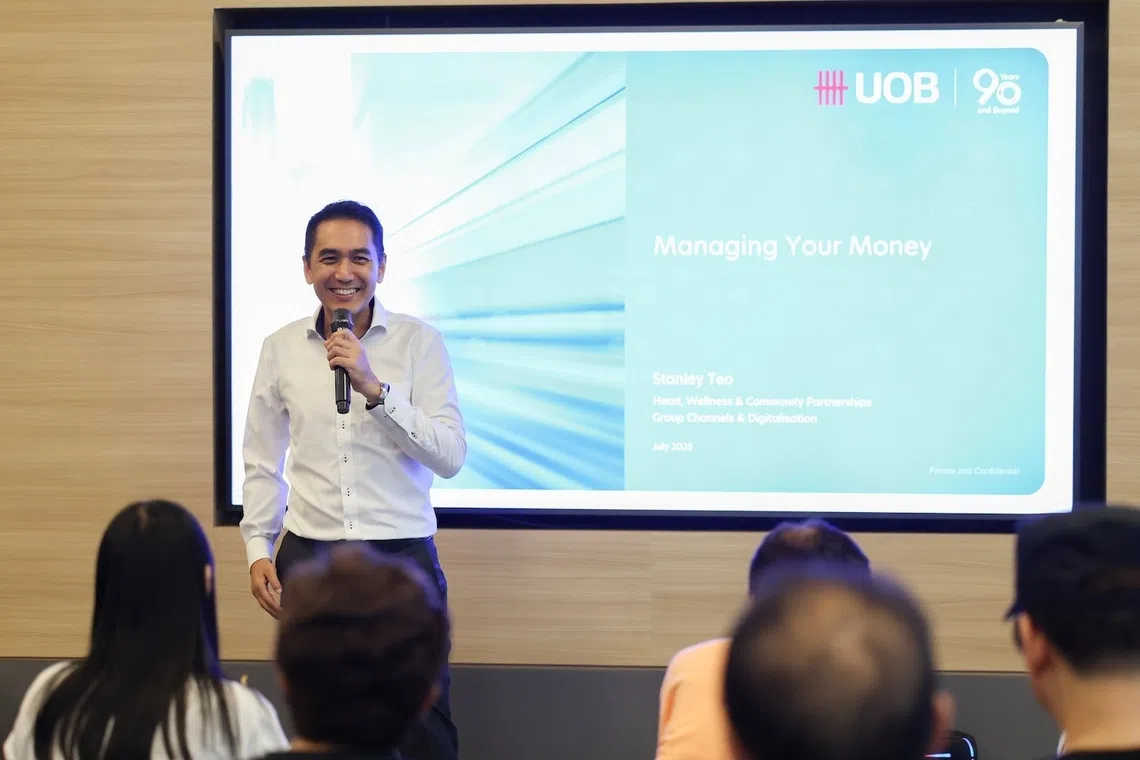
Mr Teo and his team at UOB organises financial literacy initiatives like educational talks, events and roadshows, for people of all ages. PHOTO: UOB
Mr Teo shares candidly that financial planning became a pressing concern for him at the age of 50, when he welcomed his third child. He also has a daughter, 16, and a son, 12.
“I realised I would need to support (my youngest son) until he (finishes) university,” Mr Teo says. By then, he would be in his 70s.
This forced him to rethink his long-term planning: how to grow his money steadily, support all three children through their education, and still retire before the age of 65.
The experience reinforced a belief that Mr Teo now brings into his work: that financial wellness is a key pillar of holistic wellbeing.
Money troubles can negatively impact one’s mental and physical wellbeing, he explains, likening financial planning to doing annual health check-ups. “It’s important we know where our gaps are, then we can know what to work on.”
Meanwhile, Ms Chee, who graduates in 2027, is focused on building the basics.
She saves up to 40 per cent of her three-figure monthly allowance, works part-time at a florist during her school holidays, and only eats out with friends twice a month.
The crochet lover hopes to travel regularly, buy her own home by the age of 30, and eventually start her own small business in floristry or crafts.
Ms Chee says that after graduation, she looks forward to achieving financial independence through a full-time role in marketing, a field she’s passionate about.
Mr Stanley Teo, head of Wellness and Community Partnerships at UOB, shares three practical tips to help you…
Plan better
Build an emergency fund that covers three to six months worth of expenses. This acts as a financial buffer during unexpected events like sudden income loss or medical emergencies.
Spend smarter
Follow simple budgeting rules of thumb, says Mr Teo, who recommends the 50-30-20 framework. How it works:
50 per cent for essential needs such as food, transport and basic living expenses;
30 per cent for non-essential spending, such as recreational activities and travel;
and 20 per cent for savings and investments.
Stay safer
Most banks now offer money lock features that allow customers to “lock up” unused funds and prevent them from being withdrawn digitally, Mr Teo explains.
These locked funds can only be unlocked using a physical bank card at an ATM or at the branch, reducing the risk of scammers making unauthorised transfers without the customer’s knowledge.
Right by you
series explores how organisations can drive meaningful impact for communities, customers and employees.
In partnership with