

Listen to this article
Estimated 4 minutes
The audio version of this article is generated by text-to-speech, a technology based on artificial intelligence.
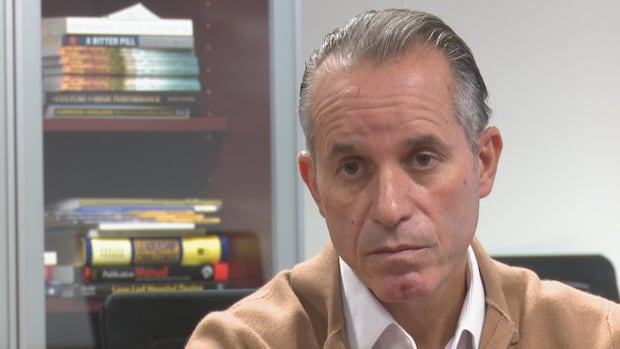
A Windsor hospital CEO, who oversees a program for problem gambling, is the latest voice to join a chorus calling for action on online sports gambling advertising.
Bill Marra is the CEO of Hotel-Dieu Grace Healthcare, which has a treatment program for problem gambling and digital dependency.
In an open letter, Marra said that money has flowed “generously” to gambling platforms, advertisers and even the government.
“However, with great power and success must come even greater responsibility,” he wrote.
“In my mind, this is a truth that appears to be overshadowed by the allure of profit and entertainment.”
He says the hospital’s program, which has both inpatient and outpatient streams, is unique — and in the last five years, attendance in the program has doubled.
“I felt certain that it was time … that we come out and express our concerns,” he said. “It is very difficult for anyone that’s monitoring a sporting event, reading something online or watching it live to not be exposed to online gambling enticements.
“And we know, it’s evidence based … that the more you provide those exposures of those opportunities, that increases the risk for individuals to get involved.”
Some people are predisposed to gambling addiction, he said, like if they already have a substance use addiction.
Marra said it would be “unrealistic” to get rid of online gambling altogether. Instead, he wants to look at how to mitigate risk, with more targeting advertising. He said it’s time to “invest more resources into into this health-care crisis.”
“There’s been a real focus on substance use and we’re really grateful for that … but gambling seems to be one that is below the radar for some.
Marra said the program has seen families fall apart and driven into bankruptcy and people who attempt self harm over their loss of income and family as a result of gambling.
Last week, dozens of Canadian senators signed a letter calling on the prime minister to ban advertising for sports betting in Canada.
The letter was penned by Charlottetown Sen. Percy Downe and Waterloo Sen. Marty Deacon.
Downe, talking with CBC Radio’s Windsor Morning, said it’s now like “everybody has a mini casino in their pocket,” with online betting from a cellphone.
Downe said a ban on advertising for online sports betting is needed.
“The government can simply duplicate what other countries have done. Belgium and Italy have imposed full bans,” he said. “We’re bringing it to the prime minister’s attention.
“We’re hopeful that he will address this problem.”
Downe and Marra both invoked cigarette advertising, which was banned for the public health of Canadians in 1989.
“It’s having a terribly negative impact. You speak to professionals in the field about the impact on mental health,” Downe said.
“People tell me that young men in particular, under the age of 25, are tremendously impacted by this in a very negative way.”
Former Windsor West MP Brian Masse put forward a motion for single-sports betting in 2016, though his motion was ultimately defeated, with the objective of getting the money out of the black market and into casinos.
He says that money needs to go back into helping people who may be impacted.
“They could pull back on some of the acceptable types of gaming especially the advertising that takes place,” he said. “That can also take place through the federal lens as well.
“There should be no reason to have commercials of sports betting constantly consuming games and having people actually have commentary about sports gaming during the actual activity.”
In a statement, the Alcohol and Gaming Commission of Ontario (AGCO) said the commission “works to make gambling safer in Ontario.”
“We’ve set and enforce some of the strictest rules in North America for online gambling ads, such as not allowing the use of athletes or celebrities and banning ads that offer bonuses,” the AGCO said.
“We continue working with all partners to protect minors and vulnerable groups.”