
Your support helps us to tell the story
From reproductive rights to climate change to Big Tech, The Independent is on the ground when the story is developing. Whether it’s investigating the financials of Elon Musk’s pro-Trump PAC or producing our latest documentary, ‘The A Word’, which shines a light on the American women fighting for reproductive rights, we know how important it is to parse out the facts from the messaging.
At such a critical moment in US history, we need reporters on the ground. Your donation allows us to keep sending journalists to speak to both sides of the story.
The Independent is trusted by Americans across the entire political spectrum. And unlike many other quality news outlets, we choose not to lock Americans out of our reporting and analysis with paywalls. We believe quality journalism should be available to everyone, paid for by those who can afford it.
Your support makes all the difference.Read more
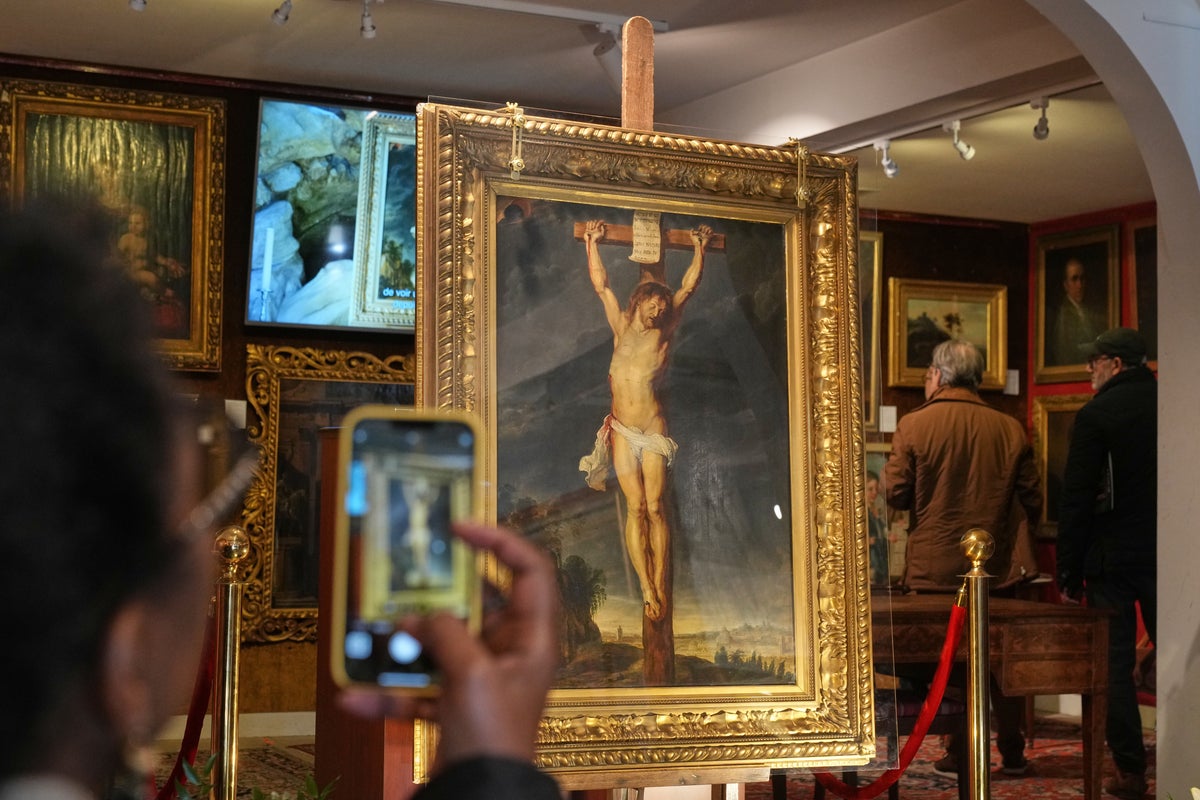
A long-lost masterpiece by Baroque artist Peter Paul Rubens, which had remained hidden for over four centuries, has sold for €2.3 million (£2 million/ $2.7 million) at auction in Versailles on Sunday.
The painting, depicting the crucifixion of Jesus Christ, was recently discovered in a private Parisian townhouse.
Previously part of a French collection, it had been mistakenly attributed to one of Rubens’ many workshops and was rarely valued at more than €10,000.
“I immediately had a hunch about this painting, and I did everything I could to try to have it authenticated,” auctioneer Jean-Pierre Osenat told The Associated Press. “And finally, we managed to have it authenticated by the Rubenianum, which is the Rubens committee in Antwerp.”

open image in gallery
The work was sold on Sunday for (Copyright 2025 The Associated Press. All rights reserved)
Nils Büttner, an expert known for his research on Rubens, explained before the auction that the master often painted crucifictions but rarely depicted “the crucified Christ as a dead body on the cross.”
“So this is the one and only painting showing blood and water coming out of the side wound of Christ, and this is something that Rubens only painted once.”
The Osenat auction house said the painting’s authenticity and provenance were confirmed after scientific analysis. It said microscopic examination of the paint layers revealed not only white, black, and red pigments in the areas representing flesh, but also blue and green pigments, whose use is typical in Rubens’ depictions of human skin.
Art expert Eric Turquin told a packed house the painting had virtually disappeared in the early 1600s. It is known to have belonged to 19th-century French classic painter William Bouguereau before it was passed down in the family.