

Australian coach Eddie Jones is no stranger to the rollercoaster of international rugby, and the highs and lows in his career have often been extreme. Even at the ultimate tournament in the rugby calendar, he helped South Africa to World Cup triumph in 2007, lost a couple of finals with Australia and England but crashed and burned spectacularly with the Wallabies in 2023. The ‘big dipper’ does not even begin to describe the Eddie Jones experience. People love him or they hate him – sometimes both at the same time.
One of the areas of consistency for the Randwick mastermind lies in his correct identification of future trends in the game. It was Jones who first saw and understood the potential for a player to function as both a back and forward within the same match, even at the most rarified level of the game.
At England’s training camp in Portugal before the 2019 Six Nations, he predicted an entirely new future for then-Exeter Chiefs wing Jack Nowell:
“He is going to be the new breed of player. The game has changed. The game used to be 80 minutes, now it is 100 minutes. The next change is you will have players who can play backs and forwards.
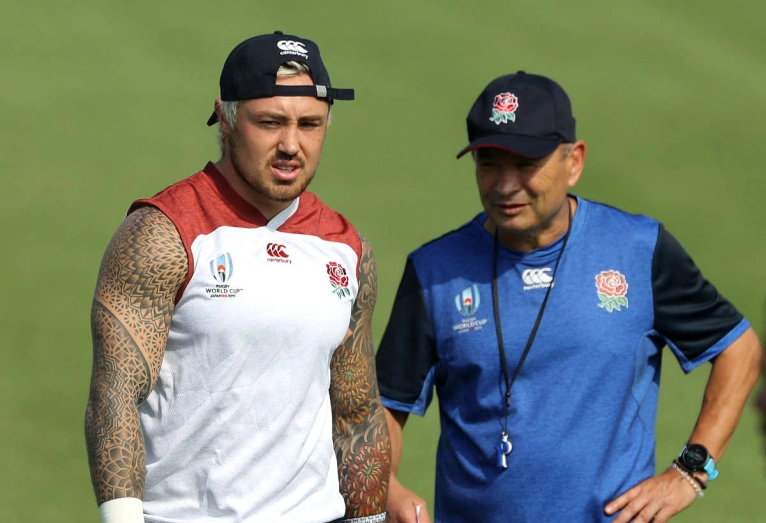 Jones had plans to use Nowell in a hybrid role but apart from one start at centre, he won all his 46 caps on the wing (Photo David Rogers/Getty Images)
“He has great ball carrying, great tackling skill. He puts his head in over the ball, he’s a tough little bloke. He’s a great option. He can play wing, centre, full-back, or seven for us.”
The idea of Nowell as a dual back-three/back-row player was a graft which never took root in either Devon or with England, but the hybrid is here to stay. Nowell moved on to pastures new in the Top 14 and Ronan O’Gara-coached La Rochelle, where he arrived to find the prototypical hybrid already in place and fully-fledged in the shape of ‘La Machine’, Fijian Levani Botia.
Over the span of a glittering 13-year career for both Les Bagnards and his native Fiji, Botia started at both number 12 and flanker for club and country. He has started at inside centre on 120 occasions, and he has appeared in the back row on 76 others. Heck, he has even played wing on four occasions.
To have that guy at 12 or in the back row, a lot of teams would avoid that area of the field entirely, he is that good. You know you have a special player when teams are changing their game-plans just for him.
In the National Football League in the U.S. they are called ‘unicorns’ – players who have a range of physical and technical attributes which enable to them to swap roles and redefine every position they play. An ex-team-mate of Botia’s at Stade Rochelais, outside-half Ryan Lamb, still remembers his range of skills fondly:
“When you are in a bit of trouble, to have ‘The Equalizer’ to get you over the gain-line and back on the front foot is great. He is made of steel.
“I remember my first home game of the season, against Clermont in front of 18,000 with a new stand. First play of the game, I look for ‘Levs’, he throws a big miss-pass and we score down the right. I used to love watching him being a wrecking machine.
“[Levani] and [erstwhile Toulon openside] Steffon Armitage are out on their own when it comes to turning the ball over [at the defensive breakdown]. As soon as they are over it, they are almost impossible to get off.
“To have that guy at 12 or in the back row, a lot of teams would avoid that area of the field entirely, he is that good. You know you have a special player when teams are changing their gameplans just for him.”
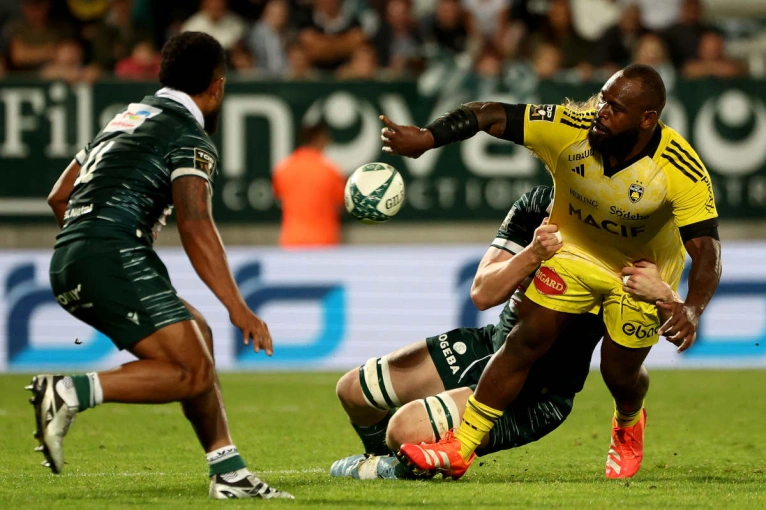 Botia’s relatively squat frame belies a superb skill-set that makes him a weapon on both sides of the ball (Photo Romain Perrocheau/AFP via Getty Images)
Botia ‘only’ stands six feet tall and weighs 103 kilos [16st 3lb]. Now imagine version 2.0, standing five inches taller and tipping the scales at 15 kilos more, and you will have the equivalent of the T-1000 terminator compared to the original T-800 in the old Arnie Schwarzenegger movies. Watch him emerge from the theatrical dry ice, and you will be slowly be able to make out the figure of Springbok upgrade Andre Esterhuizen walking towards you.
Andre the Giant is a sequel to Botia, but with a new visionary creative director in South African Svengali Rassie Erasmus at the helm. He began life as a number 12 but now he is a superannuated bench back-rower for the green-and-gold. He is the engine that drives mauls forward against France in Paris:
— William Bishop (@RPvids1994) November 10, 2025
It is probably only a matter of time before Rassie has him jumping in the lineout and winning first-phase ball from the set-piece. In the final round of November tour games against Wales, he may have been back in his familiar role at inside centre, but he was still busy redefining the spot.
At the Principality Stadium, Esterhuizen led all outside backs on both sides with 10 carries for 85 metres, 61% of them springing the Boks across the gain-line, with three busts, two offloads and one break-assist to boot; on defence he topped all the forwards with two turnovers at the breakdown and another forced fumble in the tackle. That is what ‘the hybrid effect’ can do for you.
The ex-Harlequins centrepin began by showing the same finesse on the pass he had previously demonstrated against New Zealand in the historic win at the Cake-Tin in Wellington:
— William Bishop (@RPvids1994) November 30, 2025
— William Bishop (@RPvids1994) November 30, 2025
In the first clip it is a long pass off the left hand swinging right, in the second it is a flat delivery off the right hand splitting the last two Welsh defenders heading in the opposite direction.
Defence against Andre-on-the-run became an impossible riddle for Wales to solve as the game unwound. For most of the time it took three defenders to stop a back who runs like a true number eight, and that meant Andre the Giant was able to take out the entire midfield D and leave his mates to score tries with ease on the following phases:
— William Bishop (@RPvids1994) November 30, 2025
First the Welsh replacement outside-half (No.22) Callum Sheedy is over-run at the tail of the line, pulling (No.12) Joe Hawkins into the tackle; then Hawkins is shrugged off and that means (No.13) Joe Roberts has to come in to finish the job only five metres from the Wales goal-line. The entire Welsh midfield defence finds itself on the wrong side of the ball at the ruck as the shot widens, and that means South Africa can complete the score at their leisure, by playing short or long.
In defence, Esterhuizen showed that he is quite capable of taking on, and beating, opposing forwards both in the tackle and its aftermath. He is the South African equivalent of Botia, an improved Springbok ‘Equalizer’ between forwards and backs.
— William Bishop (@RPvids1994) November 30, 2025
— William Bishop (@RPvids1994) November 30, 2025
Earlier in the game, the Red Dragons number eight Aaron Wainwright had to leave for running repairs after coming off worse in the collision with Esterhuizen, and in the first example Wainwright’s back-row compatriot Taine Plumtree is almost cut in half by the South African No.12, with a little assistance from Bongi Mbonambi. In the second clip both Welsh second-rows Ben Carter and Rhys Davies, and hooker Dewi Lake are all huffing and puffing in the cleanout effort to blow Esterhuizen’s house down, but it remains stubbornly standing, and nothing can prevent the big hybrid from winning a turnover penalty from the breakdown.
29 November was a day of experiment for South Africa’s schemer-in-chief Erasmus. The ‘big four’ of Esterhuizen [6ft 5in and 120kg], Damian de Allende [6ft 2in and 106kg], Ethan Hooker [6ft 4in and 100kg] and Canan Moodie [6ft 3in and a mere 94kg] all got a run-out together in the three-quarters and it is highly likely the trial will be repeated.
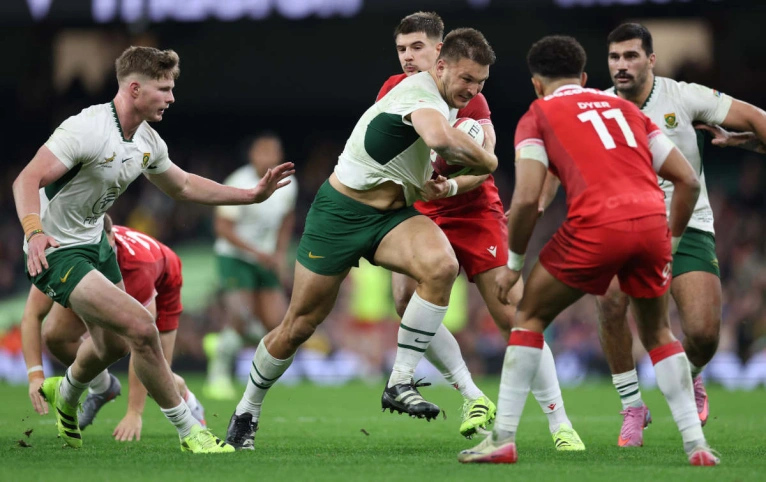 Esterhuizen made huge dents in the Welsh defence as well as scoring a second-half try (Photo Michael Steele/Getty Images)
Between them the big four ran for over 200 post-contact metres, made 14 busts or breaks and forced five turnovers in and around the tackle in defence. It was all far too much for an under-powered Wales, who were made to look little more than a developing ’third world nation’ on the day.
At the beating heart of the Springboks’ effort at the Principality Stadium was the new hybrid Esterhuizen, a man who can lift in the lineout, drive the maul, pass like a premier playmaker and dominate tackles like a top number eight. The ex-Quin has not yet been required to uncork his booming left-foot kicking game, so that is a pleasure for the future. The prophetic words of Eddie Jones about the importance of players who can fight with the forwards and run with the backs ring true. One great one [Botia] has come and gone, and his successor, the new ‘Unicorn’, has already been anointed.