

The final full moon of 2025 is also the last of three consecutive supermoons of the year – and it’s known as the cold moon.
The cold moon comes following the harvest moon on 7 October and the beaver moon on 5 November.
Supermoons occur when the moon is at its closest to Earth, and can appear around 14% bigger than normal full moons, but NASA says that in practice, you may not see the difference.
But for anyone out and about this Thursday night, it should be worth taking a look at the sky.
When is the best time to see the super cold moon?
The best time to see the cold moon will be from 14:48 on Thursday 4 December.
The supermoon will rise in the northeast on Thursday afternoon.
What is a supermoon?
Supermoons occur when the moon is closest in its orbit to the Earth, making it appear bigger and brighter than usual.
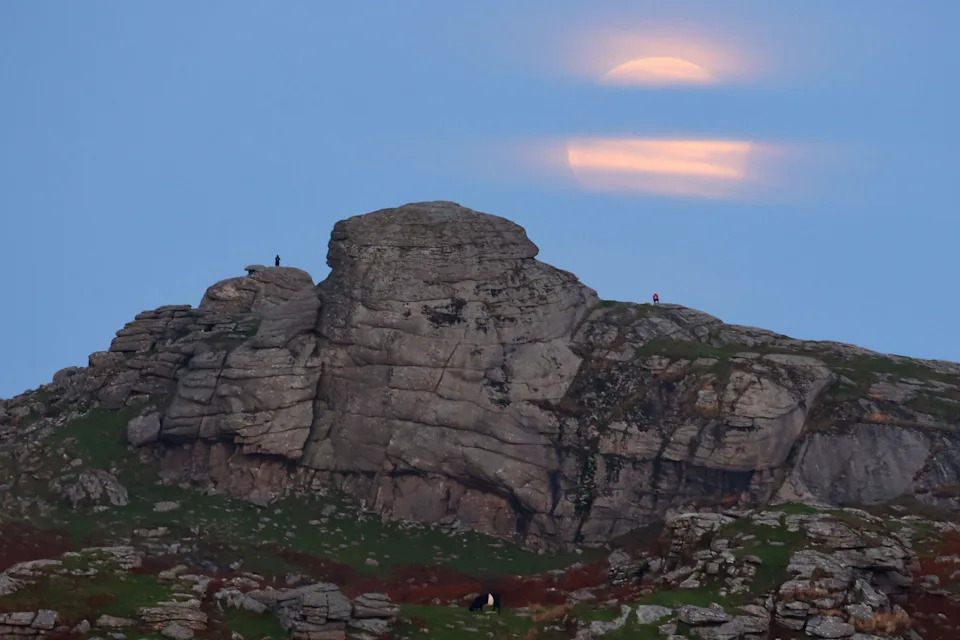
The first supermoon of 2025 rises hrough clouds over Hay Tor on Dartmoor, Devon. (Alamy)
The moon has an elliptical orbit around the Earth, ie not a perfect circle, and supermoons happen when full moons coincide with the time the moon is closest to Earth.
Supermoons (or perigean full moons, to be technical) can appear up to 14% bigger and 30% brighter than normal full moons.
The term ‘supermoon’ was coined in 1979, with NASA saying: “When a full moon appears at perigee [its closest point to Earth] it is slightly brighter and larger than a regular full moon – and that’s where we get a ‘supermoon’.”
When the moon is at its ‘perigee’, its closest point to Earth, it is at an average distance of around 226,000 miles.
At its ‘apogee’, its furthest point, it’s about 253,000 miles away.
Why is it called the cold moon?
The term cold moon comes to us indirectly from Native American traditions, although there are also other names for December’s full moon.
The moons of the year all have names, from cold moon to flower moon, many of which originate in the Old Farmer’s Almanac, a US book first published in the 1930s.
The Old Farmer’s Almanac says: “The moon names we use in The Old Farmer’s Almanac come from centuries of Native American, colonial, and European traditions. December’s full Moon is most commonly called the cold moon (Mohawk), reflecting the frigid season. It is also known as the long night moon (Mohican) because it rises during the longest nights of the year, near the winter solstice, and remains above the horizon for an extended period.”
What is a full moon?
Full moons occur when the Earth is directly in line between the moon and the sun.
Appearing every 29 and half days, they take place when the moon is completely illuminated by the sun’s rays.
How can I photograph the cold moon?
To photograph the cold moon, it’s best to think about what else is in the shot, according to NASA photographer Bill Ingalls.
“Don’t make the mistake of photographing the moon by itself with no reference to anything. Instead, think of how to make the image creative – that means tying it into some land-based object,” he says.
“It can be a local landmark or anything to give your photo a sense of place.”
“You’re not going to get a giant moon in your shot, but you can do something more panoramic, including some foreground that’s interesting. Think about being in an urban area where it’s a little bit brighter.”