
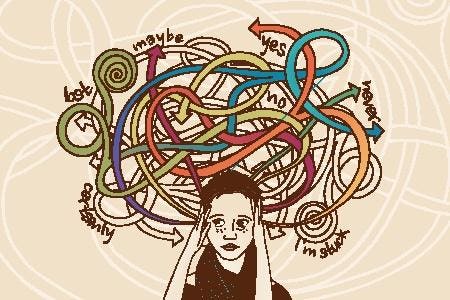
New research shows how easily our imagined choices collapse under the weight of real consequences. Here’s why overthinking them never helps.
getty
For decades, the “trolley problem” has encouraged us to overthink what we believe we’d do in an impossible situation. It goes like this:
A runaway trolley is hurtling down a track toward five people, who cannot move in time to save themselves. You are standing next to a switch that can divert the trolley onto another track — where only a single person stands. If you do nothing, five people will die; if you pull the lever, one person will.
This thought experiment has been used to assess, measure and debate human morality or, rather, impossible moral trade-offs. It’s a staple in every Philosophy 101 lecture, in psychological studies and even in late-night ethical debates between friends. In fact, you might have already answered some version of it with confidence at some point in your life.
However, what happens when the trolley problem stops being hypothetical? What happens when it’s a real person who stands in front of you, and their pain hangs in the balance? According to recent research, the answer isn’t quite what you’d expect.
When The Trolley Problem Left The Thought Experiment
The trolley problem has lived comfortably, for decades, in its own abstract world. In both classrooms and in textbooks, people are asked some variation of the same impossible question: Would you harm one person to save many? The details of the problem itself often shift, but the overarching premise always remains safely hypothetical. No one is ever actually hurt.
That is precisely what makes the new study led by psychologist and philosopher Dr. Dries H. Bostyn, published in the Journal of Personality and Social Psychology, so very unusual. Instead of sticking to asking people what they would do if they were in that scenario, Bostyn and his team observed what participants actually did when their decision carried real consequences.
In the experiment, participants were taken into a lab, and they were informed that real human volunteers would receive painful but medically safe electric shocks depending on their choice. Their task was relatively simple on paper, but in terms of consequences, it was complex: they can either allow two people to be shocked, or actively choose to administer a shock instead to only one person.
The participants were given full disclosure, they had the right to withdraw at any moment and they were carefully debriefed afterward. But in actuality, the outcomes — whether or not the electric shock was given to two people, or was instead diverted to the other — were randomized to protect participants from lasting guilt. However, while they were making and rationalizing their choice, every participant truly believed their decision truly mattered.
In explaining his choice to move beyond hypotheticals, Bostyn described to me in an interview, “The reason why is straightforwardly obvious: we have a lot of research where we have people think abstractly about what they would do.” Continuing, he clarified, “If we want to trust that research, then we also need to explore what people actually do.”
The study’s findings were striking for two reasons. Firstly, the participants’ responses to the hypothetical dilemma only moderately predicted how the choices they’d actually make in real life. In other words, most people behaved somewhat differently than they did in hypothetical versions of the dilemma. The second, more intriguing finding is just how differently they thought about it in real life compared to when it was merely hypothetical.
Some participants based their decision on the demeanor of the people in front of them. Others hesitated until the final second, unsure of what they’d choose, until they were forced to do so. And when participants encountered the same dilemma a second time, nearly a third of them switched their answer from shocking the one to shocking the two, or vice versa. Remarkably, this wasn’t necessarily an attempt to minimize how much harm they caused, but rather an attempt to distribute it more “fairly” across people.
In every repetition of their experiment, Bostyn and his team proved that real-life moral decision-making is so much more messy, relational and context-sensitive than what a neat and tidy philosophical model — built on an imaginary track, an imaginary trolley and imaginary victims — can account for.
Why Hypotheticals Break When Reality Steps In
On paper, hypothetical dilemmas and trolley-like problems seem like powerful tools for tapping into the human mind. They strip decisions down to their barest moral essence. They mitigate any distractions. They isolate principles. However, it’s perhaps this very neatness that makes hypotheticals so misleading.
As Bostyn explains, “It seems to me that when people are confronted with hypothetical dilemmas, they are more likely to gravitate towards more abstract ways of thinking.” In other words, when people try to reason about hypothetical dilemmas, they’re usually reasoning about faceless strangers who, in their minds, have no history, no personality and no future.
But in real life, humans cannot help but factor in just about everything that hypotheticals completely erase: personalities, tone of voice, perceived vulnerability, friendliness, prior events, emotional discomfort. This is to say that we are virtually incapable of calculating outcomes coldly and programmatically; it is in our nature to respond to humans with humanity.
What was even more telling was the fact that many participants entered the lab fully convinced that they knew what they would do, only to surprise themselves later on. Some hesitated until the final moment. Others changed their minds when confronted with real people.
If people cannot reliably predict their own behavior in a structured, slowed-down lab setting, it raises an uncomfortable question: How accurate can our confident moral predictions really be? Bostyn answers this question with perhaps a better question: “Hypothetical dilemmas don’t have consequences, so why would you make the ‘hard’ decision when the decision you’re making has no impact?”
In this sense, perhaps the most important fact that the study made clear is that moral decisions are not isolated snapshots. Traditional trolley-style thinking typically treats the process of human decision-making as independent to the problem itself: this moment only, and this outcome only. But, in reality, when the same participants faced the dilemma twice, their second choice was often shaped less by abstract rules and more by what had already happened.
Morality, from this perspective, is a sequential thing; it has memory. We will always carry forward what we have already done and what we expect to face next. And although hypotheticals can freeze time, reality simply can’t. We cannot remove our in-the-moment decisions from everything that has ever happened to us and all that is to come.
What This Means For How We Plan, Worry And Overthink Our Lives
We rely on hypothetical thinking almost constantly in our everyday lives. We rehearse arguments in our heads. We imagine how we’ll respond if a relationship ends, if a conflict arises, if an opportunity comes up. We create moral scripts for our future selves and assume we will follow them. In this sense, the implications of this research extend far beyond hypothetical trolleys and psychology laboratories.
Arguably the most important lesson for us to take home from this study is one that’s a little unsettling: We are very poor predictors of our future behavior once real emotional, social and contextual forces come into play.
The version of you, right now, who calmly plans what you should say tomorrow is not the version of you who will feel the pressure of the moment, the discomfort of someone’s expression, the weight of responsibility or the pull of empathy. Just as participants could not fully access the ways that real-life moral choices would feel until they were literally facing them, we, too, are prone to overestimating how much control we will have over our future reactions.
This doesn’t mean that planning or preparing is useless or futile; evolutionarily, we’ve been hardwired to do so anyway. What it actually suggests is that over-planning our behaviors, whether they’re moral or otherwise, can give us a false sense of certainty. We like to imagine ourselves as coherent agents that are guided uncomplicatedly by our principles. But, in reality, we’re shaped by context, timing, relationships and unfolding consequences far more than we can legitimately predict.
This also means we need to reconsider the ways we judge both ourselves and others. When someone fails to act the way they once insisted they would, we’re usually inclined to interpret this as hypocrisy or weakness. But, as this research suggests, our hypothetical selves have never had to carry the emotional and psychological weight that our real selves constantly bear.
From this perspective, it’s important to remind yourself that you cannot “master” life by means of endless rehearsal. The gap between who we think we will be and who we actually end up becoming is a fundamental part of being human. It’s not indicative of inherent moral failure or a character flaw.
And most importantly, remember that only hypotheticals can allow for true certainty. Reality, by its nature, cannot.
Is overthinking a part of your daily decision-making process? Take this science-backed test to find out why: Mistake Rumination Scale