
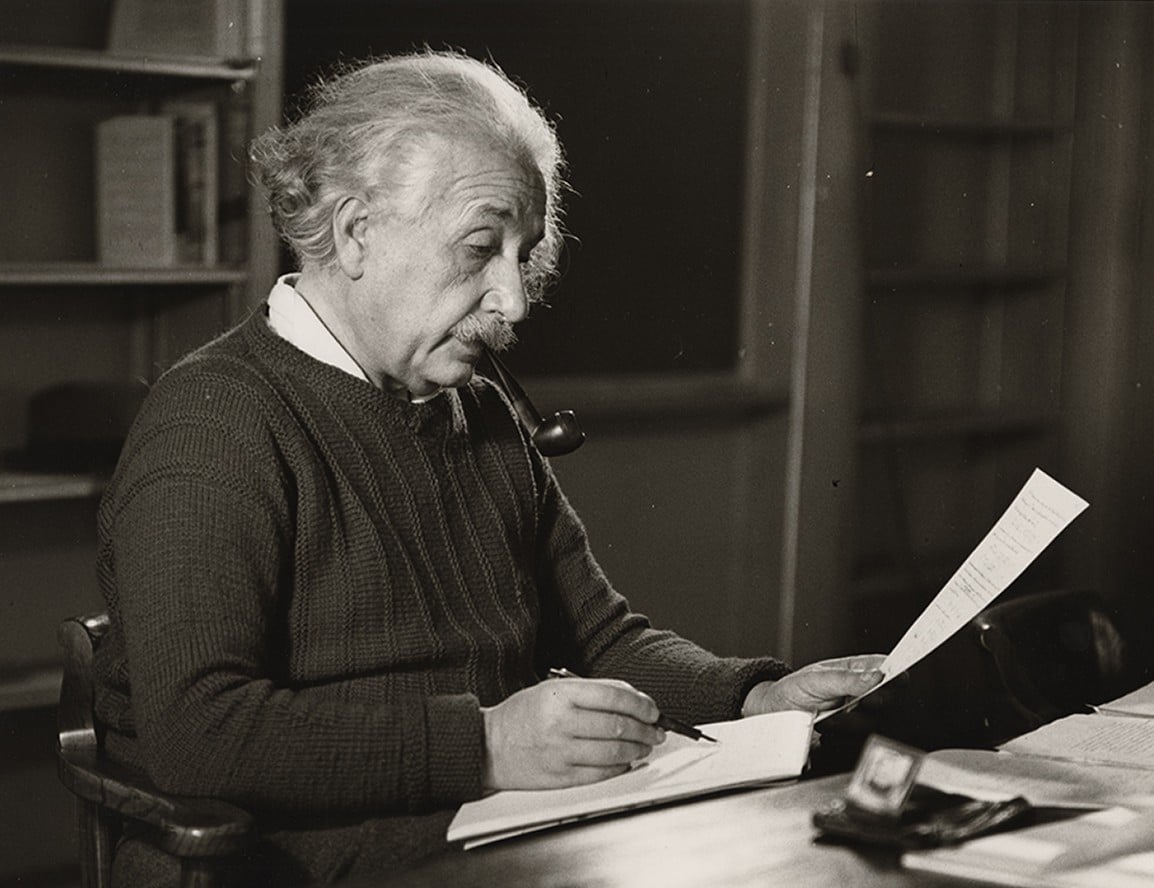
Chinese physicists prove Einstein wrong in a quantum experiment. Credit: The Magnes Collection of Jewish Art and Life, Flickr, CC BY-NC-SA 2.0
Chinese physicists have successfully recreated a century-old thought experiment proposed by Albert Einstein, producing results that support the theory he had hoped to disprove. By doing so, researchers provided fresh evidence for the quantum principle that limits what can be known about a particle’s behavior. In this long-standing debate, the team’s findings show that physicists prove Einstein wrong once again on the nature of reality at the quantum level.
Led by Pan Jianwei, known as China’s father of quantum science, the team at the University of Science and Technology of China built an ultra-sensitive system capable of detecting the push of a single photon.
Their setup closely followed the structure of Einstein’s 1927 proposal, originally intended to challenge Niels Bohr’s idea that particles cannot display both their path and wave-like interference at the same time.
A century-old argument revisited in the lab
The original thought experiment was Einstein’s response to Bohr’s theory of complementarity, which states that certain physical properties cannot be measured simultaneously.
Einstein believed this limitation was not a rule of nature but a flaw in quantum theory. At the Solvay Conference in Brussels, he outlined a modified double-slit experiment involving particles passing through a slit suspended on springs.
In theory, their path could be tracked by measuring the momentum imparted to the slit, while also producing interference patterns. If both wave and particle behaviors were observed at once, it would contradict Bohr’s position.
However, Bohr countered this argument by pointing to the uncertainty principle. He argued that precisely measuring a particle’s momentum would blur its position enough to destroy the interference pattern, upholding complementarity.
Physicists prove Einstein wrong with photon-level precision
The Chinese team’s experiment used single photons and replaced Einstein’s suspended slit with a single rubidium atom held steady by an optical tweezer. By adjusting the uncertainty in the photons’ momentum, they were able to control the clarity of the interference fringes, exactly as Bohr’s theory predicts.
Their findings, published Wednesday in the journal Physical Review Letters, confirm that a particle’s path and interference pattern cannot be observed at the same time. The results align with Bohr’s interpretation and suggest that Einstein’s argument fails under precise experimental conditions.
While the concept of complementarity is well established, Pan said their experimental platform may help explore more open questions, such as the relationship between entanglement and decoherence in quantum systems.