
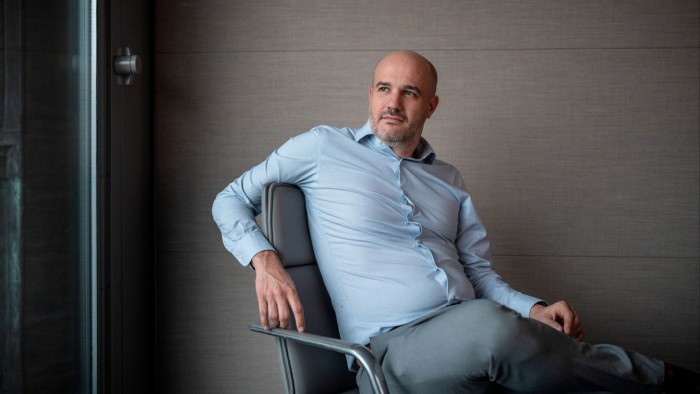
Nvidia dominates the market for the powerful chips that underpin generative artificial intelligence, potentially the most transformational technology since the Industrial Revolution. It briefly surpassed $5tn in market value in October, the first company to do so. Yet author Stephen Witt says this extraordinary success must be tormenting Nvidia’s founder and chief executive, Jensen Huang.
“It’s hard to be Jensen day to day. It’s almost nightmarish. He’s constantly paranoid about competition. He’s constantly paranoid about people taking Nvidia down,” says Witt, whose thrilling and detailed account of Nvidia’s rise, The Thinking Machine, was this week named Financial Times and Schroders Business Book of the Year.
Since the book was published in April, scrutiny of Nvidia has only intensified, as have potential challenges to its supremacy. In an interview the day after the prize-giving, Witt identifies Google’s rival chips, known as tensor processing units, as “an almost existential threat” to Nvidia. The latter’s graphics processing units, or GPUs, are the backbone for OpenAI’s ChatGPT, among others. TPUs were used to train Gemini 3, Google’s rival large language model.
Witt says Huang has “told his colleagues, ‘Look, you have to understand if you’re working at this company, there’s a team inside Google whose job is to kill us . . . And they’re smart. They’re great. They’re highly capable and have some of the best engineers. And all they want to do is destroy us.’”
The author is, however, a believer in the vast potential of AI and he knows from his intensive study of Huang and his company, that paranoia is the Nvidia chief’s rocket fuel: “He’s . . . driven by negative emotion in a way that I have never seen a CEO before, but he’s able to use this to repurpose his energy into these very productive use cases.”
Witt’s interest in Nvidia was triggered first by the public launch of ChatGPT three years ago, which fed the journalist’s concern about his own future. “I was just like, ‘Man, I am cooked.’ This thing can write almost as well as I can and very soon is going to eclipse me. What do I do? I guess I’d better just pivot to start writing about AI.” He embarked on a New Yorker article about Nvidia, thinking “it’s just a hardware company. It’s probably had a rotating cast of CEOs. It’s probably had a tortured and maybe somewhat boring corporate history.” Instead, he found “one guy pushing relentlessly for one vision, as an absolute maverick . . . and then ultimately conquering his whole industry”.
Taiwan-born Huang, now 62, emigrated to the US with his family in the 1970s and showed an early determination to succeed. As a teenager, he trained himself to become an elite table-tennis player, illustrating two key traits, according to Witt: “One, he can learn so fast. His IQ is so high, his ability to just absorb, process new information and get to a world-class level very, very quickly is just unparalleled. He just has an incredible ability to learn new stuff. And then, two, he has that competitive athlete’s killer instinct. He absolutely hates to lose.”
Nvidia initially existed to serve the fast-growing gaming industry with chips capable of generating better graphics faster, using a process called parallel computing. But in his pursuit of the next big opportunity, Huang took the high-risk approach of catering to what he called “zero-billion-dollar market” opportunities, in the hope, Witt says, that “someday someone will come along and start using your product”. Artificial intelligence based on neural networks — the foundation of generative AI — was one such apparently unpromising market when Huang redirected Nvidia’s innovative chips towards it in the early 2010s. It is an approach Witt now expects Nvidia to apply to robotics.
Nobody can argue with Huang’s success, though Nvidia has had to weather fierce attacks from activists, brushes with bankruptcy and several stock-price collapses. Yet some still think good luck played a large part in Huang’s rise. Witt counters: “If you go out into the ocean with your net and you go stand in some part of the ocean that nobody stands in, and you throw the net into the ocean every day for 10 or 11 years, and then at the end, you catch the biggest fish anyone’s ever seen, did you get lucky? Maybe. But you also put yourself in a position where you could get lucky — and you were the only one standing there.”
The sheer determination required to sustain that level of risk for that long and survive is vividly painted by Witt in The Thinking Machine, which depicts Huang as a compulsive workaholic, obsessed with the best-selling business book The Innovator’s Dilemma, in which management professor Clayton Christensen warns how complacent incumbents can fall prey to scrappy smaller competitors. Huang’s proneness to rant publicly at his staff about mistakes is matched with a strange loyalty towards, and from, them. (The fact Nvidia’s stock purchase scheme has made many employees into multimillionaires helps bind them to the group.)
Witt triggered Huang’s famous temper once, at the end of his research quest, when he tried to air AI pioneers’ concerns about the impact of the technology on the future of the species. For more than 20 minutes, Huang attacked Witt after he asked what new jobs AI might create. Nvidia was “not a manifestation of Star Trek”, the CEO raged. “It’s just a serious company, and I’m a serious person, just doing serious work.”
In the meantime, Witt is happy to use the tools Huang and Nvidia’s customers have built. In his award acceptance speech, he sent a ripple of nervous excitement around a room full of traditional publishers with a vision of the book as a constantly evolving, AI-fuelled project.
In the interview, he wonders whether “the book could respond to the reader, meet the reader in the middle in some way, understand where the reader’s at in their own knowledge, and then, on the fly, using AI, generate a unique bespoke text that speaks directly to their concerns”. In this world, “the book moves from being a static printed object to maybe a more dynamic [product], almost like a knowledge database, and I can even use feedback from readers to go do new reporting and answer reader concerns”.
Strangely, his idea echoes a similar concept laid out by Thomas Friedman in 2005, when he was interviewed the day after he won the inaugural FT book award with his paean to globalisation The World Is Flat. Friedman suggested that for subsequent editions “we actually turn the book into an open-source product. Just put it up on the web like Wikipedia and let people add to it”.
There is more than a hint of Huang’s self-motivating fear in Witt’s idea: “I saw so many journalists left behind during the internet era and so many publications just decimated during this shift away from classical print distribution to the internet and I don’t want to live through that myself,” says the author. “I don’t want to be obsolescent.”
To read more about the book award, visit www.ft.com/bookaward