
Loading
But Starc has always possessed as much ability as any lower-order batsman in world cricket. If anything, he has probably undersold himself with the bat – too often falling early when, with a little more application, he could be averaging closer to 30 than 20 in Tests.
There have been occasions, not least in India in 2013 when he clattered 99 at Mohali, when Starc has shone. He has the combination of a powerful hitting arc, derived at least partly from a pure golf swing, and plentiful game sense to choose which balls to defend or attack.
This knock, with the match still finely balanced, was clearly a juncture at which Starc decided it was time to knuckle down. When joined by Boland, Starc was initially intent on simply batting time, turning down singles and only occasionally looking to find the boundary.
He could see not only the sun beginning to set, but also how tired England were from an innings that ultimately crept into its 118th over. Every time a ball beat the bat, or an edge skewed wide of a fielder, Stokes reacted as though no captain had ever suffered a bigger dose of bad luck: Starc resolved to keep him out there.
Gradually, and in the manner of the old-fashioned Test batting almost completely absent from the series so far, Starc and Boland got more comfortable and started to score more freely. Their job was made easier by how Stokes more or less gave up on dismissing Starc, spreading the field and uncharacteristically letting things drift.
Partly this was because of the heat of the Gabba, the length of the innings, and also through the hard work of Jake Weatherald, Marnus Labuschagne, Steve Smith and Carey before Starc came to the middle. In the Seven commentary box, Simon Katich pointed to the indiscipline of the bowlers in the first session on day two.
As the tea break neared, Starc opened his shoulders with a series of rasping drives, and when the second session resumed, he went to 50 with a crisp slog sweep from the sparingly used spin of Will Jacks.
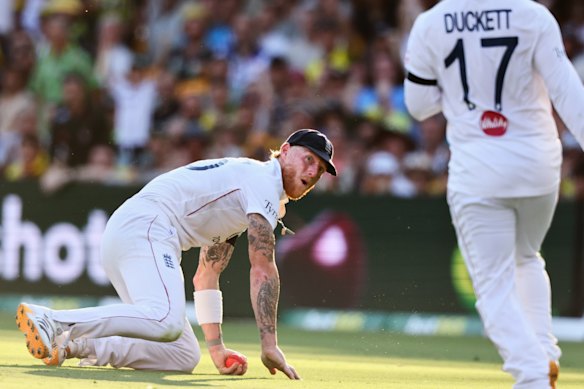
That was close: Ben Stokes takes the catch to dismiss Starc, despite a near collission with Ben Duckett.Credit: AP
Briefly, a century looked possible – Starc is certainly good enough to have one, backing that up is how he surpassed Stuart Broad (who had a top score of 169) for the most runs in Test history from number nine in the order. Starc looked disconsolate when he eventually skewed a catch to mid-off, Stokes and Ben Duckett narrowly avoiding a collision as the chance was taken.
But his combination of skill and good sense had turned a day of some optimism for England into one of shattered hopes for the tourists. From lunchtime on day two in Perth, Bazball has not stood up to the time-honoured Test match pressure exerted by an Australian team still lacking Pat Cummins.
While Nathan Lyon still has reason to curse his omission here, the number of contributors has made up for the absence of a quality spin bowler. This was only the third time in history that all 11 members of an Australian batting lineup reached double figures, and under lights, the seamers hunted like a wolf pack.
It had truly been an ensemble effort to rank with the cast of the Star Wars trilogy. But there could be no doubting that the starring role was, once again, played by Starc.
News, results and expert analysis from the weekend of sport sent every Monday. Sign up for our Sport newsletter.