
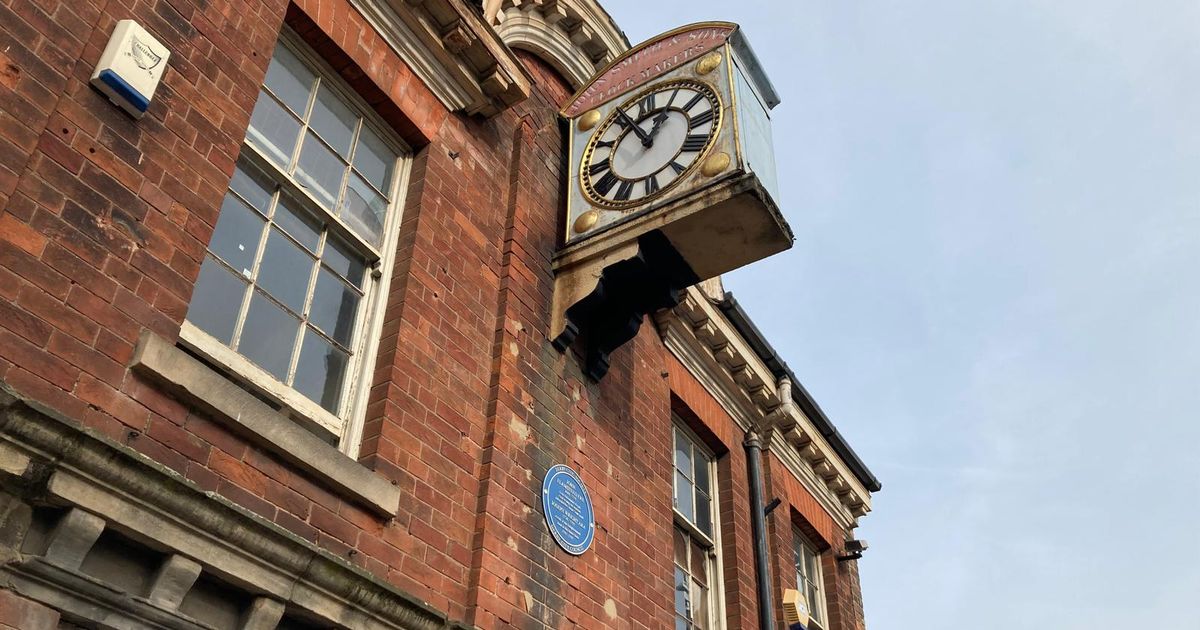
Derby could have been the line of longitude from which all calculations have been taken. Read more in the latest instalment of our ‘Little Did You Know’ series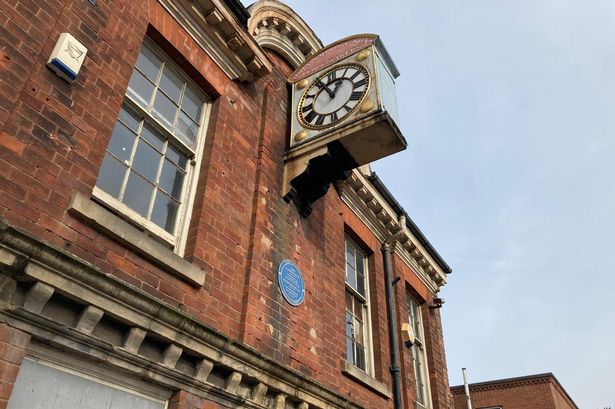 The frontage of the Queen Street house, which has been altered over time but still retains historic features inside. It has a blue plaque to commemorate both John Flamsteed and artist Joseph Wright living there(Image: Derby Telegraph)
If England’s first Astronomer Royal had got his own way, Derby would by now be on everyone’s lips as the basis for all time zones time zone and for civil time in the UK. So instead of saying GMT (Greenwich Mean Time) the world could have been referring to DMT (Derby Mean Time).
Certainly, John Flamsteed, born in Denby in 1646, but with an observatory at 27 Queen Street in Derby, pursued the idea of Derby being the centre of time-setting and navigation very vigorously.
Flamsteed spent 30 years living in Derby, from being a small child and attending Derby Free Grammar School, taking an interest in maths and astronomy and discovering that many of the things he was reading were incorrect. He wrote: “The tables differ from the heavens.”
In 1666 and 1668, he accurately calculated two soar eclipses and made the earliest sightings of Uranus. Between 1668 and 1719, he accurately recorded the positions of more than 3,000 stars.
Working on establishing a Prime Meridian – a line of longitude which can serve as 0 deg and with it become the centre of world time with all other time zones based on it (which eventually happened in 1884), Flamsteed naturally chose Derby and he positioned the meridian running through the back garden of his home in Queen Street at a latitude of 52 degs 55 N.
He sent a paper to the Royal Society, of which he was a member, which included a strong recommendation that the Prime Meridian be drawn through Derby.
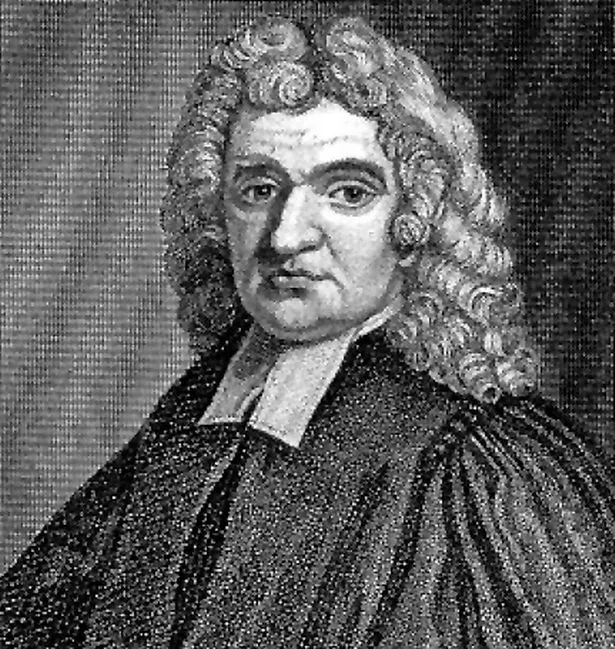 Rev John Flamsteed, the first Astronomer Royal(Image: Unknown)
Flamsteed, who became Astronomer Royal in 1675, wrote: “I hope you will not account me culpable for having adapted the calculations of a place no more famous than Derby.
“Although London be the seat of wits, the meridian passing over Derby is nearer the middle of England than that of London and that its latitude bisects it nearer than any yet stated.
“So this town which is seated in umbilico quasi regni (the navel of the country) must be the most convenient place that can be elected whereon to fix our calculations. I remain your obedient servant.”
Unfortunately, the push was to make the meridian accessible to sailors as England was a maritime nation and it was thought better to fix the Prime Meridian nearer to a naval base on the coast and fairly soon an observatory was established at Greenwich, which was overseen as the new Astronomer Royal by Flamsteed.
But up until 1674, all of Flamsteed’s calculations were taken using Derby as the meridian line. As a result of choosing Greenwich as 0 degs, Derby now sits -1.47687 degs W.
Flamsteed fulfilled his ambition by setting the Prime Meridian even though it was at Greenwich but he would have been equally happy to see Derby Mean Time on everyone’s lips.
Even so, and despite the Greenwich meridian being used for many years, it wasn’t until 1884 that it officially became the Prime Meridian and the standard for global longitude.
Prime Meridian facts:
In the northern hemisphere, the Prime Meridian passes through the UK, France and Spain in Europe, and Algeria, Mali, Burkina Faso, Togo and Ghana in Africa.The only landmass crossed by the meridian in the southern hemisphere is Antarctica.The Prime Meridian in Greenwich is marked by a metal line fixed into the Royal Observatory courtyard, and at night by a laser beam.From pole to pole, the Prime Meridian covers a distance of 20,000 km.
Flamsteed’s former home in Queen Street does remain, together with the garden, where he carried out his observations. The future of the listed building is unclear but several heritage organisations are hoping that it could be turned into a venue which pays homage to the extremely clever son of our city.
The next instalment in the ‘Little Did You Know’ series will be on Sunday, December 14. Meanwhile, catch up with some of the best ones below: