
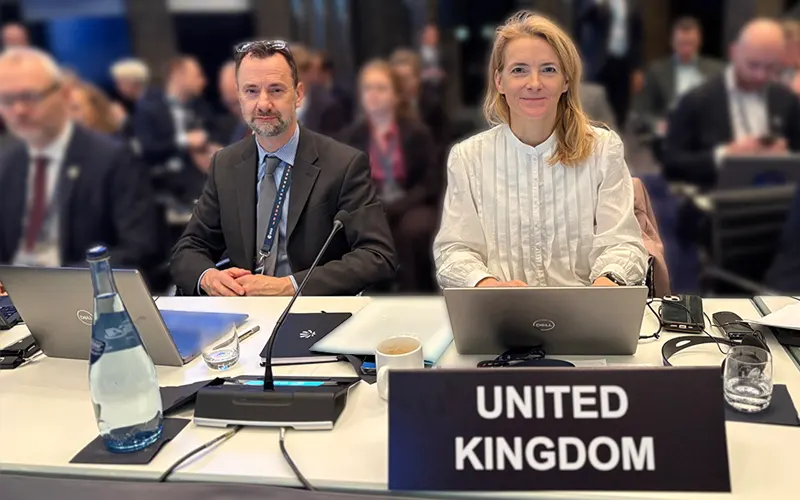
 Credit: UK Space Agency
During the European Space Agency’s (ESA) Ministerial Council meeting in Bremen last week, the United Kingdom pledged €172 million less for the coming three years than it did for the previous three. The reduction in its contributions to ESA came amid large increases from other countries, notably Germany, which increased its commitments by more than €1.5 billion.
In early November, the UK Engagement with Space Committee of the House of Lords published a report called The Space Economy: Act Now or Lose Out. In it, the committee laments that the UK space sector “receives little public attention” despite the country having “important advantages” that need to be built on. It recommends focusing on the development of dual-use space projects with both civil and military applications, and reforming its funding model from a grant-based approach to one that focuses more on government procurement to enable private investment.
A UK Space Agency spokesperson told European Spaceflight that the current economic climate had forced the agency to concentrate its ESA contributions on a few key priorities.
“The fiscal environment requires us to sharpen the focus of our funding. We chose to prioritise security and commercially-focussed programmes, which benefit all our partners. We also prioritised activity where the UK can be a catalyst for European-wide priorities, complementing and working hand in glove with our closest partners. We remain a committed member of the European Space Agency, and our investment strategy through ESA will evolve to ensure it delivers maximum value for UK objectives. ”
UK Space Agency CEO Dr Paul Bate echoed this position, stating that its focus was on delivering “maximum value for the UK.”
“We have focused deliberately on areas which deliver maximum value for the UK and are closely aligned to our national objectives for economic growth and national security,” Dr Bate told European Spaceflight.
Despite the UK’s ESA contribution dropping from €1.878 billion to €1.706 billion, which represents a reduction of almost 10% before inflation adjustments are considered, a UK Space Agency press release published on 27 November referred to its contributions as a “UK funding boost for [the] European Space Agency.” The release added that an “evaluation”, although it is not clear precisely what evaluation is being cited, shows that every £1 invested in ESA returns £7.49 in direct benefits to the UK economy. By that standard, the UK economy lost out on over £1.1 billion in direct benefits. For reference, the evaluation in question is from a Rand Europe study commissioned by the UK Space Agency and published in July 2025.
While the UK Space Agency highlights an 8% year-on-year increase in its core civil space budget, once inflation is taken into account, the real-terms increase is significantly lower.
Keep European Spaceflight Independent
Your donation will help European Spaceflight to continue digging into the stories others miss. Every euro keeps our reporting alive.