
For more than a decade, cosmology has been stuck with a puzzling contradiction. Two of the most trusted ways of measuring the universe’s expansion give two different answers.
One set of measurements, based on nearby stars and exploding supernovas, says the universe is expanding at about 73 km/s/Mpc. Another method, based on the faint radiation from the Big Bang, known as the cosmic microwave background (CMB), points to a slower expansion of around 67 km/s/Mpc.
This mismatch, also called the Hubble tension, has grown into one of the biggest problems in modern physics. If the disagreement is real and not due to mistakes, it could mean our understanding of the universe is incomplete.
Now, a team of astronomers has approached the problem from a completely different angle by measuring tiny time delays in the light paths of gravitationally lensed quasars. Their new analysis adds weight to the idea that the Hubble tension may reflect real physics rather than just mistakes in past methods.
“The Hubble tension matters, as it may point to a new era in cosmology revealing new physics,” the study authors said.
Measuring cosmic expansion without relying on distance ladders
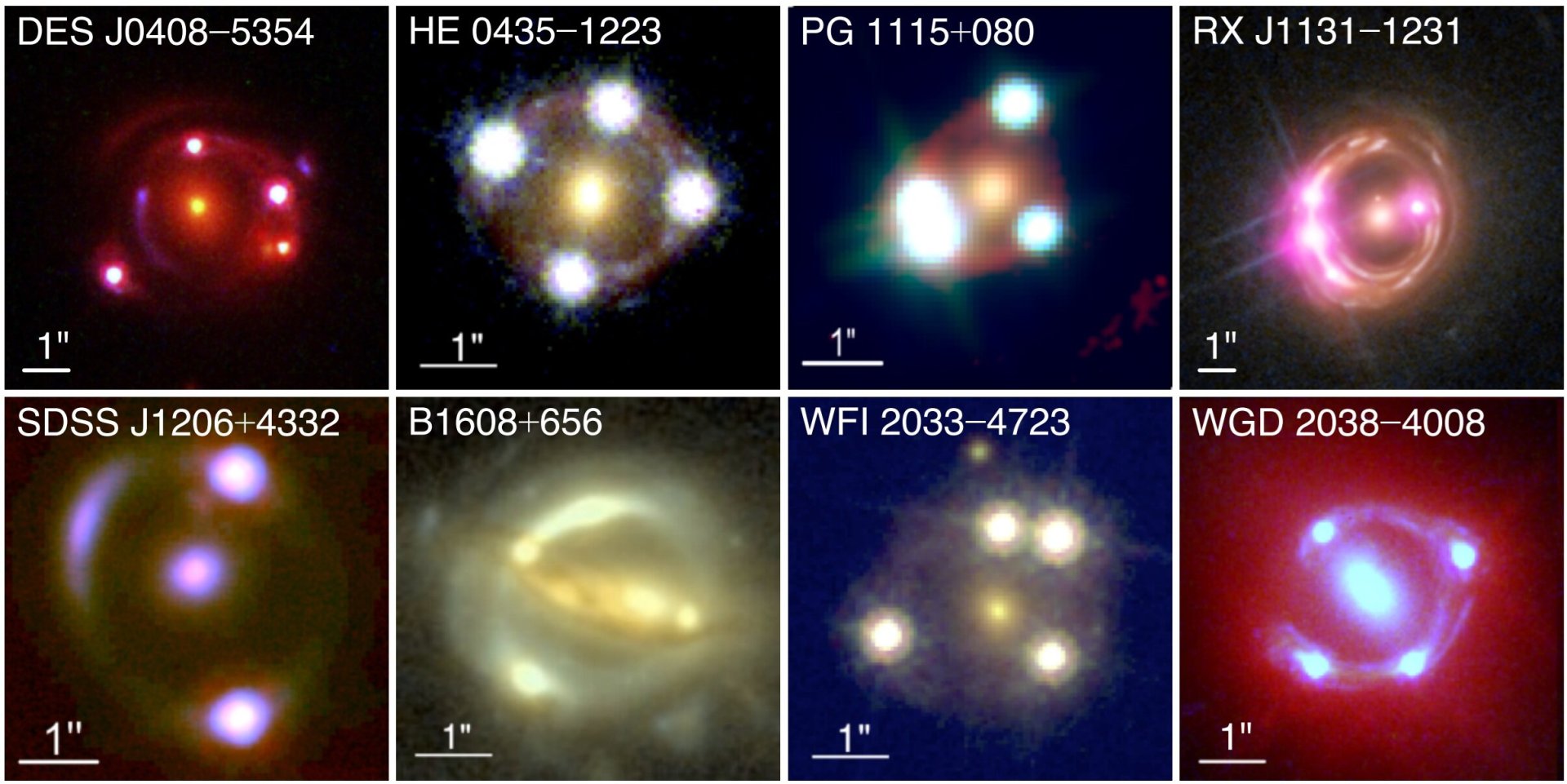 The eight time-delay gravitational lens systems. Source: S. Birrer et al. (2025)
Traditionally, astronomers build a distance ladder to estimate how far objects are and how fast they’re moving away from us. They start with stars whose brightness is well understood, then use them to calibrate supernovae, and then use those supernovae to gauge distances across the universe.
It’s a powerful technique, but small uncertainties at each step can add up, something critics argue may be behind the Hubble tension. The new study bypasses this entire ladder using a method called time-delay cosmography. It depends on one of the strangest tricks of gravity, called gravitational lensing.
“To measure the Hubble constant using time-delay cosmography, you need a really massive galaxy that can act as a lens. The gravity of this ‘lens’ deflects light from objects (quasars) hiding behind it around itself, so we see a distorted version of them. This is called gravitational lensing,” Eric Wong, one of the researchers and an assistant professor at the University of Tokyo, explained.
This bending can create multiple images of the same quasar, each taking a slightly different path and therefore arriving at Earth at different times. The researchers used eight such lens systems, each involving a foreground galaxy and a background quasar. Whenever the quasar brightened or dimmed, those changes showed up in the multiple images but with tiny delays.
By precisely measuring these delays, they could tell how long each light path was. However, timing alone isn’t enough. To calculate the expansion rate, the team also needed to estimate how mass is distributed inside the lensing galaxies, because the shape of the lens determines how light bends.
They combined detailed images from some of the world’s best telescopes, including the James Webb Space Telescope, with models of how galaxies typically distribute their mass. Putting the timing and mass-distribution data together gave them a measurement of the Hubble constant with about 4.5 percent precision.
This measurement supports the higher expansion rate (~73 km/s/Mpc) seen in local-universe studies, hinting that the ‘Hubble tension’ may reflect real physics rather than just measurement error. However, because uncertainties remain (especially regarding how mass is distributed in lens galaxies), scientists are not yet ready to declare the standard cosmological model broken.
More consistent but not confirmed
The findings strengthen the idea that the Hubble tension is not just a measurement glitch but may reflect real physics that current theories cannot explain.
For instance, if the universe expanded differently in the past than standard cosmology predicts, or if some unknown form of energy or particle played a role, it could force scientists to rewrite parts of the Big Bang model.
However, the researchers emphasize that there is still work to do. Their main limitation is the uncertainty in how mass is distributed inside lensing galaxies; even small deviations can shift the final numbers. They also need a much bigger sample. Eight systems aren’t enough to reach the precision (one to two percent) required to decisively confirm whether new physics is needed.
“Right now, our precision is about 4.5%, and in order to really nail down the Hubble constant to a level that would definitively confirm the Hubble tension, we need to get to a precision of around 1–2%,” Eric Paic, one of the study authors and a postdoc researcher at the University of Tokyo, said.
Their next step is to expand the number of time-delay lenses, collect sharper images, and rule out any remaining sources of error. With new, powerful telescopes now online, the study authors are confident the method can soon deliver more accurate measurements.
“The main focus of this work was to improve our methodology, and now we need to increase the sample size to improve the precision and decisively settle the Hubble tension,” Paic said.
The study is published in the journal Astronomy & Astrophysics.