
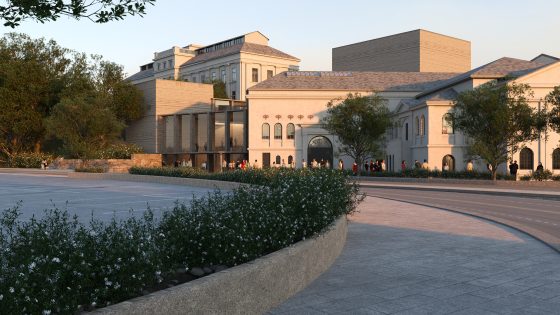
The practice is working with Norwegian practices Lund Hagem, which designed the Deichman Library in Oslo, and Jonas Thor, landscape architect Edikt and technical adviser Arup.
The two-stage competition was organised by Stavanger Municipality. The other finalists were: Helen & Hard with Lundgaard & Tranberg; Dorte Mandrup with Holon; Kima Arkitektur with Mestres Wage; Moreau Kusunoki; and Reiulf Ramstad Arkitektur with 3RW and Schjelderup & Gram.
The 20,000m² Etter Eckhoff project in Kannikhøyden, close to Stavanger Harbour, will retain parts of the historic 1883 theatre, which was enlarged several times throughout the 20th century, and the neighbouring museum. It will also create a new building between the two facilities.
DRDH’s appointment comes just over 10 years after it completed the Stormen Library and Concert Hall in Bodø within Norway’s Arctic Circle, which was named AJ’s 2014 Building of the Year.
Stavanger’s mayor Tormod W Losnedal, who chaired the competition jury, said: ‘The winning design will help develop Kannikhøyden into an attractive meeting place, and Stavanger and the region will gain a new attraction.
‘The historical cultural environment will be strengthened through open park spaces and clear sightlines, and the historical terrain towards Teaterveien and Lagårdsveien will be preserved.
‘Future generations will be able to enjoy these historical cultural buildings, which many of us have grown up with and have fond memories of.
‘We will have modern theatre stages and exhibition halls that will give the theatre and museum completely new opportunities to create unique art and cultural experiences, and, not least, the magnificent buildings will be accessible and adapted for all visitors.’
Also on the jury were Stavanger Museum chief executive Siri Aavitsland; Glenn André Kaada, director of the Rogaland Theatre; and Ole Ueland, county mayor of Rogaland County Municipality. The project is planned to complete in 2032-33.
In a statement, the winning team said: ‘It is a great honour to be entrusted with such an assignment – an important project that is meant for everyone: for the city, its users, and its visitors.
‘We approach this task with humility, with respect for the cultural heritage the site represents and for the significance of Kannikhøyden in Stavanger’s urban history.
‘This has guided the development of Etter Eckhoff. We have emphasised the site’s identity, its history, nature, and existing structures, and designed the new elements to frame, complement, and strengthen what is already there.’
The competition comes four years after an international contest was held for a new ‘modern and future-orientated’ addition to Norway’s landmark Anno Museum in Hamar.
Last year, the National Association of Norwegian Architects launched an international contest for a new visitor centre at the former home of the artist Nikolai Astrup.
Winner: Etter Eckhoff by DRDH with Lund Hagem, Jonas Thor, Edit and Arup
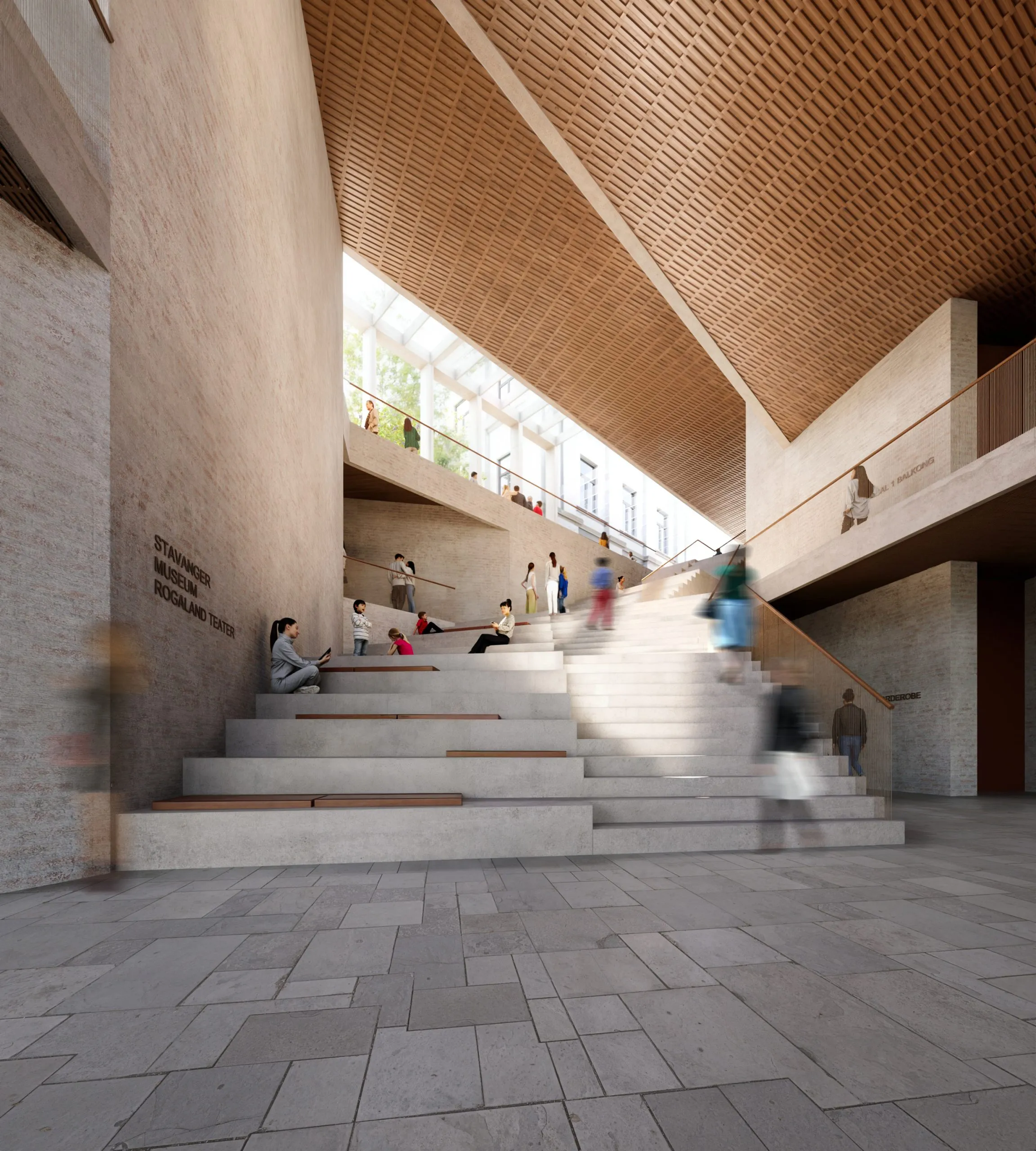
Winner: Etter Eckhoff
Our proposal, Etter Eckhoff, takes as its starting point a group of nationally significant monumental buildings, originally designed by the 19th-century architect Hartvig Sverdrup Eckhoff and subsequently extended and remodelled.
This civic ensemble is set within the remnants of its original 19th-century garden landscape, on a steeply topographic site known as the Akropolis, a steeply topographic site that is part of Kannikhøyden, an area of the city, set across the lake from the historic centre.
The project builds on Eckhoff’s original plans, transforming the area into an open and vibrant destination for the entire city. Respecting and restoring the forms of the existing buildings, while preserving their collective urban image, the project draws the theatre and museum into dialogue.
Offering new museum galleries and theatre spaces, it transforms both institutions functionally while creating a coherent public experience through space and movement: a shared foyer that winds between existing structures, forming an inner street with cafés, meeting places, and public spaces, accessible to all.
Preserving the existing topography, all of the mature trees and the existing fragments of 19th-century landscape, the design opens the surrounding park to the public. The existing buildings are opened to it, while new buildings are carefully integrated above and below ground to maintain the park’s character.