
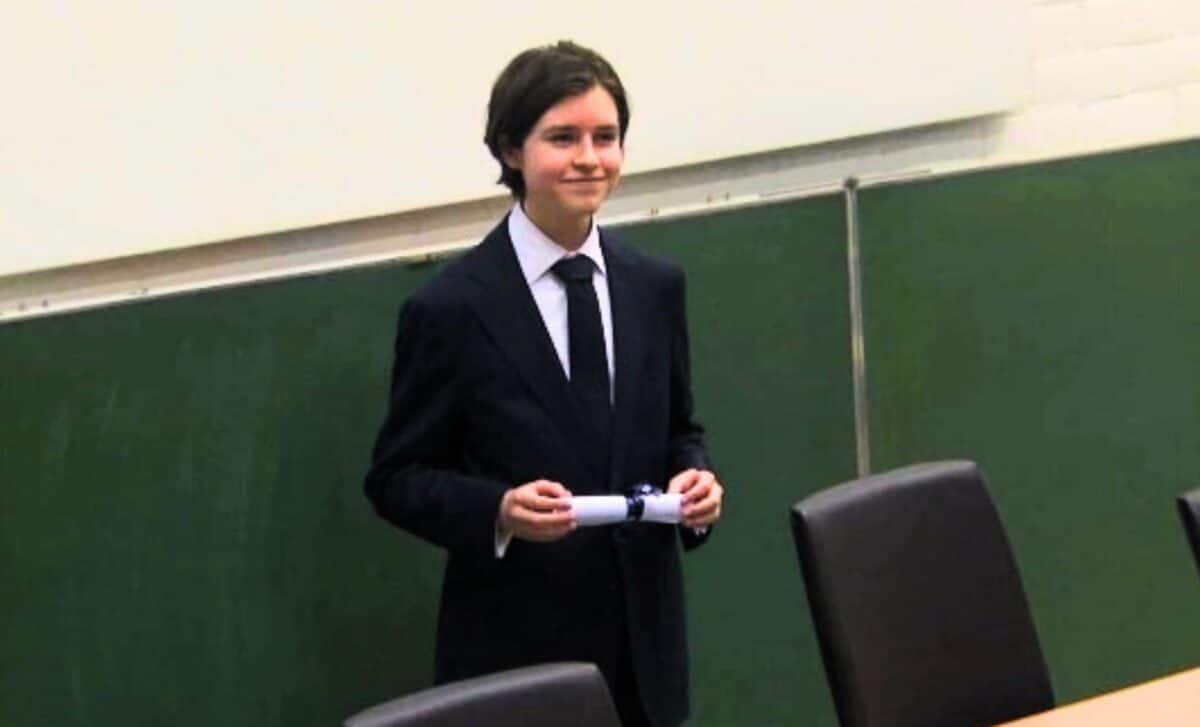
A Belgian teenager has become one of the youngest individuals in modern history to complete a PhD in quantum physics. But for A 15-year-old has just earned a PhD in quantum physics—and that’s only the beginning. Now pursuing advanced research in AI and human enhancement, age 15, this milestone is just one phase in a much broader—and more provocative—scientific agenda.
This week, the University of Antwerp confirmed that Simons successfully defended his doctoral dissertation in theoretical physics, completing work typically undertaken by graduate researchers more than a decade older. His thesis focused on Bose polarons in superfluids and supersolids, complex quantum systems involving ultracold matter.
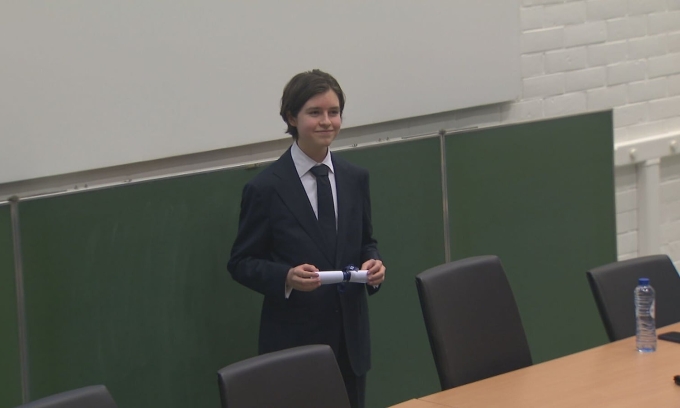 Photo of Laurent Simons. Credit: TV channel VTM
Simons is already pursuing a second PhD in medical science with a specialization in artificial intelligence, and has stated publicly that his ultimate goal is to design technologies that extend and enhance human life. His next ambition, as he describes it, is the development of “superhumans.”
From Ultracold Physics to Biomedical Innovation
Simons’ doctoral research delved into the quantum behavior of Bose–Einstein condensates, a state of matter where atoms cooled to near absolute zero behave as a single coherent entity. His work specifically examined Bose polarons—foreign particles interacting with the condensate—offering insights into how quasiparticles behave in quantum fluids.
These phenomena are essential to the study of many-body systems, and have implications for material science, quantum computing, and even astrophysics. His dissertation was officially validated by the University of Antwerp and marks a significant contribution to one of the most challenging fields in theoretical physics.
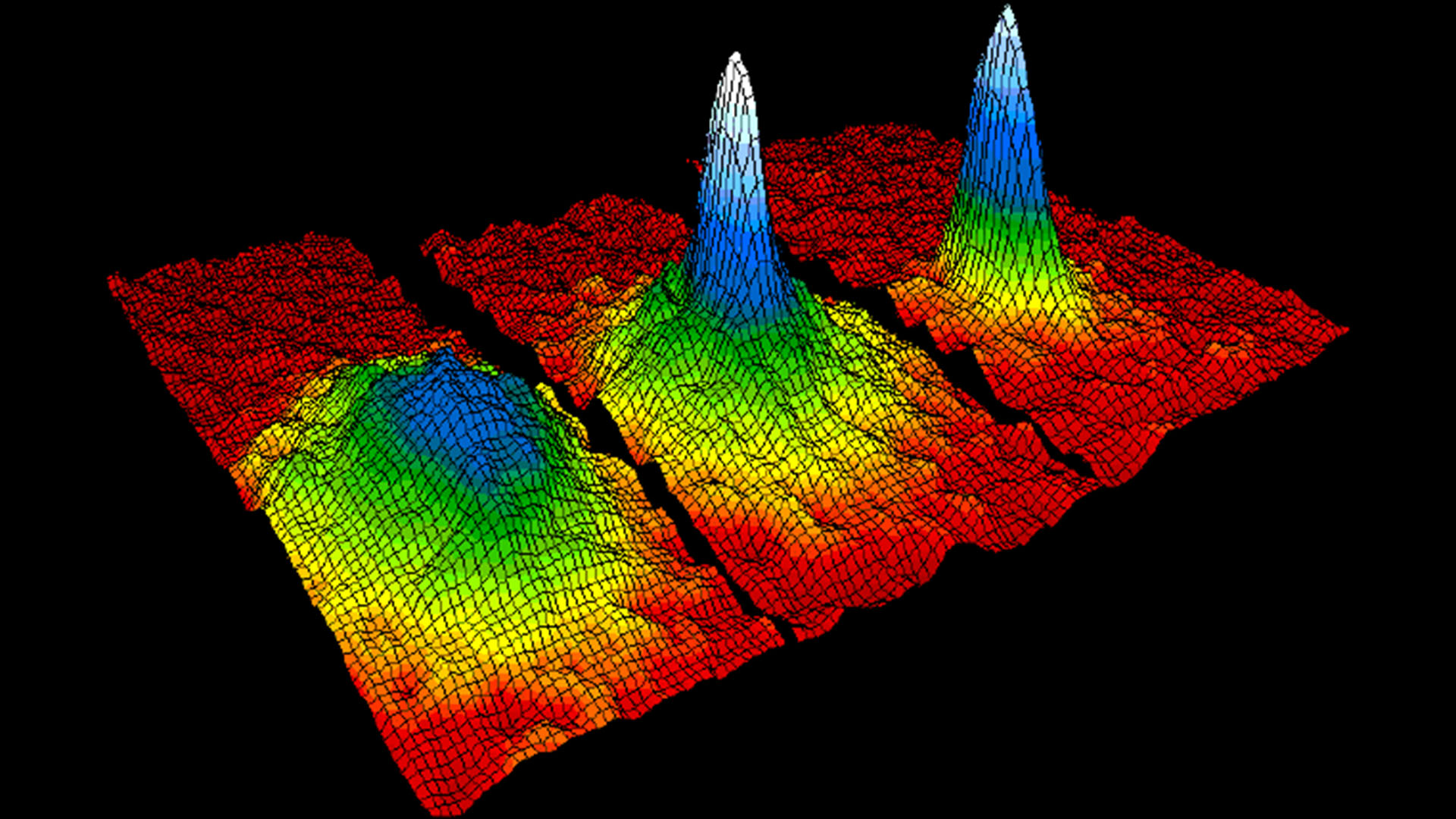 Visualization of Bose–Einstein condensate behavior—Simons’ doctoral research focused on impurity interactions in such quantum states. Credit: NIST/JILA/CU-Boulder
Before completing his PhD, Simons earned both his bachelor’s and master’s degrees in physics at the University of Antwerp in under two years. He also completed an internship in quantum optics at the Max Planck Institute for Quantum Optics in Germany, where he began exploring parallels between quantum systems and biological processes.
This exposure to interdisciplinary research appears to have influenced his academic trajectory. He is now enrolled in a medical science doctoral program in Munich, where his focus has shifted toward AI applications in diagnostics, aging, and regenerative medicine.
AI and the Pursuit of Engineered Longevity
Simons has stated in multiple interviews that he is motivated by the goal of extending human life through advanced science. In an interview with Belgian broadcaster VTM, he said: “After this, I’ll start working towards my goal: creating super-humans.”
His long-term interest in biological enhancement and human immortality has been on record since at least age 11, when he referred to defeating aging as his “end goal.” He now sees artificial intelligence in medicine as the most promising pathway toward that vision.
 Artificial intelligence is being explored in fields ranging from regenerative medicine to predictive diagnostics—Simons is positioning this as his next research frontier. Credit: Shutterstock
The timing aligns with broader momentum in longevity research and AI-driven healthcare. Companies like Altos Labs and Calico Life Sciences have attracted global attention and billions in funding to pursue cellular reprogramming, AI-guided diagnostics, and anti-aging therapeutics. Research published in Nature Aging and Cell Reports Medicine continues to highlight progress in areas like senolytic drugs, genetic editing, and machine learning-based predictive biomarkers.
Simons’ entry into this space brings a different dimension—not just due to his age, but due to his deep background in quantum theory, which rarely intersects with medical research at the doctoral level.
Redefining Scientific Acceleration
Simons’ academic timeline defies traditional pathways. He finished high school at age 8, enrolled in university before age 10, and earned a master’s degree in quantum physics by 12. His original plan to graduate from Eindhoven University of Technology at 9 was delayed due to internal scheduling disagreements, prompting a switch to Antwerp.
At each stage, he has moved through coursework at unprecedented speeds. During his master’s program, he completed all requirements in the first semester, using the second semester to conduct thesis research and intern at Max Planck.
Public fascination with child prodigies is nothing new, but Simons’ focus on radical biomedical innovation places him in an uncommon category—students not just advancing fast, but pushing into ethically and scientifically controversial domains.
There is no indication from the University of Antwerp or his current institutions that his academic credentials are anything but legitimate. His PhD defense and dissertation topic are publicly documented, and the university confirmed his successful completion of the program.
An Ambition That Tests Scientific Boundaries
Simons’ transition from quantum physics to biomedical AI is unconventional, and many researchers remain skeptical about the feasibility of engineering “superhumans” within current scientific or ethical boundaries.
The field of human enhancement, often aligned with transhumanism, remains speculative in most areas beyond assistive technologies and precision medicine. Scientific literature supports incremental progress in aging biomarkers and tissue engineering, but the concept of “superhuman capabilities” remains largely theoretical.
 Advanced anti-aging therapies are one area that could deepen inequality. Credit: Shutterstock
Nonetheless, Simons is framing his academic work as a direct path toward these goals. His public statements—and the direction of his research—signal a belief that human biology can be reengineered, not merely treated or repaired.
The fact that such ambitions are emerging from a researcher not yet old enough to vote only amplifies the debate around ethics, oversight, and acceleration in high-stakes science.