

André Esterhuizen may just be the most valuable player in rugby right now.
An inside centre that every team in the world would start consistently at No12, bar perhaps the All Blacks who have Jordie Barrett, he has become the ultimate hybrid for South Africa.
This year he has started wearing a replacement forward’s jersey — either No20 or 21 — as part of Rassie Erasmus’s innovative 7-1 and 6-2 benches. Aside from being the ultimate flex from the Springboks — who else would use one of the world’s great midfielders as a spare forward? — it has afforded Esterhuizen a spot in the world’s most dominant team.
While part of the 2023 World Cup-winning squad, he did not feature in South Africa’s three knockout matches — each of which they won by a single point. The 31-year-old has 29 caps but was barely selected for Test-match duty while dominating in the Gallagher Prem outside Marcus Smith with Harlequins, to the point where others investigated if he had any English heritage.
However, Esterhuizen never wanted to play for a nation that was not his own. Now his patience has been rewarded as he has become the most fascinatingly versatile rugby player on the planet.
Esterhuizen did initially try to play in the back-row as a 21-year-old, when World Cup-winning South African coach Jake White led the Sharks franchise team in Durban. The experiment did not last long.
“I played ten minutes there, went for a steal and they busted open my whole mouth so I said, ‘No way,’ ” Esterhuizen tells the Ruck podcast.
“The second game I played 40 minutes and at that time when I was younger, my temper wasn’t great. So I said to Jake, ‘Listen, I can’t be this close to contact the whole time. I need to either move back to centre or go off. I’m going to get a red card or something.’ ”

Esterhuizen was part of the South Africa team that won the last World Cup but did not play in the three knockout rounds
ADAM PRETTY/GETTY IMAGES
It was during last year’s United Rugby Championship season that Erasmus called and suggested a second go in the back row for Esterhuizen, who had worn No12 for the entire Sharks campaign. Other coaches have mused about hybrid players — Eddie Jones spoke about using England wing Jack Nowell as a flanker, Sekou Macalou has played in the backs and forwards for France, Ben Earl has moved to centre from No8 in Tests for England — but Erasmus has always been ahead of the game.
“He asked, ‘Am I open to this?’ ” Esterhuizen says. “I said to him, ‘Definitely, if it gives me more opportunity and I can play more regularly, then obviously I’ll do it.’ ” He was first listed as a replacement forward for the 30-22 win over Australia in August, replacing the lock Franco Mostert after 66 minutes in Cape Town.
“In a way you’re surprised but you’re also not surprised because you know something like that can happen, especially coming from them,” he says. “The coaches are always innovative and thinking outside the box. You need to be innovative and you need to bring something new, an X factor or something else that other teams aren’t doing or having. You’ve got to be the first to beat the curve.”
Esterhuizen is still a little reluctant to call himself a forward, though. The Springbok mauling sessions he joins on Tuesdays are brutal.
“The toughest thing is not the game, it’s training against your own players,” he says. “Especially if those guys make each other mad and rally each other up before training, it gets quite tough in there.
“Tuesdays are the worst, when the mauling sessions are. It gets quite rough. At club level, I don’t want to train that hard for the whole year. Luckily my hybrid role is mostly staying at the international level, not at club level.”
Esterhuizen’s new value was proved during the autumn when South Africa had Lood de Jager and Mostert sent off against France and Italy respectively. Esterhuizen replaced the centre Damian de Allende in Paris, but packed down on the flank and provided a try in the stunning 32-17 win. Then in Italy, he came on for Edwill van der Merwe, the wing, after 26 minutes to shore up the pack which was down a man again.
“Who would have thought that we’d get two red cards, and would need a flank and a 12 at the same time? It happened twice in a row,” Esterhuizen says. “It was quite funny how it worked out. It’s basically the perfect scenario for what they’ve tried to do with me.
“When the chips were down, we always pitched up and took things to the next level. The character that the boys showed, to still stick in those games and take it through to the end, that’s probably the biggest thing for me.”
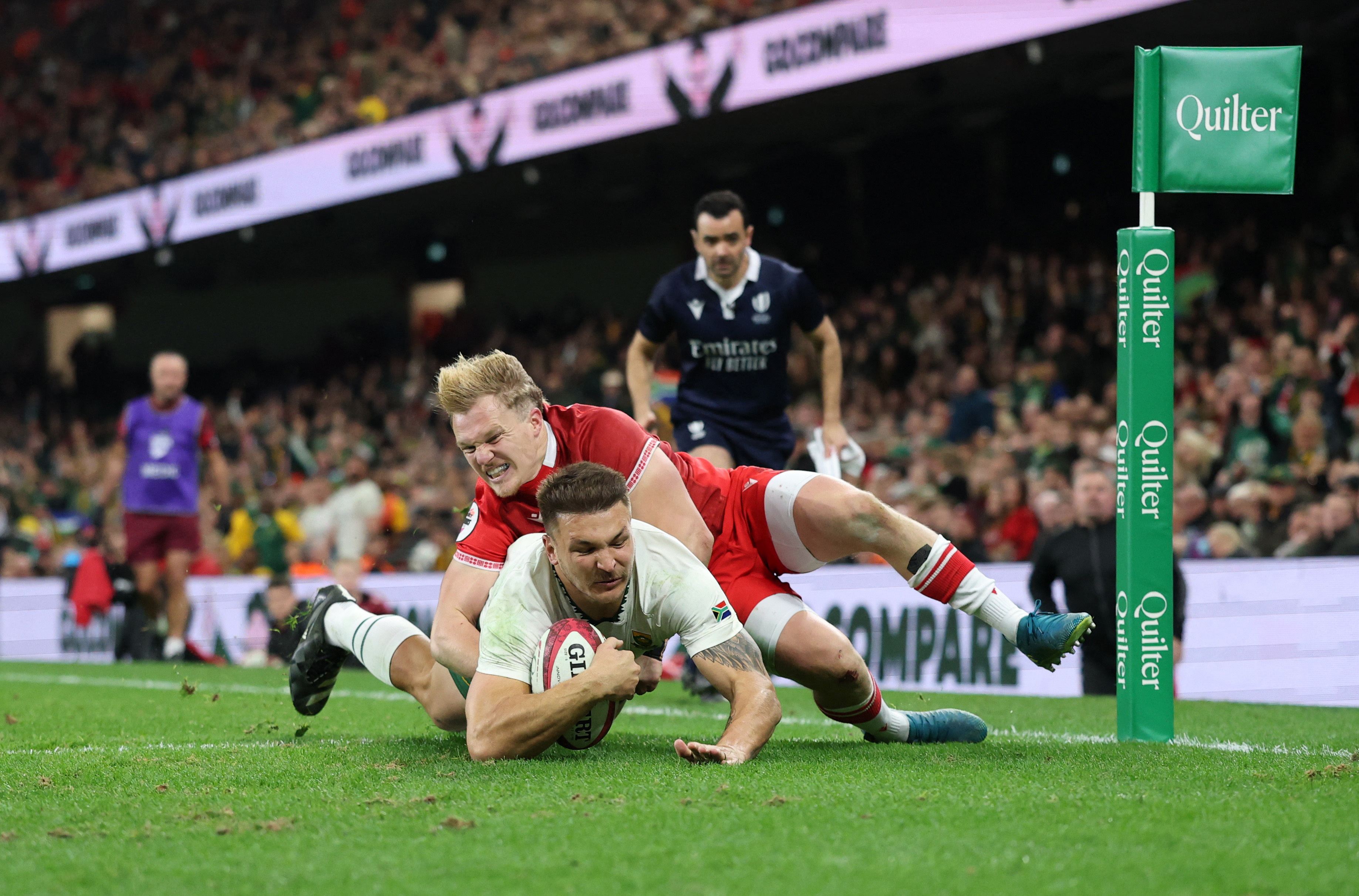
Esterhuizen scores the Springboks’ eighth try in their rout of Wales last month
ANDREW BOYERS/REUTERS
Esterhuizen says the Springboks can beat teams any way they choose — “We can play an expansive game, we can play a tight game, we can play a physical game” — and adds that the double world champions cannot wait to return to the Test game next July in Johannesburg against England.
“Everyone’s looking forward to that,” Esterhuizen says, grinning. “I think everyone wished we played them this year. The Springboks also wished that.”
To put them in their place, you mean?
“We’re just looking forward to playing against them,” he says, still smiling. “They’ve been very consistent, have good players and a good coach and a good structure now.”
For now, Esterhuizen’s Sharks lie in wait for Saracens this Saturday in the Investec Champions Cup. The Durban franchise are an odd team; they are full of Springbok players yet have won only one match all season, against the Scarlets.
The Sharks sent their second team to be trounced 56-19 in France against Toulouse last Sunday, so they could target Saracens with their strongest outfit. Those who featured in Toulouse will only arrive home on Wednesday, so it made sense to split the line-ups. Logistics, once again, are proving an issue in the cross-hemisphere “European” Cup.
As a former Harlequin, who travelled to Cape Town and Durban for Champions Cup matches, Esterhuizen understands why fans find this frustrating.
“They don’t understand why we’re sending teams like that over there, thinking we’re not taking it seriously, but we actually are,” he says. “We want to compete every weekend — the Champions Cup is probably the best club trophy to win, that’s why we’re targeting this game.”
Esterhuizen never beat Saracens while with Harlequins, but the English side face a tough task to get one over the Sharks in the December Durban tropics — especially with their hybrid hero involved.
Round twoFriday, December 12
Leicester Tigers v Leinster (8pm)Saturday, December 13
Stormers v La Rochelle (1pm)
Sharks v Saracens (3.15pm)
Clermont Auvergne v Sale Sharks (3.15pm)
Bordeaux-Bègles v Scarlets (5.30pm)
Munster v Gloucester (5.30pm)
Glasgow Warriors v Toulouse (8pm)Sunday, December 14
Harlequins v Bayonne (1pm)
Castres v Edinburgh (1pm)
Toulon v Bath (3.15pm)
Northampton Saints v Bulls (3.15pm)
Bristol Bears v Pau (5.30pm)