
(Credits: Far Out / YouTube Still / Alamy)
Tue 9 December 2025 20:00, UK
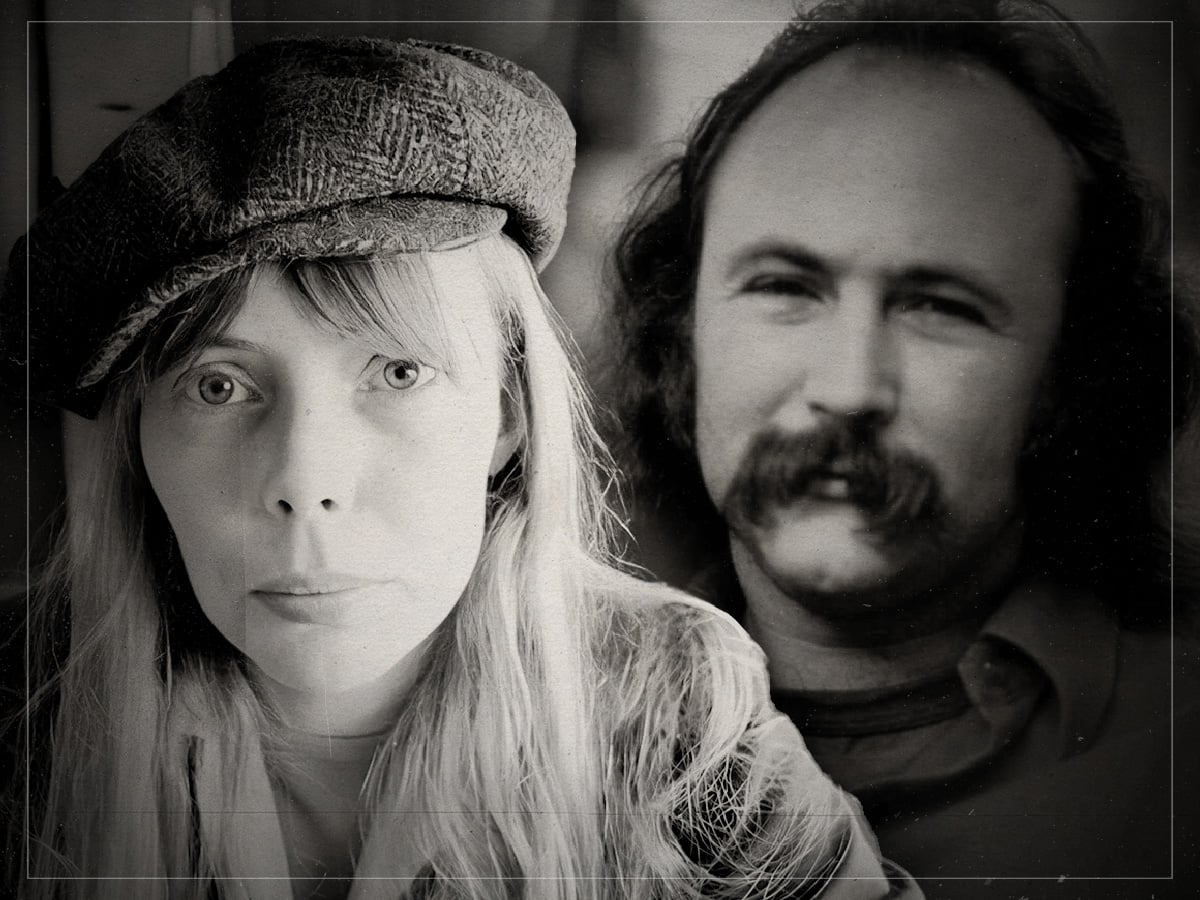
One of the things that initially drew David Crosby to Joni Mitchell was that she could musically “expand your goddamn consciousness”.
In his view, her storytelling could viscerally transport you somewhere else and take you on a personal journey, even through words that aren’t your own. To Crosby, this was what made her stand apart from her peers and made her a force to be reckoned with, because she could take seemingly normal, everyday musings and turn them into world-class poetry, taking you somewhere you never knew you needed.
For Mitchell, Crosby was more than just a seminal influence; he sparked the beginning of her career after he discovered her while performing at a club in Coconut Grove, Florida. He was immediately enchanted by her talent, but quickly learned how erratic she could be, which, although intense at times, ultimately ended up enhancing her career and the way she approached her own writing.
Their brief romance was authentic yet explosive, and a moment that Crosby later compared to “falling into a cement mixer”. Their affair wouldn’t last, but they never stopped respecting each other, even after Mitchell effectively ended their relationship through song, savagely calling attention to all of her grievances before they’d even officially broken up.
As with most major songwriters, however, disagreements and fallouts are inevitable, especially those who cross paths creatively before falling into a more intimate or romantic relationship. Mitchell and Crosby might have remained close after their liaisons, but when it came to others in the counterculture circle, their opinions sometimes differed. One divisive figure among them was the psychedelic force of the movement herself, Grace Slick.
Crosby’s admiration for the ‘White Rabbit’ singer runs deeper than the music, especially after he had a hand in helping her get sober, while also regarding her as one of the crucial “queens of rock” who had a “power” and “intensity” that could outshine other rock powerhouses like Stevie Nicks. “Slick reigned with Janis Joplin as queens of rock at that time,“ Crosby told Jefferson Airplane biographer Jeff Tamarkin for Got a Revolution!.
“The force of both her voice and her personality made her a ceiling-shattering feminist counterculture icon and an inspirational model for many to follow,” he added. “When [Jefferson Airplane] got Grace in the band, that was just beyond belief. She was stunning… She had a power and intensity onstage that Stevie Nicks should only ever dream she could get.”
Mitchell, on the other hand, couldn’t disagree more. In fact, Mitchell has expressed her disdain for her fellow counterculture icon more than once, including one particularly scathing remark about how both Slick and Janis Joplin’s careers were based on “sleeping with their whole bands and falling down drunk”. In 2009, Mitchell also told Mojo, “[Slick] was very competitive with me, very insecure. She was the ‘Queen of Rock ’n’ Roll’ [one year], and then Rolling Stone made me the ‘Queen of Rock ‘n’ Roll’, and she hated me after that.”
It’s unclear why Mitchell turned her back on her female rock peers, though it’s obvious that it was sparked by a more bitter-fuelled, personal point of view. Slick, on the other hand, hasn’t responded to Mitchell’s grievances all that much, except for subtle acknowledgements and criticisms about her songwriting, including her song ‘Woodstock’, saying that Mitchell painted it out to be more poetic and romantic than it actually was.
Major figures across the 1960s-1970s singer-songwriter boom were always going to clash in one way or another, whether creatively, personally, or for other reasons, like sociopolitical views or recollections of major festival events. However, the differences in Mitchell and Crosby’s opinions seem to be a matter of personal position and subjectivity, with Crosby falling into the more common category of viewing Slick as an ultimate rock legend.
Related Topics