
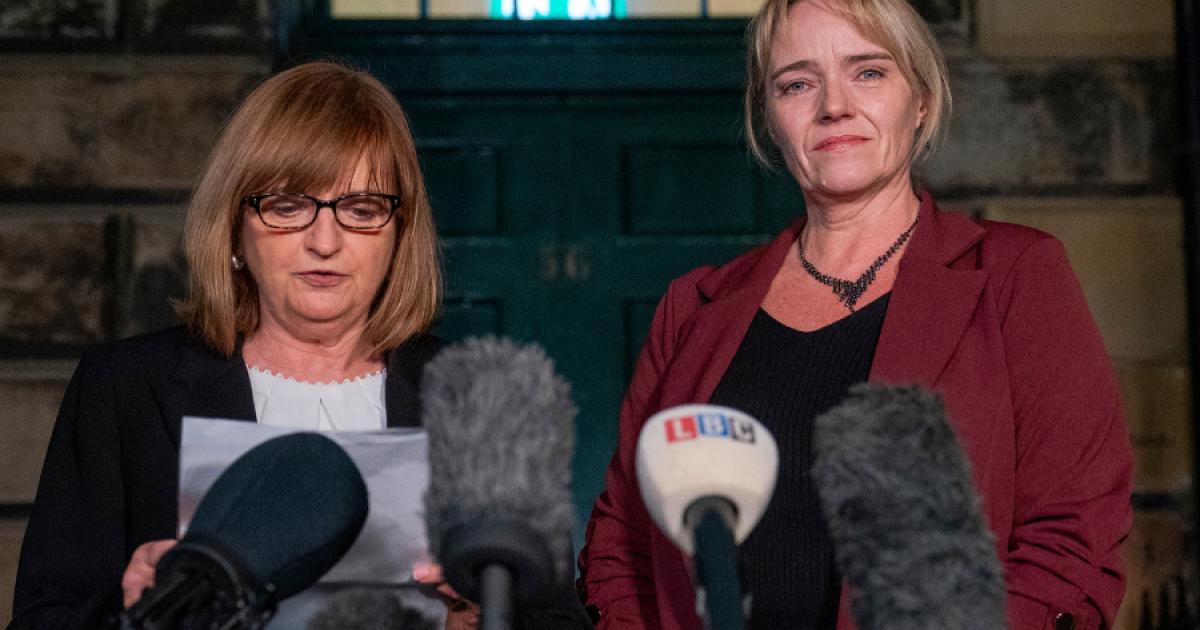
On Monday, a tribunal ruling on Peggie’s complaint against NHS Fife and trans doctor Beth Upton was published, concluding that the health board had harassed the nurse on four counts, all of which related to the handling of her complaint.
A further 43 counts were thrown out, including all allegations against Upton, and the tribunal said that NHS Fife giving the doctor permission to use female changing spaces was not unlawful.
READ MORE: Senior Police Scotland officer suspended over bullying allegations
An urgent question on the tribunal ruling was raised at Holyrood on Tuesday, with Green MSP Patrick Harvie saying: “Despite the valiant attempts of anti-trans campaigners to claim a win on this issue, the tribunal in fact found that Ms Peggie’s own behaviour amounted to harassment of Dr Upton, and it dismissed the vast majority of her claims.
“Most importantly, it is the second Scottish employment tribunal in a month to find that employers are not in fact required to operate the kind of trans-segregation policies which anti-equality groups are pushing for.
“So, does the Scottish Government agree that the blanket exclusion of trans people from facilities that they need at work is generally unlawful – and will it therefore make clear to all public bodies in Scotland that segregation of trans people is not supported in law and that their human rights will be defended against the current onslaught?”
Scottish Green MSP and former co-leader Patrick Harvie (Image: PA)
Health Secretary Neil Gray responded: “We’re still working through and we’ll consider carefully the tribunal ruling and its implication not just for the health service, but for the wider public bodies as employers and ensuring that our health system is based on the core values of care, compassion, openness, honesty, integrity, and respect for everyone, irrespective of their individual identities.
“There are four areas that were upheld by the tribunal which need to be taken seriously, and I’ll be corresponding with NHS Fife in order to hear how they intend to respond to those.”
The Equality Network said in an analysis of the case, published on Tuesday, that there had been “another important Scottish Employment Tribunal judgment last week, in the case of Maria Kelly v Leonardo”.
It went on: “Kelly had claimed that allowing trans women to use the women’s toilets at her work amounted to direct and indirect discrimination against her, and also harassment. The tribunal dismissed all her claims. It noted that there were single occupancy toilets nearby that Ms Kelly could use, if she did not want to go to the women’s toilets when a trans woman might be in there.”
READ MORE: Ellie Gomersall: Girlguiding and the Women’s Institute forced decisions are ludicrous
The Equality Network added: “For now, these cases confirm that the Supreme Court ruling in April this year, in the case of For Women Scotland v Scottish Ministers, does not require a blanket ban of trans people from the services, facilities and toilets that they use in line with their gender.
“This also suggests that anti-trans or gender critical campaigners, and many in the media, as well as some pushing in parliament, have been incorrectly and harmfully misstating the law in this area.”
One of the four points in which the tribunal did rule in Peggie’s favour was that the NHS Fife board should have found a temporary solution after her complaint so that she and Upton would not have to use the changing room at the same time.
Speaking at Holyrood, Scottish Labour depute leader Jackie Baillie said: “The ruling in the Sandie Peggie case leaves significant questions for both NHS Fife and the Scottish Government to answer.
Scottish Labour MSP and depute leader Jackie Baillie
“Now, the Scottish Government has written to health boards in early September about the Supreme Court judgment [on biological sex in the Equality Act], but leaves it as a matter for individual boards to consider following their own legal advice.
“Can I ask the Cabinet Secretary, surely we should have one consistent approach across Scotland, where the legal advice for boards is the same, where a woman does not need to first complain to have her employer follow the law, or is it the case that the Scottish Government expect individual frontline staff to be their own experts on human rights law?”
Gray responded: “The Scottish Government accepts the Supreme Court ruling. We accept that judgment. We’re taking forward the detailed work that is necessary as a consequence.
“The group that has been established and convened by the permanent secretary has been actively considering the implications of the judgment across every key area of government and as a result of this work, action has already been taken, including updated guidance for the Gender Representation on Public Boards Scotland Act 2018, and amendment to the Public bodies, public appointments recruitment process for regulated public bodies, through which the Act is applied.
“So, action has been taken.”
READ MORE: Richard Murphy: Scotland’s banks, not its currency, hold the key to real independence
Tory MSP Murdo Fraser called for Carol Potter, the chief executive of NHS Fife, to be fired.
He said: “Carol Potter, as chief executive of NHS Fife, has lost the confidence of the people of Fife, does not deserve to continue in that role, should not be allowed to retire next year on a healthy pension.
“Will the Health Secretary now sack her and remove her from a job she is not fit to do?”
Gray said: “The tribunal is still to remedy. The parties involved still have 14 days to appeal the decision.
“I do note that four of the 47 claims were upheld, and it’s important that serious consideration is given by Fife to those four areas of 47 that were upheld.
“I’ll be corresponding with Fife in order to hear their response to how they will respond to those claims being upheld.”