
Illustration by The Globe and Mail; Sammy Kogan/The Globe and Mail, Duane Cole/The Globe and Mail, Supplied
Best collection
The Montreal Museum of Fine Arts can boast it holds one of the most important design collections in North America, a claim greatly boosted by this year’s reinstallation of furniture, vases, silverware – and a snowmobile – by independent curator Rachel Gotlieb. One highlight of the newly reopened galleries is the wall of modernist chairs demonstrating how a technical innovation, such as the use of cantilevered forms, led to an aesthetic revolution in interior design.
Best retrospectiveOpen this photo in gallery:
A Jeff Wall retrospective at the Museum of Contemporary Art in Toronto includes Dead Troops Talk (a vision after an ambush of a Red Army Patrol, near Moqor, Afghanistan, winter 1986) of 1992, while The Storyteller of 1986 can be seen in the background.LF Documentation/Jeff Wall/Supplied
Despite his international reputation as a conceptual photographer, Vancouver artist Jeff Wall hasn’t shown much in Toronto, or even in Western Canada, in decades. The retrospective of his work from 1984 to 2023 at the Museum of Contemporary Art in Toronto provides a wonderful opportunity to catch up with his arresting images, often deliberately and obviously staged, of urban life, nature and people. To March 22.
Best revelation
In southern Canada, we associate Inuit art with a set iconography that is devoted to animals and mythic figures. The McMichael Canadian Art Collection in Kleinburg, Ont., shattered that image with a spring-summer show devoted to the Kinngait Drawings Archive. The McMichael is the custodian of this trove, which includes the drawings on which the familiar Inuit prints from Kinngait (formerly Cape Dorset) were based – but also many other images. Greenlandic Inuk curator Emily Laurent Henderson made her selections with a particular focus on pictures of people, from portraits to social scenes, as well as drawings addressing technology and futurism, for a show that greatly broadened the public perception of Inuit art.
Best interventionOpen this photo in gallery:
Altmejd’s exhibit, titled “Agora: An Assembly of Fabulous Creatures,” is a selection of the artist’s works over the last thirty years, from 1999 to 2025.Andrej Ivanov/The Globe and Mail
The Canadian sculptor David Altmejd, known for an antic art of monstrous hybrids, loves to add last-minute tweaks to his pieces or hang extra drawings in a show. In his current exhibition at the Galerie de l’UQAM in Montreal, his interventions go one step further. In the long, low white plinth that serves as a base to display several sculptures, he has added a white mould of a hand, clawing at the surface, as though a new sculpture was making itself while you stand there. Beside it, one of his signature bunnies – exaggerated creatures with unnaturally long ears – is also climbing out of the plaster. It’s a witty gesture that adds to the fantastical aspect of his art, suggesting that a living, breathing thing is reproducing itself in the gallery. To Jan. 24.
Best public art Open this photo in gallery:
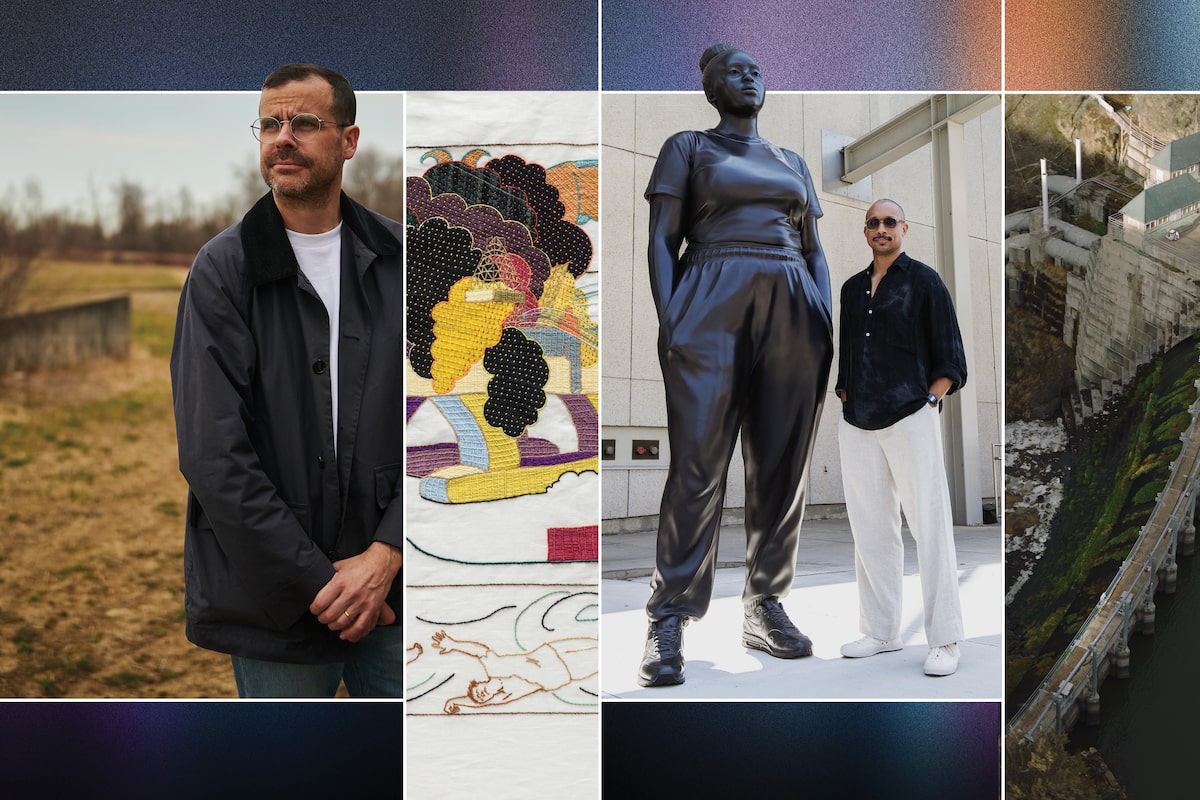
Artist Thomas J Price stands next to his sculpture Moments Contained outside of the Art Gallery of Ontario.DUANE COLE/The Globe and Mail
You can’t miss her: Since August, a very large young woman has been standing on Dundas Street outside the Art Gallery of Ontario. Cast from bronze by the British artist Thomas J Price, Moments Contained depicts a Black woman with her hands in her pockets and a faraway look on her face. (She’s a permanent acquisition by the AGO and will be there for the foreseeable future.) Casually dressed, her hair in a top knot, she might be anybody or nobody – but because she is three metres tall, you are going to notice her and think, as Price continues his critique of social hierarchies, public commemoration and race.
Best portraitOpen this photo in gallery:
Portrait of a Gentleman Wearing a Fur-Lined Cloak and Hat.The Phoebus Foundation, Antwerp/Supplied
Since the advent of photography – and only more so in the age of the selfie – it has become easy to forget that in centuries past, a realistic portrait was a miraculous thing. There was a powerful reminder this year, however, in an exhibition of Flemish art at the Royal Ontario Museum where Jan van Scorel’s 16th-century Portrait of a Gentleman Wearing a Fur-Lined Cloak and Hat featured a heavy-set, middle-aged man with a sagging face and 5 o’clock shadow. You feel like you know this sad-sack guy – wasn’t he trying to sell you new winter tires last week? – and then you pinch yourself to remember this is oil painted on canvas almost 500 years ago. To Jan. 18
Best video
When they blew a hole in the biggest dam on the Klamath River that runs from Oregon to the Californian coast, the American artist Lucy Raven was there to film the drama from a helicopter. Her video, Murderers Bar, is partly an artistic documentary about the largest dam removal project in U.S. history, and partly a wordless – but never silent – investigation of the mythic power of the West and the real power of water. Showing on a giant vertical screen at Toronto’s Power Plant Contemporary Art Gallery, the 42-minute video is riveting, with a score by Deantoni Parks, swelling toward that moment when the sediment-stained river water flows into the blue of the Pacific. To March 22
Best needlepoint Open this photo in gallery:
The Black Gold Tapestry is a 67-metre history of fossil fuel extraction. This part of the artwork is depicting Deepwater Horizon oil spill.Don Lee/Supplied
Calgary textile artist Sandra Sawatzky, known for her giant tapestry recounting the history of oil extraction, has expanded her iconography to include all recent anxieties. The Age of Uncertainty, a series of embroidered panels evoking such headaches as consumer debt and climate change, showed at the Red Deer Museum and Art Gallery in Alberta last winter, as Sawatzky pursues a remarkable encounter between a supposedly feminine craft and tough contemporary topics.
Best photographerOpen this photo in gallery:
Les Sœurs Clarisses, Valleyfield, 1991Clara Gutsche/Supplied
Montreal photographer Clara Gutsche was the recipient of the 2024 Scotiabank Photography Award and then featured in a springtime exhibition at the Image Centre gallery at Toronto Metropolitan University. It was a welcome opportunity to revisit – or get acquainted with – her commitment to pursuing a single theme over several years, creating serial images of siblings, high-school students and Quebec’s vanishing nuns.
Best kept secretOpen this photo in gallery:
Derek Sullivan stands by Shift, a concrete sculpture by renowned American artist Richard Serra, located in a field in King, Ontario.Sammy Kogan/The Globe and Mail
From 1970 to 1972, the American sculptor Richard Serra built Shift, a series of low walls following the rise and fall of the moraine in a field in King City, north of Toronto. Today, this seminal piece of seventies land art still stands and is protected as a cultural landscape, but it’s located on private land owned by a developer with no official public access. Still, locals know of its whereabouts, and Ontario artist Derek Sullivan can lead you there. He’s interested in the context in which art is made and displayed, and for a project with the nearby McMichael Canadian Art Collection, he investigated the odd circumstances of the much neglected Shift – cracked, half-covered in weeds and grasses, and occasionally dinged by a passing tractor, since the surrounding field is still farmed.