
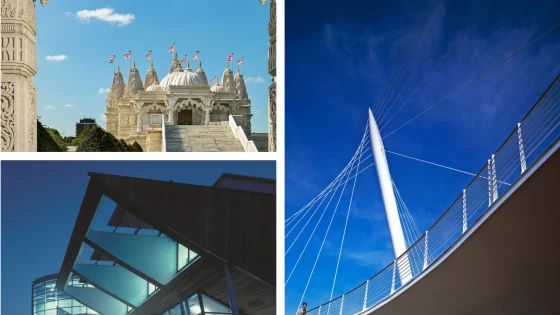
The heritage campaign group announced its Coming of Age list today (14 November) and called for the government and Historic England to consider listing the 10 structures.
Also on the list are Burrell Foley Fischer’s Harbour Lights Southampton cinema; Neasden’s Hindu temple – once the largest temple built outside of India, Hopkins’ Queens Building, Emmanuel College building in Cambridge, and the first completed project by Níall McLaughlin, the Photographer’s Hide, in Northamptonshire.
The other five buildings are ZED Factory’s Hope House in Hampton, Lifschutz; Davidson, Sandilands’ Broadwell housing in Lambeth; Napper Collerton Partnership + Arup’s Tees Barrage in Stockton-on-Tees; Kennedy Fitzgerald & Associates’ St Brigid’s Church in Belfast; and Techniquest, Cardiff – the UK’s first science discovery centre, designed by Ahrends Burton and Koralek.
Thirty is the age that buildings become eligible for listing. Government guidance states that buildings under 30 years of age are not usually considered eligible because ‘they have yet to stand the test of time’.
The Twentieth Century Society says that turning 30 is also when buildings are ‘likely to require their first major refurbishment’ and often face their ‘nadir’ or risk being redeveloped.
Twentieth Century Society campaigns director Oli Marshall commented: ‘Now That’s What I Call Architecture, 1995! The wonderfully rich and varied buildings on our annual Coming of Age list offer us a snapshot of the now not-so-recent past. They act as vivid manifestations of Britain’s aspirations and priorities at a time, in the mid-1990s, which is now at the centre of our cultural nostalgia, but probably more distant than we might think from our world today.
‘We say: why wait until the bulldozers are poised, to intervene and recognise outstanding buildings like these, when it is possible to make an objective judgement far earlier? C20’s ‘End of Year Honours List’ is the gong for modern heritage, signalling that, for these outstanding projects, national listing surely awaits.’
In October, the AJ revealed that Labour ministers have repeatedly overruled official listing advice from Historic England. This has affected 20th-century buildings in particular.
Meanwhile, Historic England has refused to recommend listing several major 20th-century projects, including Foster + Partners’ 23-year-old former City Hall building, which was refused listing for the second time in July last year ahead of its oveerhaul by Gensler, and Alban Gate – the green-glass City of London office block by National Theatre architect Denys Lasdun – which was refused listing in September 2023 ahead of an AHMM redevelopment.
However, last month, MacCormac Jamieson Prichard’s Southwark Station, part of London’s Jubilee Line Extension, was Grade II listed despite only being completed in 1999. Other schemes listed before their 30th birthday include James Stirling and Michael Wilford & Partners’ No 1 Poultry, which was listed at Grade II* in 2016 despite being completed in 1994.
Twentieth Century Society citations for its Coming of Age list
BAPS Shri Swaminarayan Mandir (Neasden Temple), Brent, London, by Chandrakant Sompura
East meets West in suburban Neasden at what was Europe’s first traditional Hindu Mandir, and for a long time the largest temple ever built outside of India. The herculean £12 million, five-year project employed some 450 craftsmen and 1,000 volunteers, and was built entirely using traditional methods and materials, with no structural steel. A masterpiece of exquisite Indian craftsmanship, 5,000 tonnes of Italian and Indian marble and the finest Bulgarian limestone were hand-carved in India before being assembled in London, while the adjoining timber Haveli courtyard uses Burmese Teak and English Oak
Harbour Lights Cinema, Southampton, by Burrell Foley Fischer
Among the mediocrity of Southampton waterfront’s 1980s and 90s redevelopment, Harbour Lights stands out as perhaps the most original new cinema building in Britain over the last 40 years. Described by architectural critic and Sotonian, Owen Hatherley, as ‘a beacon of confident and optimistic 1990s architecture, where you can both gaze outwards at the marina and gaze inwards at the cinematic dreamworld. It is an irreplaceable building, a time capsule of a more open, cosmopolitan city’.
Trinity Footbridge, Salford, Manchester, by Santiago Calatrava
The first pedestrian crossing of the River Irwell, the Trinity Bridge linked the adjoining cities of Salford and Manchester and symbolically marked the first phase of regeneration of the former docklands. The design is a 79m-long asymmetric cable-stayed bridge, in trademark white-painted steel, with striking cable geometry from the 60-degree tilted, cigar-shaped pylon. One of Calatrava’s earliest bridge works, remarkably, it remains the only UK project by the feted Spanish-Swiss architect.
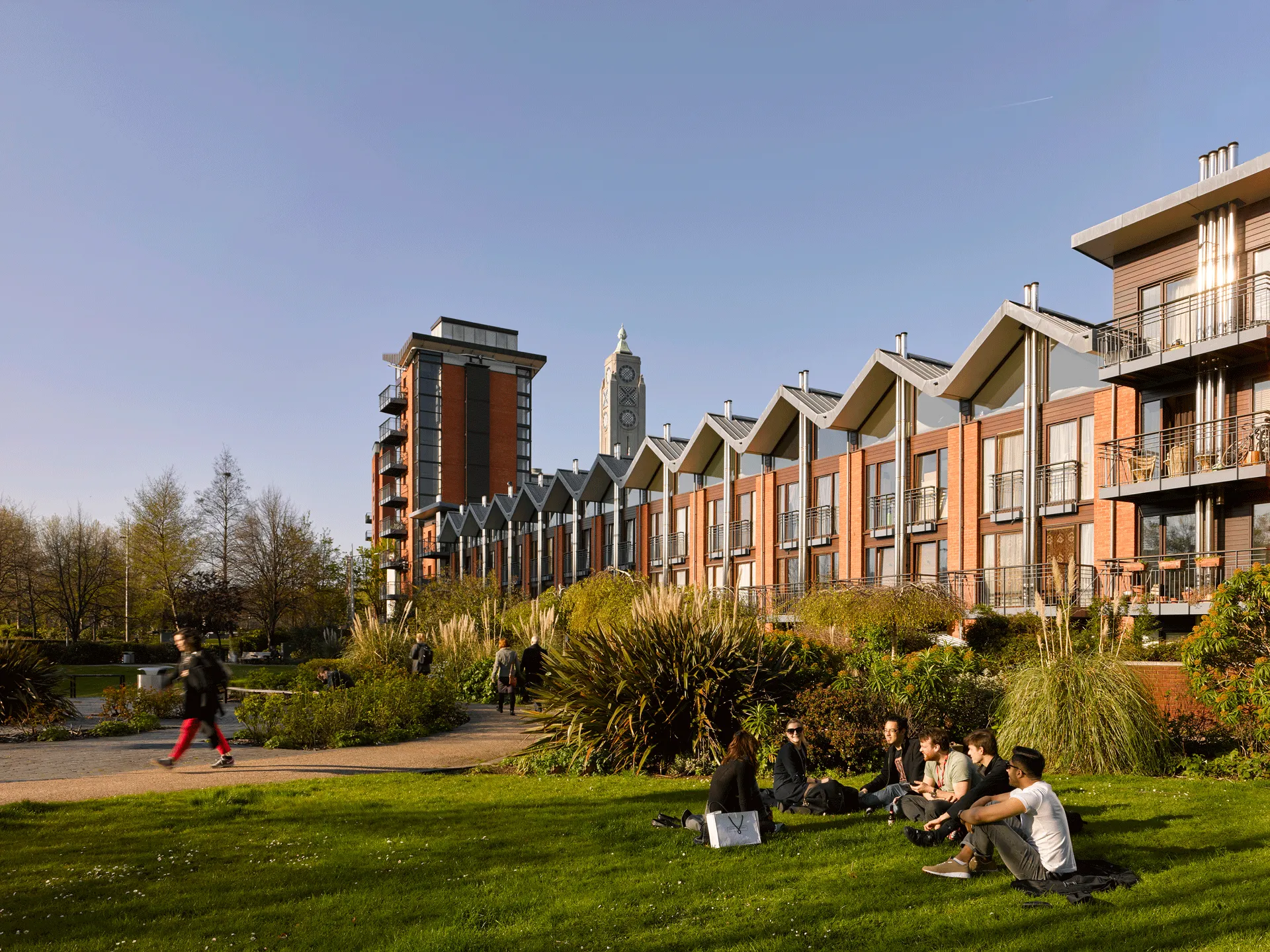
Broadwell Housing. Photo: James Brittain
Hope House, Hampton, London, by ZED Factory
Bill and Sue Dunster’s Hope House was the first experimental ‘ZED‘ project, which eventually led to the large-scale BedZED in 2002. Sitting on a floodplain at the confluence of three waterways, the building is reached by a bridge with a flood-resistant brick ground floor supporting a two-storey weatherboarded timber frame. A faceted south-facing conservatory is clad with photovoltaic panels and solar heating tubes at the upper level, with an internal cantilevered balcony terrace connecting all floors, testing the many possibilities of flexibly planned, economic, zero-energy housing.
Broadwell Housing, Lambeth, London, by Lifschutz Davidson Sandilands
In a decade that represented something of a nadir for socially oriented housing, and at a time when much of the South Bank was still bleak and unattractive, Lifschutz Davidson Sandilands’ Broadwell Housing development for the Coin Street Community Builders is especially worthy of celebration – both for its elegant design of “long-life, loose-fit” homes, with gabled roofs that give each house a clear identity, and as a model of community-led urban regeneration and co-operative ownership.
Queens Building, Emmanuel College, Cambridge, by Hopkins Architects
Enclosed by a colonnade and clad extensively in Ketton limestone, referencing the nearby College chapel designed by Sir Christopher Wren in 1673, Hopkins’ Queens Building provided an intimate yet highly tuned double-height auditorium for lectures and recitals at Emmanuel College. Like the practice’s Glyndebourne project from the previous year, it demonstrated the practice’s sensitivity in fusing High-Tech and vernacular architecture in harmony with the historic setting.
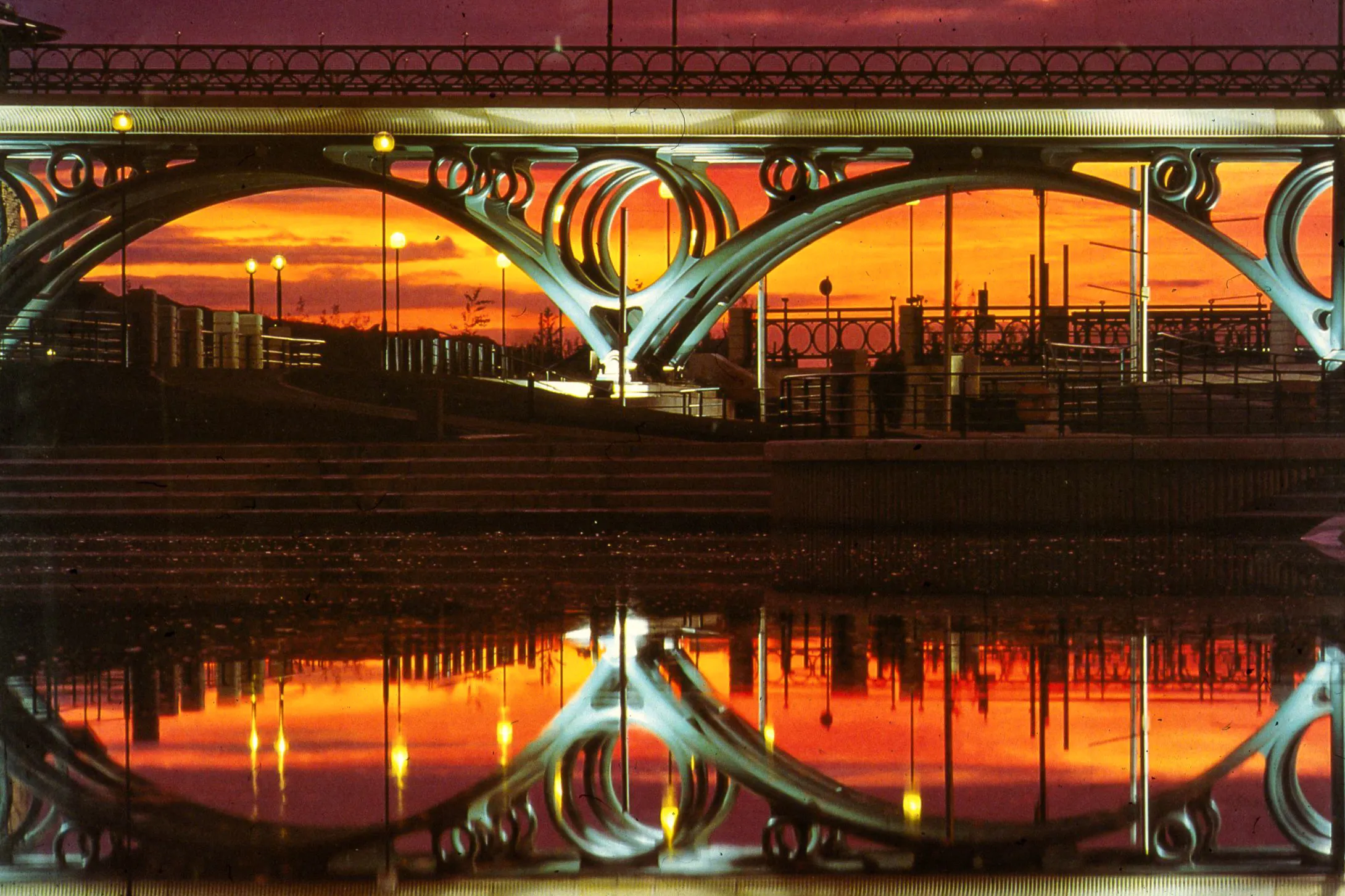
Tees Barrage. Photo: Napper Architects
Tees Barage, Stockton-on-Tees, by Napper Collerton Partnership and Arup
Evoking a supersized Pont des Arts, this elegant 160m-long barrage spans the unsightly tidal mudflats of the Tees with a collection of road and footbridges, two control pavilions, a fish ladder and a canoe slalom. Extending the Teesside tradition of virtuoso steel structures, as previously demonstrated by the iconic Transporter Bridge, the sequence of cast tubular steel arches with airy filigree tracing showcases a Po-Mo verve that was increasingly out of fashion by the mid-90s.
St Brigid’s Church, Belfast, by Kennedy Fitzgerald & Associates
The ‘cradle of Catholicism in Belfast’, this is the second St Brigid’s Church on the site. The 1891 original was enlarged in the 1960s as the parish grew and subsequently damaged by IRA bombings in the 70s; in 1989 the decision was taken to build a new church. Kennedy Fitzgerald & Associates winning scheme is a simple hall on a traditional plan, with glass block clerestory, a roof of steel trusses clad in pitch pine, and brickwork influenced by the vernacular character of Victorian Belfast. With playful drums, turrets and a slender bell tower, this is Dudok meets Cloud City by way of Ulster.
Photographer’s Hide, Northamptonshire, by Níall McLaughlin Architects
Hovering over a pond on the site of a former US Air Force base, McLaughlin’s first complete building is a highly original dragonfly of organic architecture, containing a small studio, sauna and bedroom. The client was a wildlife photographer and the building’s scaly glass-fibre canopies, perforated metal wings and blind blockwork ‘shack’, with projector room style openings, draw inspiration from both their insectine subject matter and military debris strewn across the site. Costing only £15,000 and built entirely from models with no formal plans, this tiny project helped the studio win Young Architect of the Year.
Techniquest, Cardiff, by Ahrends Burton and Koralek
A flagship project in the regeneration of the former Cardiff Docks, Techniquest was the UK’s first science discovery centre. Built around the iron frame of a late-19th-century repair workshop of the Mount Stuart Dry Dock, here the retained element becomes the foil to a series of playful interventions. An external scaffold of tubes and tension rods buttresses the structural glass walls, while internally the open-plan exhibition hall is animated by information pods, a gallery and randomly placed exhibits in joyful primary colours.
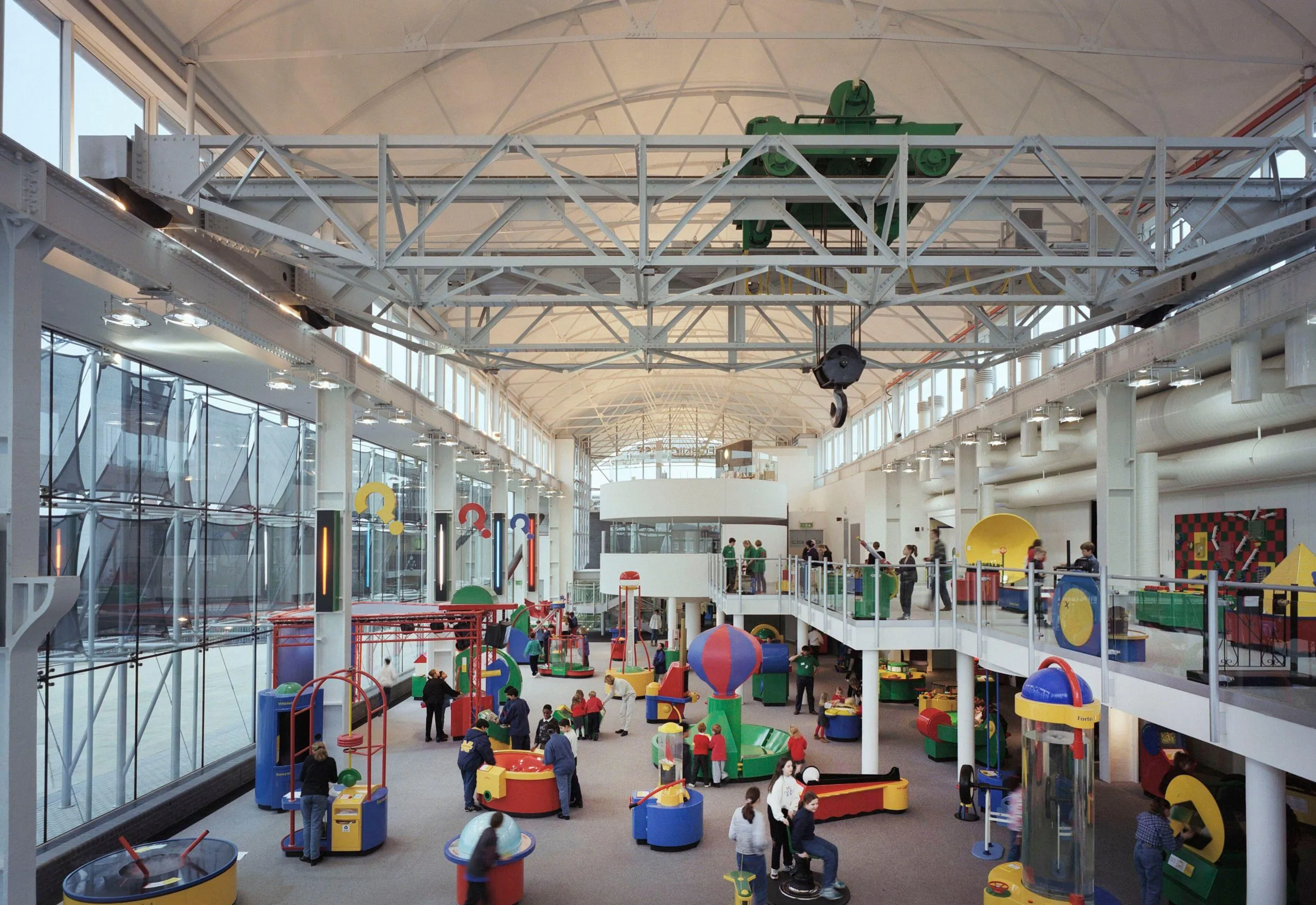
Techniquest, Cardiff by Ahrends Burton and Koralek. Photo: Steve Oprey