
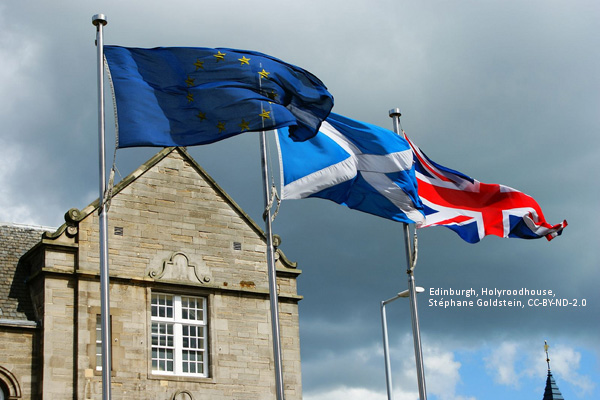
Angus Robertson MSP outlines the Scottish Government’s priorities for the forthcoming UK-EU negotiations, arguing that the UK government needs to adopt a more ambitious package of measures and give devolved governments a real say in negotiations.
What’s at stake and why you should care?
The UK and EU are back at the negotiating table, and Scotland has a clear message: it wants a closer, more constructive relationship with Europe. Following the UK–EU Leaders’ Summit in May this year, the Scottish Government has published its priorities for the next phase of talks.
These negotiations aren’t just about politics – they affect everyday life. From the price of food and energy to opportunities for young people and cultural exchange, the outcome will shape Scotland’s future for years to come. Whether you’re a student hoping to study abroad, a farmer exporting to Europe, or an artist planning a tour, the decisions made now will matter.
Why this matters
Brexit changed everything. It is widely acknowledged that the UK’s economy is smaller than it would be if it had retained EU membership. Investment, productivity and employment are all lower. The US-based National Bureau of Economic Research estimates that, as of 2025, the UK’s economy is 6-8% smaller than it would be if it had retained EU membership. In the 12 months to September 2024, the UK’s total trade with the EU was 5% below the level seen in 2018, a gap estimated to be worth £37bn a year.
Scotland voted decisively to remain in the EU in 2016, and public opinion hasn’t shifted since. Recent polls show that if there were another referendum tomorrow, nearly two-thirds of Scots would vote to rejoin the EU. But until that happens, the Scottish Government is focused on rebuilding as deep and ambitious a partnership as possible.
The May Summit signaled a more positive tone in UK–EU relations. Both sides agreed on a ‘Common Understanding’ that sets the framework for future cooperation. For Scotland, this is an opportunity to repair some of the damage Brexit caused – especially to trade, education, and cultural exchange.
What Scotland wants
The Scottish Government produced a series of detailed position papers ahead of the May Summit, and shared these with the UK government and our wider partners. Our priorities can be grouped into three main areas:
1. Trade and economy
A sanitary and phytosanitary (SPS) deal to make it easier to trade food and drink with the EU, while ensuring the rules are sufficiently adaptable to recognise the distinctive Scottish context in areas like innovation and variability of climatic conditions.
Energy cooperation: linking the UK and EU carbon trading systems to lower the cost of cutting emissions and help Scottish businesses avoid new trade barriers, and better electricity trading arrangements to reduce energy costs, encourage investment in net zero, and to improve resilience.
Barriers to trade: beyond food and energy, Scotland is pushing for agreements to simplify customs processes and reduce red tape for businesses
2. People and culture
Erasmus+: Scotland is calling for the UK to rejoin Erasmus+, the EU’s flagship education exchange scheme, which gave thousands of Scottish students the chance to study abroad and brought EU students to Scotland. Reassociation to other EU programmes, like Creative Europe, must be reconsidered.
Youth mobility: A new visa scheme could allow young people to live, work, and study across the EU and UK – rebuilding opportunities lost after Brexit.
Touring artists: Scottish musicians and performers face major hurdles touring in Europe. The Scottish Government wants simpler visa and other related rules to reduce costs and improve the conditions for cultural exchange.
3. Security and justice
Scotland supports deeper cooperation with the EU on law enforcement and criminal justice. This includes better data sharing and joint efforts to tackle cross-border crime, while upholding human rights and data protection standards.
Where progress has been made – and where it hasn’t
The Summit delivered some positive commitments, like exploring SPS and energy agreements, Erasmus+ reassociation, and youth mobility. But other areas saw only partial progress and more limited commitment to further work – such as business travel and mutual recognition of professional qualifications. And some priorities, like reducing wider trade barriers and re-joining creative programmes, got no mention at all.
The failure of the UK government and EU to reach an agreement on the SAFE loan fund is hugely disappointing. This was important both for this country’s defence and security, for Scottish defence businesses, and for our economic interests.
Europe’s security is stronger by acting together. The Scottish Government continues to urge the closest possible working between the UK and our EU partners, to emphasise the contribution we can make on defence and security, our shared economic interests and our common ambitions.
The need to stay aligned with the EU
The UK EU ‘Strategic Partnership’ includes dynamic alignment with EU rules and a role for the Court of Justice, as well as a role for the UK in decision-shaping of EU rules. The Scottish Government welcomes this commitment which removes one of the key obstacles to a closer post-Brexit relationship between the UK and EU.
The bigger picture
Brexit has caused lasting harm to Scotland’s economy and society. The fact is that the current deal – if delivered – will only unpick a small part of the immense damage that Brexit continues to inflict on the Scottish economy and our living standards.
While no deal can fully restore what was lost, closer ties with the EU could ease the pain. That means moving beyond the UK government’s ‘red lines’ and considering steps toward reintegration with the single market and customs union over time. The Scottish Government has consistently argued for a more ambitious package in the interests of people and businesses across Scotland.
The relationship with the EU matters more than ever in today’s uncertain world.
Scotland also insists that devolved governments must have a real say in negotiations. Many of the issues – like agriculture, energy, and education – fall under powers and responsibilities that are devolved to Scottish Ministers or the Scottish Parliament. The Scottish Government wants meaningful consultation, transparency, and access to talks, so decisions reflect Scotland’s interests.
The Scottish Government stands ready to work constructively with the UK and EU to secure the best outcomes for Scotland’s people and businesses.
By Angus Robertson, MSP, Cabinet Secretary for Constitution, External Affairs and Culture, Scottish Government