
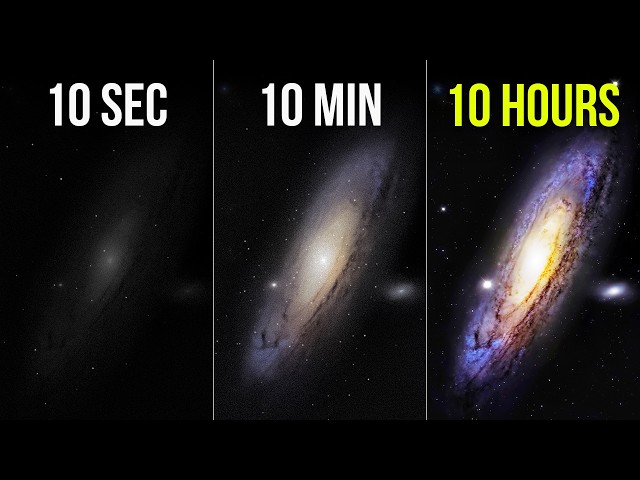
Photographing the Andromeda Galaxy for 10 Seconds vs 10 Hours
This video by Ian Lauer is an excellent accessible explanation of the basics of astrophotography as he runs through the process of how he captures a long-exposure image of the Andromeda galaxy.
This picture is still black and white — and no, the galaxy is not devoid of color. There’s actually color in there, and we’ll get to color in a second. But first, let’s look at what happens when I zoom in on this image.
You can see there’s some graininess in this image, which we call noise. And we hate it because it prevents you from seeing more detail in your image. To combat the noise, we can take multiple images of that same target — so, one after the other — and stack them together using software to average out all of that background noise.
Take a look at what happens when we do that. This image isn’t just a single 1-minute image but 10 1-minute images stacked on top of each other. Look how how much better, how much cleaner, it looks when compared to the single 1-minute image.
There are a bunch more videos on Lauer’s channel to check out, including Shooting the Milky Way from Every Light Pollution Level and The BEST Telescope for Beginners (he recommends the Seestar S50 Astronomical All-in-one Smart Telescope, which many other people recommended on social media instead of anything on this list). Oh, and I’m gonna watch this one about astrophotography with the iPhone 17 Pro right now. (via the kid should see this)